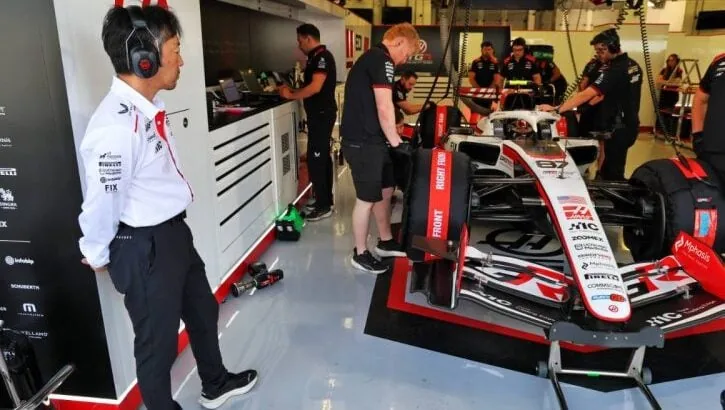
The calm before the 2026 regulatory storm is about to shatter in Melbourne, and Haas F1 Team boss Ayao Komatsu knows exactly where the first shock will occur: qualifying.
Read more Coulthard criticizes the FIA after the controversy over the Mercedes engine compression ratio
As the paddock moves into the Albert Park Circuit for the Australian Grand Prix — which celebrates its 30th anniversary — a new technical era collides with a grid expanded to 22 cars.
Narrower and lighter cars, increased dependence on electrical energy: 2026 marks a true regulatory reset.
Leap into the unknown
Haas completed 794 laps during the six days of testing in Bahrain with the VF-26, accumulating valuable data. But Komatsu remains clear-eyed about the Australian challenge.
« Everyone is excited for this first race of this brand-new regulatory era, and the midfield is going to be extremely competitive, says the Japanese engineer. I don’t think anyone knows exactly where they stand, but we had a very good winter preparation. Reliability was good, we continued to learn about the car, understand the regulations, and manage energy. »
However, he emphasizes the break between testing and the reality of a Grand Prix weekend: « It’s a completely different game to complete six days of testing on a single circuit, then arrive in Melbourne and be immediately operational in FP1. What we were doing in half a day in Bahrain, we now have to do in two runs during the first session. That’s the big challenge this year. »
Read more Pierre Waché assures that Red Bull will avoid correlation errors in 2026
Energy management and traffic: the double trap
Melbourne’s semi-urban layout, with its long fast curves and heavy braking zones, will highlight one of the major stakes of 2026: energy recovery and management.
« Melbourne, in terms of energy recovery — which is crucial this year — will be much more demanding than Bahrain, says Komatsu. We are all expecting a huge challenge, but we are preparing as best as possible. In Q1, it will be a huge challenge with 22 cars, managing traffic on the out-lap and traffic in general. »
The team principal remains ambitious nonetheless: « With the work done in testing and the car’s performance, if we cover the basics and execute correctly, we should be able to fight where we want to, at minimum in the midfield, ideally close to the front of the midfield. »
The team relies on the experience of Esteban Ocon and the potential of young Ollie Bearman to navigate this uncertain environment.
But in a season where the unknown dominates, Komatsu’s message is unambiguous: preparation is worth nothing without the capacity for immediate adaptation. At Melbourne, the hierarchy could be decided from the very first timed laps.
Read more Aston Martin in «serious trouble» before Melbourne: maximum alert on the Honda engine