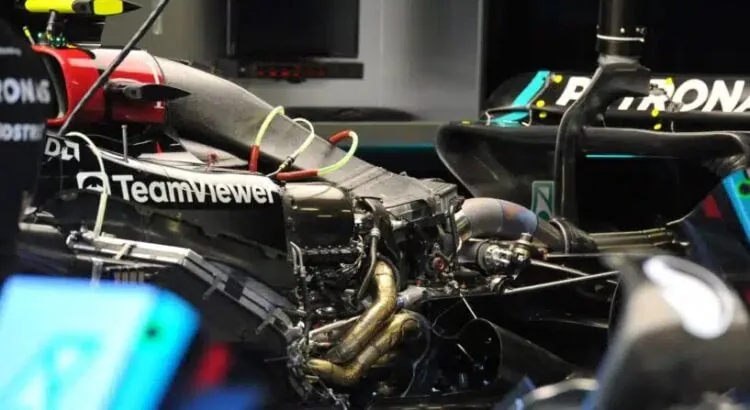
The Fédération Internationale de l’Automobile (FIA) is facing new criticism following allegations that Mercedes exploited a regulatory loophole regarding the engine compression ratio under Formula 1’s 2026 rules.
Read more Pierre Waché assures that Red Bull will avoid correlation errors in 2026
At the heart of the controversy: the reduction of the compression ratio from 18:1 to 16:1 planned by the new engine regulations.
According to some sources, Mercedes has reportedly found a way to achieve a higher compression ratio in real operating conditions — that is, when the engine is running on track at high temperatures — while remaining compliant with official measurement procedures, which are carried out at a standstill and at room temperature.
An imbalance between the FIA and the teams
A regulatory change intended to close this gap will finally take place in June 2026, following a vote by the engine manufacturers, the FIA, and F1.
A guest on the podcast Up To Speed, David Coulthard strongly criticized the rule-making process: “That’s the problem. You mentioned the FIA, the Fédération Internationale de l’Automobile. It’s the governing body of Formula 1. And I read recently that they said: ‘We are only about twenty people writing the rules, while Formula 1 teams have hundreds of engineers, which explains why we didn’t identify the loophole and didn’t fix it.'”
Read more Aston Martin in «serious trouble» before Melbourne: maximum alert on the Honda engine
Monitoring in real conditions
The Scotsman insisted on the need for the regulator to better understand the real operating conditions of a single-seater: “If the rule-makers did a better job, frankly, of understanding the operating window of a Formula 1 car… The operating window of a Formula 1 car is not a stationary car in a garage at room temperature. It’s on track. With an engine at 110 degrees, everything is scorching, the brakes at over 1000 degrees. It’s in these conditions that they should design the rules and regulations.”
This remark highlights a structural issue: the potential gap between the theoretical drafting of a regulation and its application in an extreme thermodynamic environment. In a context where the 2026 power units will rely on increased hybridization and a revised architecture, any regulatory ambiguity can represent a significant competitive advantage.
Mercedes deflects
For his part, Mercedes director Toto Wolff firmly defended the legality of the concept developed by his team, stating that the engine design fully complies with the rules and has been validated by the FIA.
The episode thus restarts the classic debate in Formula 1: brilliant innovation or opportunistic exploitation of a gray area? In any case, the question of the 2026 compression ratio could become a major political and technical issue as the full implementation of the new regulations approaches.
Read more Marcus Ericsson discusses his experiences with Lewis Hamilton and Alex Palou