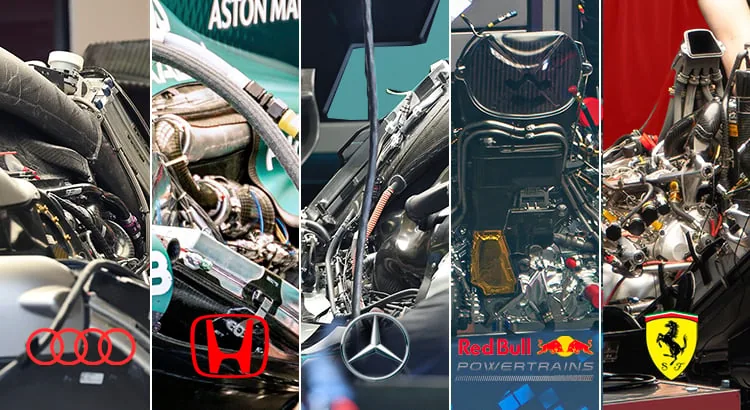
A clear hierarchy is emerging on the engine side: Mercedes dominates, Ferrari offers targeted resistance, while Red Bull, Audi, and Honda face structural challenges.
Read more Zak Brown sets a new colossal goal for F1 in the United States
Four races were enough to outline a first engine hierarchy in the 2026 Formula 1 version. Mercedes (1020 km in the lead and four wins in the four Grand Prix contested) establishes itself as the reference, with dominance both in pure performance and energy management.
Behind, Ferrari (202 km in the lead) defends a different but effective approach in certain areas, while Red Bull (5 km) confirms a solid level for a new engine manufacturer. Audi and Honda, on the other hand, face more structural difficulties. Here are their summarized strengths and weaknesses.
| Engine Manufacturer | Advantages | Drawbacks |
|---|---|---|
| Mercedes | Benchmark energy management, innovation on compression ratio, high power at high speed, overall efficiency of the hybrid system | Lower responsiveness at low speed, less effective starts |
| Ferrari | Excellent responsiveness thanks to the small turbo, very good starts, efficiency at low speed | Power deficit at high speed, more constrained energy management |
| Red Bull | Good engine base, solid reliability, original solutions (cooling, MGU-K) | Slight power deficit, lack of experience, limited gains on certain innovations |
| Audi | Power potential with large turbo, coherent long-term concept | Poor starts, high turbo inertia, increased dependence on electric power |
| Honda | Coherent architecture, potential still difficult to assess | Vibration problems, thermal engine deficit, complex integration |
Mercedes: a systemic superiority
Mercedes’ lead is primarily based on energy management, a field in which the manufacturer benefits from historical expertise reinforced by its involvement in Formula E. The ability to precisely decide when to deploy electric energy is a key advantage, especially in qualifying.
Added to this is a major innovation around the dynamic compression ratio, which would increase thermal efficiency under real conditions. Coupled with a large turbocharger, this choice favors high-speed performance and reduces dependence on electric energy on long straights.
This overall package explains Mercedes’ current dominance in the 2026 F1 engine, even though weaknesses remain, notably at starts and low speed, where engine response is less immediate.
Ferrari: formidable at low speed
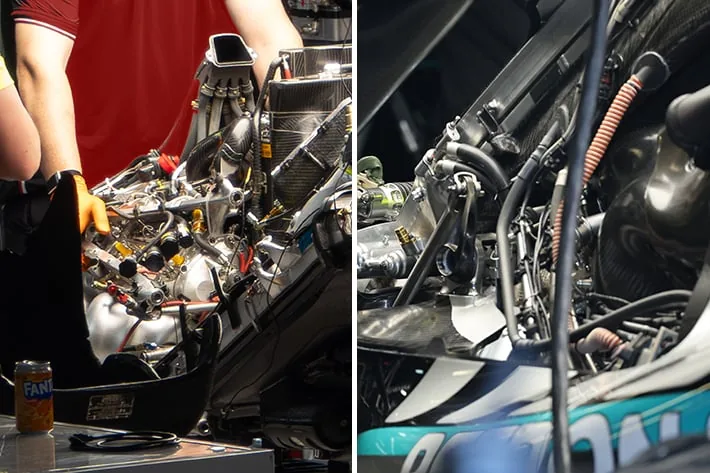
Ferrari made a radical choice with a small turbo, favoring responsiveness. This concept directly translates into particularly effective starts and excellent traction out of slow corners.
The absence of MGU-H in 2026 further strengthens this advantage, since turbo spool-up now depends solely on thermal energy. In this context, Ferrari’s chosen architecture offers an immediate response that is hard to match.
On the other hand, this solution limits maximum power at high speed. The deficit compared to Mercedes on long straights remains significant and imposes more constrained energy management throughout the lap. For a complete and illustrated analysis of the Ferrari engine, click here.
Red Bull: a solid but improvable base
For its first season as an engine manufacturer, Red Bull shows a generally competitive level. Reliability is on point and the engine base appears sound, with power close to the references.
The project benefits from massive recruitment of experienced engineers, notably from Mercedes, which explains the relative maturity of the 2026 F1 engine from the start.
Read more Hamilton already pushed towards the exit? Günther Steiner sets the limit at Ferrari
However, a slight power deficit remains and some innovations, notably around the compression ratio, have not produced the same gains as Mercedes. The Red Bull engine remains performant but still in a development phase.
Audi: a concept penalizing in the short term
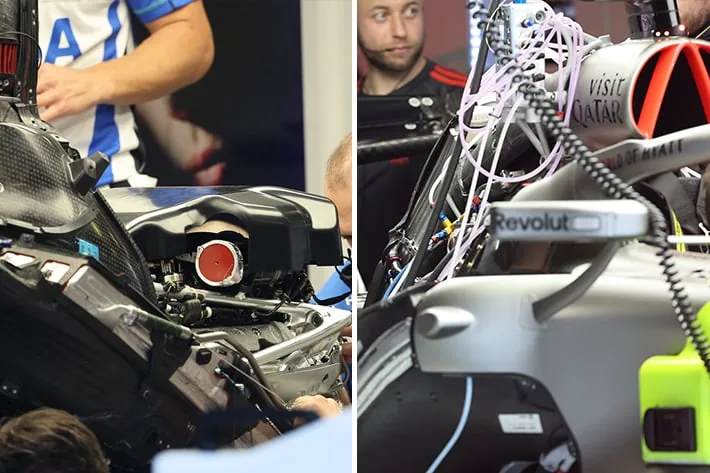
Audi pays the consequences of a technical choice made during the design of its 2026 F1 engine: a large turbocharger. While this concept can offer high power in the long term, it causes significant inertia that heavily penalizes starts and acceleration phases.
This weakness requires increased use of electric energy to compensate, which reduces the margin available for the rest of the lap. The problem thus goes beyond just the start and affects overall performance.
Within a constrained regulatory framework, these limitations appear difficult to quickly correct, placing Audi behind at the start of this cycle.
Honda: potential masked by vibrations
The case of the Honda V6 (detailed here) is more complex to analyze. The engine presents a coherent architecture, but its operation is heavily disturbed by a vibration problem, particularly under real conditions.
This phenomenon directly affects the battery and limits the hybrid system’s ability to deliver full performance. This results in difficulty precisely assessing the engine’s real level.
Added to this is a thermal engine deficit, which leads to increased dependence on electric energy, creating a negative performance feedback loop.
F1 2026 Engine: an advantage built on multiple levers
Mercedes’ advantage is not based on a single element but on a coherent combination of gains: energy management, thermal efficiency, and architectural choices.
Ferrari demonstrates that a different approach can remain competitive in certain areas, while Red Bull confirms the solidity of its project. Audi and Honda, on the other hand, illustrate the inherent difficulties of such a profound regulatory change.
Read more The biggest rivals of Max Verstappen at the 24 Hours of Nürburgring