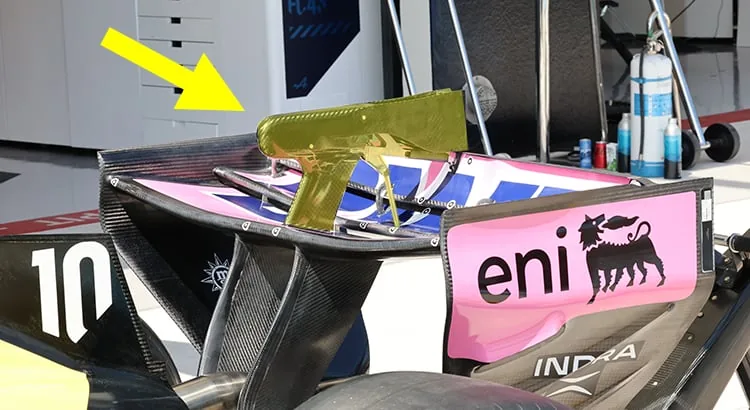
By introducing new features in Miami affecting both the front and rear of the A526, Alpine continues to try to structure its progress on track. Let’s examine these developments closely.
In Miami, the Alpine is the fifth fastest car on the grid, thanks no doubt to a significant set of developments, combining flow conditioning work at the front and aerodynamic downforce research at the rear.
With the exception of Aston Martin, all teams brought developments for the Miami Grand Prix. Mercedes, championship leader, limited itself to a minor revision of its W17, while the majority of the grid, including Alpine, introduced more substantial modifications.
David Sanchez, Alpine’s French technical director, sums up the extent of the work done at Enstone, which placed Pierre Gasly and Franco Colapinto in the top 10:
“We introduced a good package of developments, like all the other teams. Some teams even brought an almost new car. We have new features at the front, at the rear, with a new wing for Pierre and some other parts. In free practice, we were able to evaluate the parts and verify that they worked well as we wanted, no more, no less. We will continue to evaluate and develop them.”
At the front of the Alpine A526, the modifications remain in a refinement logic. The air outlet of the front brake duct has been redesigned to improve the quality of the flow around the front corner and further downstream. The camera mount on the nose has also been reshaped to optimize flow management.
These developments fit into a classic approach aimed at improving the quality of the air directed towards the rear of the car, without visible conceptual modification.
Alpine improves flow quality
The most notable developments are however concentrated at the rear. The suspension arms have been reshaped to better control the flow around the rear suspension and improve the overall quality of the flow.
Read more McLaren cooled down: Lando Norris talks about a «return to reality» in Miami
A solution inspired by Ferrari at the rear
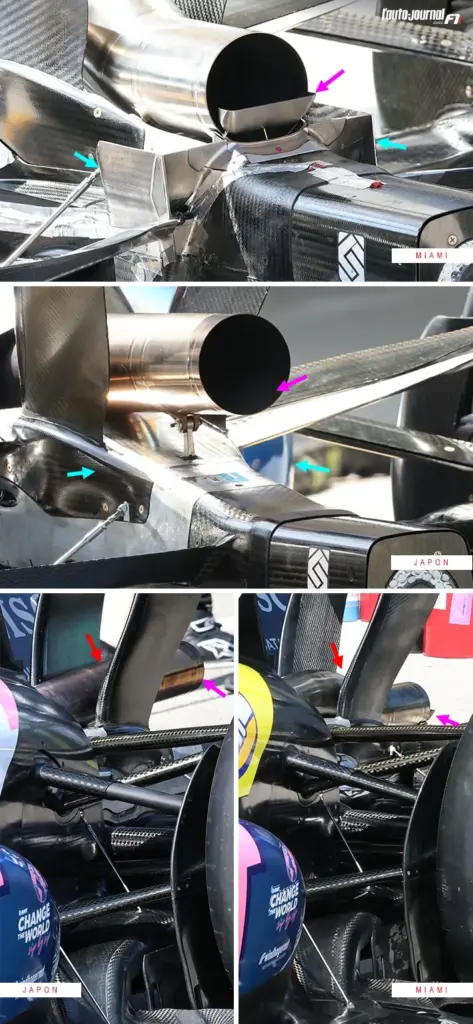
A fin has been added on the rear impact structure. Alpine, like many teams (Mercedes, Red Bull, McLaren, Williams, Haas), was inspired by the solution introduced by Ferrari.
On the A526, the new geometry developed aims to increase downforce locally and effectively over the entire operating range of the car. Alpine’s exhaust wing thus features a double element, with a support body extending over the rear impact structure, under a plane fed by the flow from the exhaust.
This fin adopts a double element configuration, with a support body extending over the rear impact structure, under a plane fed by the flow from the exhaust.
A new rear wing in a coherent package
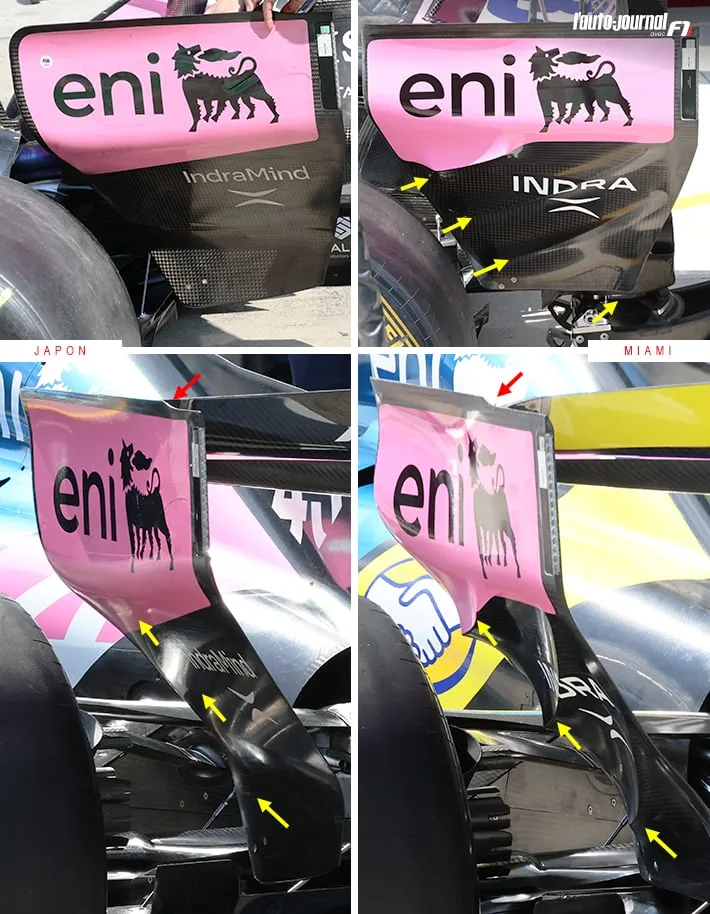
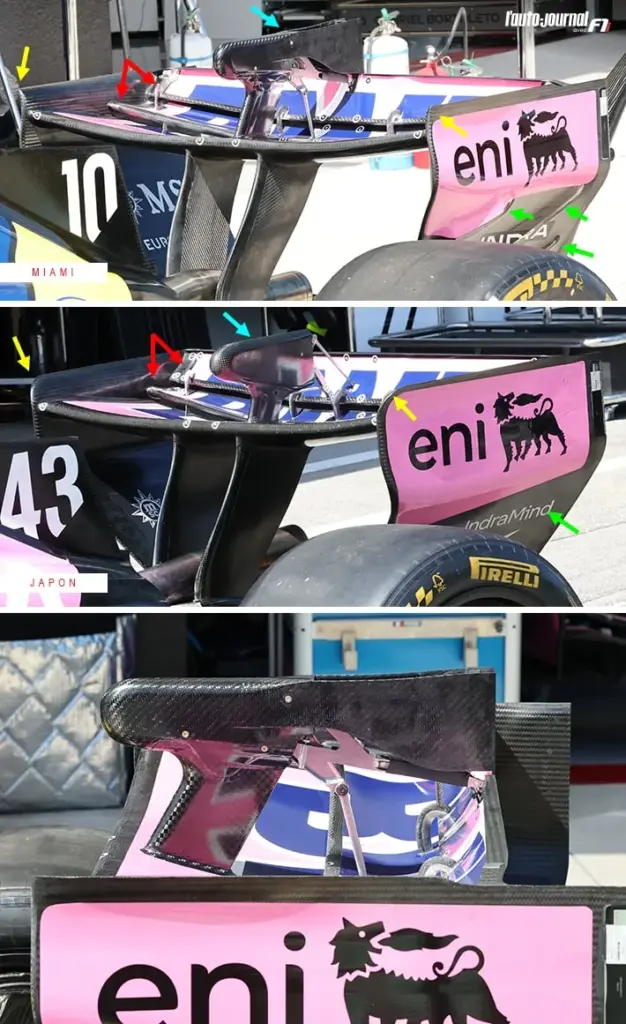
Finally, Alpine introduced a new complete rear wing on Pierre Gasly’s car, with ribs on the endplate. These contribute to deflecting the airflow upwards (“upwash”), which occurs at the rear of the single-seater. This upward expansion phenomenon allows the diffuser to extract more air from the flat floor, which increases downforce in fine.
This development is part of a global update of the rear, suggesting a search for coherence between the different downforce-generating surfaces. The mechanism activating the upper flap in straight-line mode (the old DRS) has also been modified, as can be seen in the image below:
Beyond the simple accumulation of parts, this package mainly illustrates the direction taken by Alpine under the impetus of David Sanchez: favoring a progressive improvement of aerodynamic efficiency rather than a conceptual overhaul, seeking to make the car more coherent in its flow management between front and rear.
In this logic, potential gains will depend less on each development taken in isolation than on their overall integration into the balance of the A526, a point already highlighted in the analysis of the team’s recent progress.
Read more Kimi Antonelli shakes up Miami: Mercedes reborn with a sensational pole position