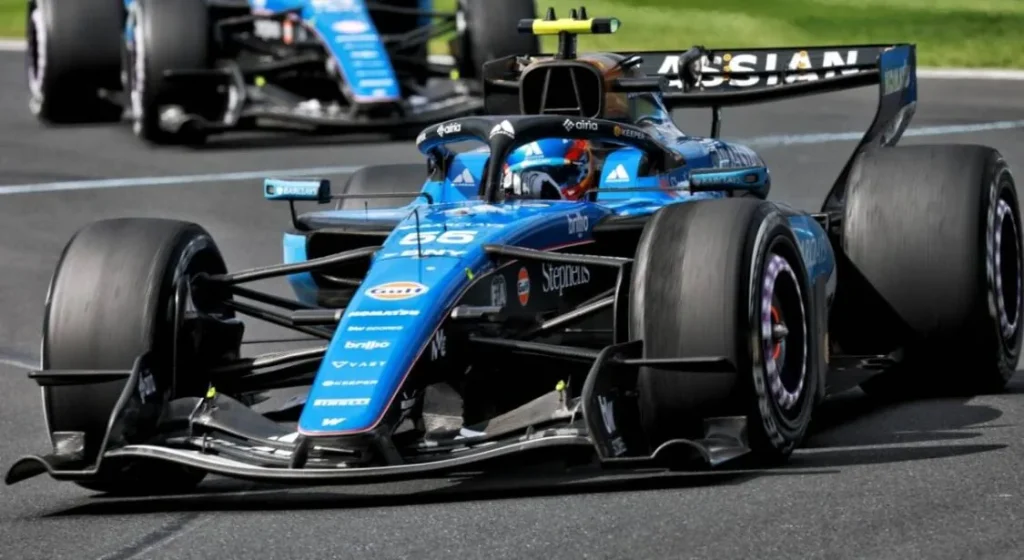
The start of the 2026 season revealed an unexpected gap between Mercedes and some customer teams. At Williams, James Vowles admits to being caught off guard by the German team’s technical lead.
Read more Christian Horner to Aston Martin in case of an agreement between Alpine and Toto Wolff?
The Australian Grand Prix immediately set the tone for the 2026 Formula 1 season. On the Melbourne circuit, Mercedes dominated the proceedings by turning a fully locked-out front row into a convincing one-two finish on Sunday, thanks to George Russell and Kimi Antonelli.
This impressive performance confirmed the rumors circulating in the paddock during the winter: the new power unit developed by Mercedes High Performance Powertrains could well be the benchmark of the grid.
The figures observed in Australia were indeed striking. In qualifying, the works Mercedes had an advantage of nearly a second over Oscar Piastri’s McLaren, despite it being equipped with the same engine. In the race, the gap was just as significant: Lando Norris finished more than fifty seconds behind George Russell at the finish.
Williams discovers the scale of the challenge
For Williams, also powered by Mercedes, this start to the season has been much more complicated. The British team, which already has to deal with an overweight car, could do no better than 12th and 15th positions in Melbourne.
After the race, James Vowles did not hide his surprise at the advantage the works Mercedes team seems to have with the same power unit.
“What Mercedes has managed to do with its engine caught us off guard. But it was really in qualifying that we realized how far off the mark we were” he admits.
A former strategy chief at Mercedes before joining Williams, Vowles is well acquainted with the German manufacturer’s working methods. However, the gap observed in Melbourne clearly surprised him.
Technological sophistication difficult to reproduce
According to the Williams director, Mercedes remains beyond reproach in the way it supplies its engines to customer teams. The data and technical elements available are identical for all teams using this power unit.
“I am convinced that Mercedes gives us everything we need to operate the engine. They have always been very fair with their customer teams” he insists.
Read more Mercedes’ experience in Formula E could explain its energy advantage in F1
But the difference lies elsewhere: in the ability to fully exploit the potential of this technology.
“Today, I simply don’t know how they manage to achieve this level of performance. That is exactly what we are trying to understand internally.”
For Williams, the work now consists of analyzing what might have been missed in the operation of the engine: “We are looking to identify what we missed and how we can reach the same level.”
Mercedes more ingenious than its customers
Vowles also admits that the works team likely has a higher level of technological sophistication than some customer teams.
“We have to recognize that we don’t yet have their level of sophistication or their technologies. This is clearly an area where we need to progress.”
He also mentions the existence of internal know-how specific to Mercedes, difficult to reproduce immediately: “There is probably implicit knowledge that they possess and that we don’t have yet.”
For the Williams boss, the conclusion is clear: Mercedes has hidden nothing from its partners, but the works team has simply been more ingenious.
“Mercedes is extremely fair with its customer teams. We have access to the same elements as they do, he concludes. They have simply been smarter than us… and now it’s up to us to close that gap.”
Read more Reliability and caution: teams facing the first power unit constraints