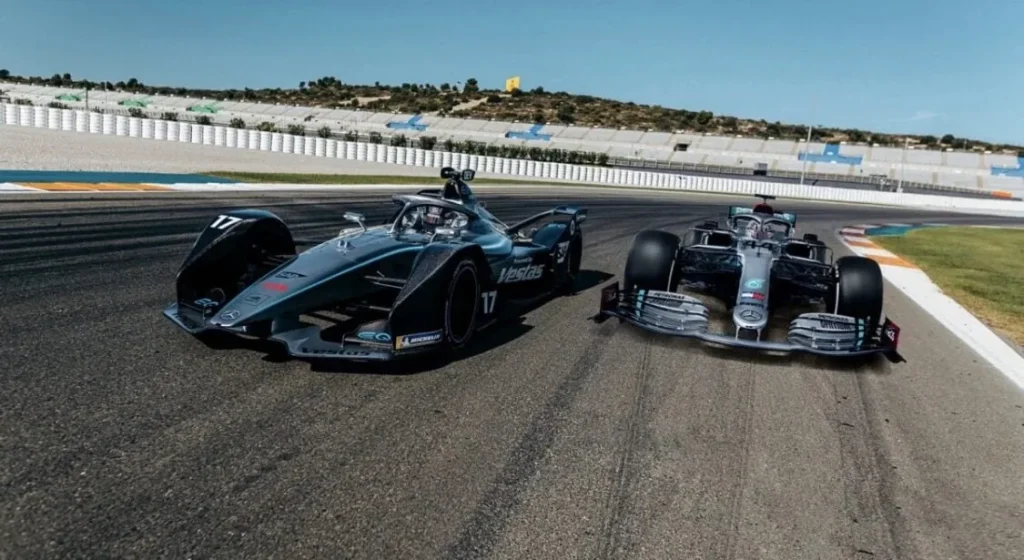
Mercedes’ impressive performance in Australia could be partly explained by its mastery of energy management, possibly inherited from its experience in Formula E.
Read more Reliability and caution: teams facing the first power unit constraints
In Melbourne, the German team dominated the weekend with a full front row in qualifying and a one-two finish in the race.
For former Ferrari engineer Luigi Mazzola, this superiority is not limited to the engine: “Mercedes gave the clear impression of being ahead as a complete package. Not just as a power unit, but also on the rest: the car’s balance, aerodynamics, downforce. Let’s say it’s a bit of everything. The drivers said it was a pleasant car to drive, so that means the car looks good.”
Very efficient battery management
According to him, Mercedes particularly stands out in the way it recharges and exploits electrical energy: “It seems to me that they are quite good, compared to the others — and they proved it in qualifying — at knowing how to charge the battery and use the maximum electrical power where it is needed.”
Mazzola puts forward the hypothesis that this skill could come from the experience gained by Mercedes in Formula E, where the brand won two world titles with Stoffel Vandoorne and Nyck de Vries: “I don’t know, and it’s my hypothesis, if this can also come from the experience they had in Formula E, where they won two championships.”
Read more A first Sprint in 2026 on a demanding circuit for tires and energy
The German manufacturer was indeed the only one to tackle the FIA’s electric competition in parallel with its participation in Grands Prix (photo above) and there is no doubt that bridges have been established internally between the two formulas by HPP (High Performance Powertrains) engineers at the Brixworth factory in Great Britain.
An advantage that doesn’t just come from the engine
The Italian recalls, however, that Mercedes’ superiority cannot be attributed solely to the power unit, since other teams use the same technical base: “It is clear that it is not just a question of the engine, because McLaren has the same one, but it was inferior in its ability to recharge the batteries and manage the power unit, as Andrea Stella also noted.”
Mazzola also mentioned the debate around the compression ratio of the Mercedes engine, often cited as one of its strengths: “On the compression ratio, it is clear that anything that gives you more power is free power, which you can then also use to charge the battery. So this excess power can certainly help you not to lose — or not to lack — available electrical power.”
In a 2026 era where the electrical part of the powertrain is much more significant, the ability to efficiently manage energy could therefore become a decisive factor in the championship hierarchy.
Read more The Chinese Grand Prix TV schedule