After a nightmare 2025 season, Lewis Hamilton believes he could have turned the situation around… if the rules hadn’t changed.
Read more Costly cancellations for F1 teams
The year 2025 will remain a real low point in the career of Lewis Hamilton. For the first time, the Briton did not achieve any podiums over a full season, despite a victory in the Sprint race in China.
Even more striking, he experienced a rare humiliation in Las Vegas, qualifying last purely on performance. An unthinkable scenario for a driver of his caliber, used to playing leading roles.
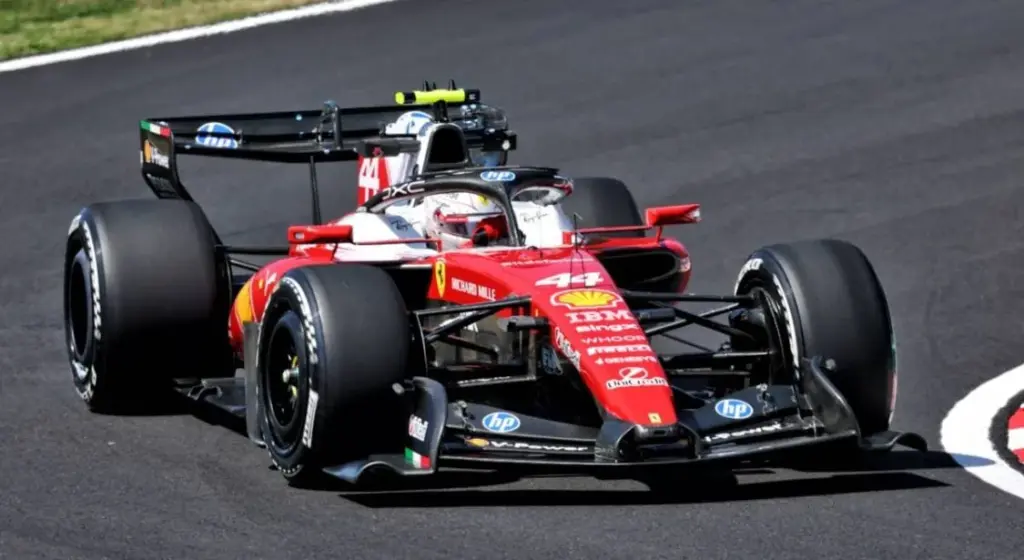
Behind these disappointing results lies a technical reality: Hamilton never fully managed to adapt to the Ferrari SF-25, a car designed according to ground effect rules.
A driving style completely out of sync
The problem is primarily a matter of driving philosophy. Hamilton favors an aggressive style: late braking, quick rotation of the car, and strong acceleration out of corners.
However, ground effect cars required a radically different approach. They rewarded smoother lines, with earlier braking and a constant cornering speed, often described as a “U” shaped line.
Moreover, these cars were known for their pronounced understeer and a lack of rear feel — two characteristics opposite to the preferences of the seven-time world champion.
An unexpected regret about the old rules
Despite these difficulties, Hamilton surprises by stating that he could have been much more competitive… if the rules had remained the same in 2026.
“If we had continued with these cars, I would have been involved in their development. I think I would have been more comfortable with this year’s car than with last year’s” he confides.
Read more Korea returns to the route: new urban circuit in 2028?
In other words, even though he struggled with the SF-25, he believes that a gradual evolution of the concept could have allowed him to regain the upper hand. A statement that contrasts with the frequent criticisms often directed at ground effect cars.
The switch to the new 2026 rules seems, however, to better match his expectations. The current cars notably reintroduce more aerodynamic “rake,” a feature close to the dominant Mercedes cars between 2017 and 2021.
Hamilton also confirms his positive feeling: “The cars are more enjoyable to drive than the ground effect ones”, he explains, also highlighting the disappearance of the porpoising phenomenon (“bouncing”).
These changes give the Briton an environment more in tune with his natural style, based on attack and precision.
Between past frustration and renewed optimism
This dual narrative clearly illustrates the complexity of the situation experienced by Hamilton. On one side, a frustrating 2025 season and a difficult car to tame. On the other, the conviction that he could have reversed the trend with more continuity.
Today, the Ferrari driver seems to have turned the page. More comfortable with the new cars, he approaches the future with serenity, convinced he is evolving in a more favorable environment.
It remains to be seen if this renewed confidence will finally translate into a return to the top, after such an unexpected and challenging period in the career of one of Formula 1’s greatest names.
Read more Aston Martin and Honda sent back to back: the chassis is as flawed as the engine