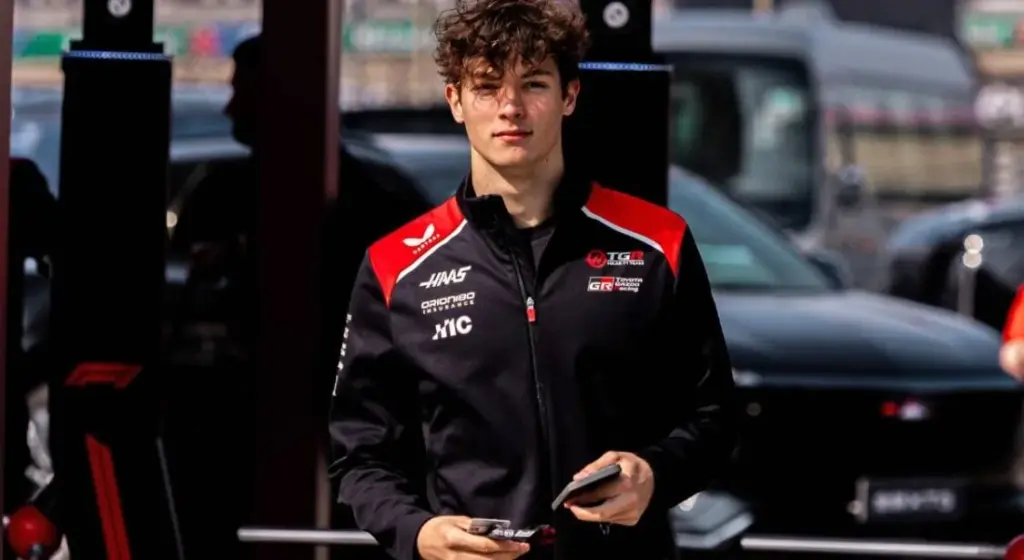
After his violent accident in Japan, Oliver Bearman sounds the alarm. The Haas driver calls for quick adjustments to avoid further tragedies.
Read more Lewis Hamilton makes an unexpected confession about his «hated» Ferrari
The impact suffered by Oliver Bearman at Suzuka continues to provoke reactions. While trying to avoid Franco Colapinto, the Briton was involved in a very high-speed impact, a direct consequence of an extreme speed difference between the two cars.
With the 2026 rules, energy management has profoundly changed the dynamics on track. Between a car in full attack and another in energy recovery phase, the differences can reach up to 50 km/h, a situation considered particularly dangerous.
For Bearman, this accident is not just a racing incident, but rather a symptom of a broader problem related to the technical regulations.
A “not good” maneuver in a risky context
The Haas driver did not hide his incomprehension regarding Colapinto’s defense. According to him, this type of move has become much more risky with the new rules.
“He saw me coming and he moved. Last year, that would have been acceptable, but this year, he reacted too late” he explains. With such a high speed differential, timing becomes crucial.
“At that moment, I was arriving with such a speed gap that it was already too late to move aside” he adds, considering that this kind of reaction is now unsuitable for current F1.
At the heart of the debate is the new power split between the internal combustion engine and electric energy, now balanced at 50-50. This evolution leads to unprecedented situations, where some drivers have a power surplus while others completely lack it.
Result: speed gaps comparable to those between a car on a flying lap and another on a cooldown lap: “50 km/h is normally the difference between a car in cooldown and another at full throttle” Bearman points out.
These conditions make duels much more unpredictable and significantly increase the risk of accidents.
Read more Costly cancellations for F1 teams
Accelerated discussions with the FIA
Faced with these concerns, the governing bodies have intensified discussions. The FIA, teams, and F1 are actively working on several avenues to reduce these dangerous gaps.
Several solutions are currently under study, including adjustments to energy deployment or limits on certain strategies like “super-clipping”. Meetings have already taken place in early April, with a decision expected before the Miami Grand Prix.
Bearman is involved in these exchanges: “We are working well with the FIA to avoid these big speed differences” he assures.
While some mention the need for increased respect between drivers, Bearman remains skeptical. For him, this is not a sustainable solution.
“It’s not a solution, it’s more like a band-aid” he states, believing the problem must be fixed at the source, through the regulations.
He nevertheless acknowledges that drivers must adapt to this new reality, where limits are still poorly defined: “We are in a new era where we do not yet fully know the limits” he explains.
Changes as early as Miami?
Despite the seriousness of the situation, Bearman remains optimistic. He hopes that the ongoing adjustments will significantly reduce speed gaps.
“In theory, we should no longer see these differences for the rest of the season” he concludes, confident in the upcoming measures.
If decisions are validated quickly, some modifications could be introduced as early as Miami. An evolution closely watched, as driver safety is now at the heart of concerns.
Read more Korea returns to the route: new urban circuit in 2028?