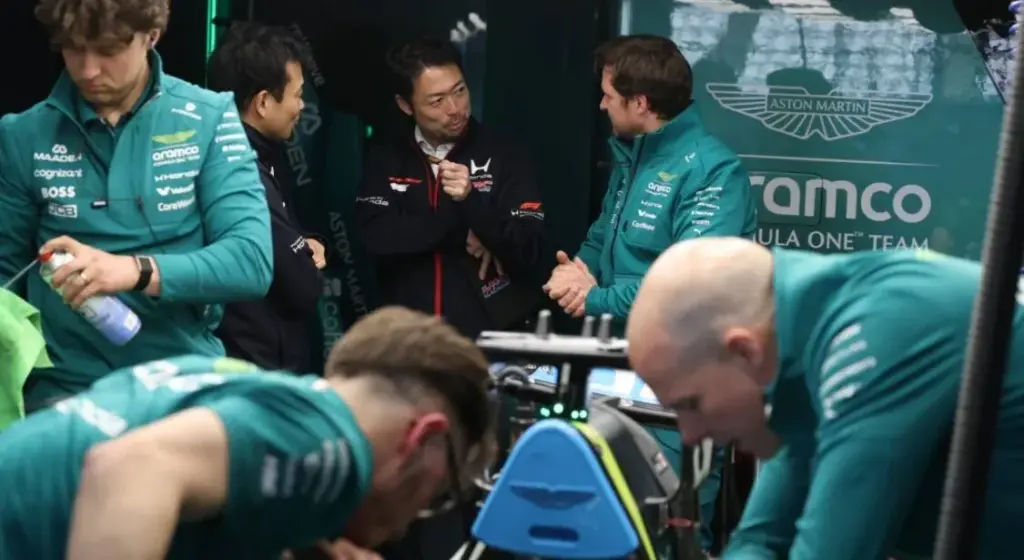
Fourteen Grands Prix, three small points scored and a humiliating tenth place in the constructors’ championship. Faced with a dramatic sporting record despite the arrival of its new engine evolution, Honda is urgently reorganizing the head of its F1 program to try to turn things around alongside Aston Martin.
Read more McLaren disgusted by Norris’ bad luck: «We were winning this race by 20 to 25 seconds»
The timing is obviously no coincidence. The day after another very difficult weekend for Aston Martin at the Spanish Grand Prix, Honda announced a change at the head of the development of its Formula 1 power unit.
From October 1st, Yoichiro Fukao will replace Tetsushi Kakuda as Large Project Leader, in other words the operational director of Honda Racing Corporation’s F1 project. Until now Kakuda’s deputy, Fukao will therefore take command of the program that has designed the engine exclusively powering Aston Martin since the start of the new 2026 regulations.
Honda officially presents this reorganization as a planned transition, intended notably to ensure the transfer of technical skills within HRC. But it is difficult to dissociate this change from the extreme weakness of the results recorded since the beginning of the season.
Three points in fourteen Grands Prix
The Aston Martin-Honda partnership was nevertheless one of the most anticipated of this new technical era. It has turned, so far, into a sporting fiasco.
After fourteen Grands Prix, Aston Martin occupies tenth place in the constructors’ championship with… three points. Only Cadillac, a newcomer this season and still stuck at zero, is behind the Silverstone team.
All three points were scored by Fernando Alonso: one point thanks to his tenth place in Monaco, then two more with a ninth position in Zandvoort. Lance Stroll, meanwhile, has yet to score a single point in 2026.
In short, out of the 28 combined starts of the two Aston Martins in Grands Prix this season, only two finished in the top 10.
A particularly harsh record for a project associating Honda, Aston Martin and Adrian Newey, for which the Japanese manufacturer had chosen to officially return to F1 in order to develop a power unit fully adapted to the 2026 regulations. This is the least powerful and least developed engine on the grid…
The new engine has not yet changed the game
Honda has not, however, remained idle.
An important evolution of its power unit, called Spec 2, was introduced in Zandvoort after the summer break. It was intended notably to improve one of the main weaknesses of the Japanese engine: its ease of use and power management. Alonso immediately scored two points in the Netherlands, raising hopes for a first breakthrough.
The follow-up has been much less encouraging.
At Monza, Alonso retired. In Madrid on Sunday, the two-time world champion could do no better than 17th, while Stroll again retired. Over the three Grands Prix contested with the latest evolution of the Honda engine, Aston Martin therefore collected only two points.
Read more George Russell calls for a change to the Madring after finishing with a «headache»
After the finish, Alonso did not hide his frustration regarding the power unit, judging the boost management particularly difficult.
Honda nevertheless believes it has made progress in this area. The manufacturer considers that the drivability problems of Spec 2 have been reduced over the last three races and that it can now focus more on pure performance.
A software-focused profile to solve problem number 1
The choice of Yoichiro Fukao is far from accidental. An engineer by training, he is above all a specialist in engine control software and hybrid system management. And it is precisely in the exploitation of electric power and boost modulation that Aston Martin suffers the most this season.
While recent telemetry analyses show that the chassis developed at Silverstone is beginning to regain pace in the twisty sections, the car remains hampered by energy management on the straights. By placing a software expert at the head of the HRC project, Honda hopes to correct this major flaw of Spec 2 before definitively switching to the development of the 2027 engine.
Honda is already preparing the future
It is precisely in this context that Fukao will take command.
The Japanese engineer knows the company perfectly. Having joined Honda’s F1 program in 2002, he worked on engine and gearbox control systems before joining the MotoGP program, then activities dedicated to series hybrid systems. Returning to Formula 1 in 2014, he had been deputy project director since 2017.
Honda explains it wants to anticipate upcoming regulatory steps rather than wait.
“After the introduction of the new regulations in 2026, and with new regulatory changes expected from 2027, Honda wishes to establish a solid development structure and provide a highly competitive power unit by quickly making this transition to a new organization.”
On paper, this is therefore an organized succession.
On the track, the urgency is much more obvious.
With three points scored in fourteen Grands Prix and an Aston Martin still far from the midfield despite significant upgrades to the car and engine, Honda’s return to Formula 1 is so far far from meeting expectations.
And after the Madrid weekend, patience is inevitably starting to wear thin.
Read more Max Verstappen mocks Madring after holding off Norris: «You just have to stay in the middle»