Highly criticized after its first Formula 1 Grand Prix, the Madring will not be able to be deeply modified. Its designer explains why.
Read more Australia closes the door on a 2027 F1 season start despite uncertainties in the Middle East
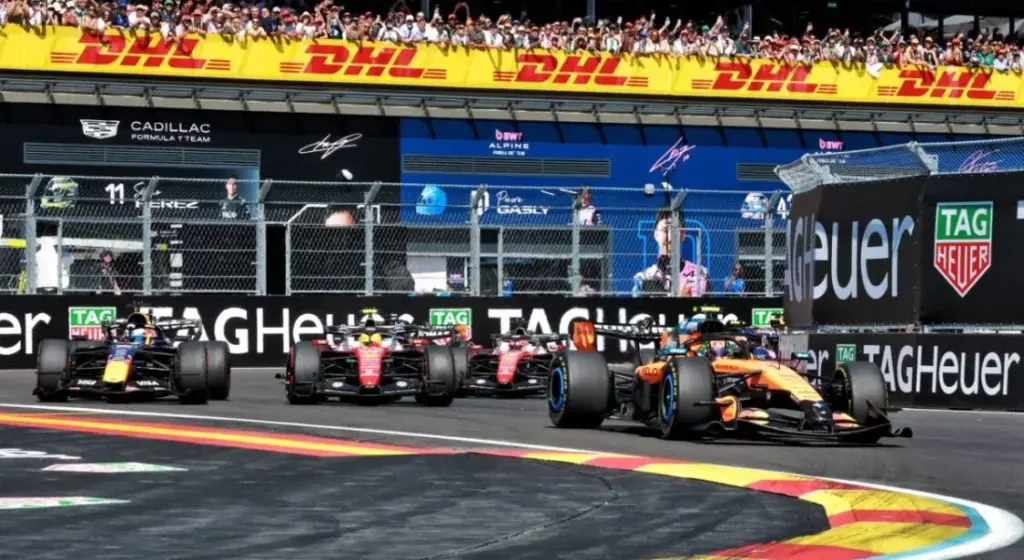
The first Grand Prix held on the Madring was awaited with curiosity, but the new Spanish track did not really convince in its Formula 1 debut. Despite a spectacular layout in places, overtaking was extremely rare and the race offered very few battles on track.
Criticism quickly multiplied after the weekend, with several drivers themselves calling for changes before the 2027 edition. But Jarno Zaffelli, general manager of the company that designed the Madring, already warns that no major transformation of the circuit should be expected.
Only “minimal” changes
The main weakness identified after the first Grand Prix concerns overtaking opportunities. The problem was not limited to Formula 1 since the support categories also encountered similar difficulties during the weekend.
Faced with numerous criticisms, Zaffelli acknowledges that some adjustments can be considered. However, the constraints surrounding the circuit make a deep redesign of the layout impossible.
“Some changes are possible, but they are minimal. According to what has been publicly stated, some of the options mentioned actually seem quite close to ideas that were already in our initial project, notably a possibility of overtaking at turn 5.”
This sector was precisely heavily criticized by the drivers. The approach to turns 5, 6, and 7 forces the cars to brake while changing direction, considerably complicating overtaking attempts.
Turn 5 was originally supposed to be different
Zaffelli reveals that the version ultimately built does not fully correspond to the project imagined by the designers. Turn 5 was notably supposed to be tighter to offer a different braking zone and potentially favor attacks.
“Turn 5 was supposed to be tighter and require less cornering.”
Another important difference concerned the runoff area inside turn 6. The designers initially wanted to install gravel there instead of asphalt. The goal was to truly penalize drivers leaving the track and prevent them from simply cutting that part of the layout.
“In our project, there was no asphalt runoff inside turn 6, but gravel. This was meant to force drivers to take a slower line and prevent them from cutting directly, as that would have cost them time.”
The succession of the two turns was thus meant to allow the use of different lines, each presenting its own advantages.
Read more Ferrari sounds the alarm on its engine
“The idea of this sequence was not to gain time thanks to banking, but to create two lines offering opposite advantages.”
The Madring was never designed from a blank page
Another criticism regularly addressed to the Madring concerns the very design of the circuit. Since it is a new track and not a historic layout gradually adapted to Formula 1, some observers believe the architects had great freedom to create overtaking zones.
Zaffelli rejects this interpretation. The Madring is located in a heavily urbanized environment and had to deal with many infrastructures already existing or approved even before the circuit’s design.
“What was presented as a blank page is actually a heavily urbanized area, with very specific constraints to design a circuit suitable for Formula 1.”
The new exhibition halls and the road network had notably already been defined by local authorities. The layout therefore had to fit into this environment rather than the other way around.
“A detailed map shows that the circuit was subject to very significant constraints in many places. New exhibition halls had already been designed and approved by urban planning authorities, while the road network also followed predefined lines.”
Constraints dictated part of the circuit
According to Zaffelli, these restrictions forced his team to be creative to give the Madring a true identity. The safety requirements imposed by the FIA further reduced the available possibilities.
“It is precisely for this reason that a lot of creativity was needed. The constraints limited our room for maneuver, but they did not impose a single solution.”
The designers therefore worked on sequences and different possible lines to create a circuit identifiable despite the available space.
“We had to invent geometries, sequences, and lines capable of giving the circuit its own identity despite these structural limitations and the constraints imposed by FIA safety rules.”
Madrid having signed a ten-year contract with Formula 1, the Madring is expected to remain on the calendar for a long time. The many criticisms made after its first race could therefore lead to some adjustments as early as 2027, but the statements of its designer already lower expectations: improving overtaking opportunities seems feasible, deeply transforming the layout much less so.
Read more No 24 Hours of Le Mans for Lando Norris