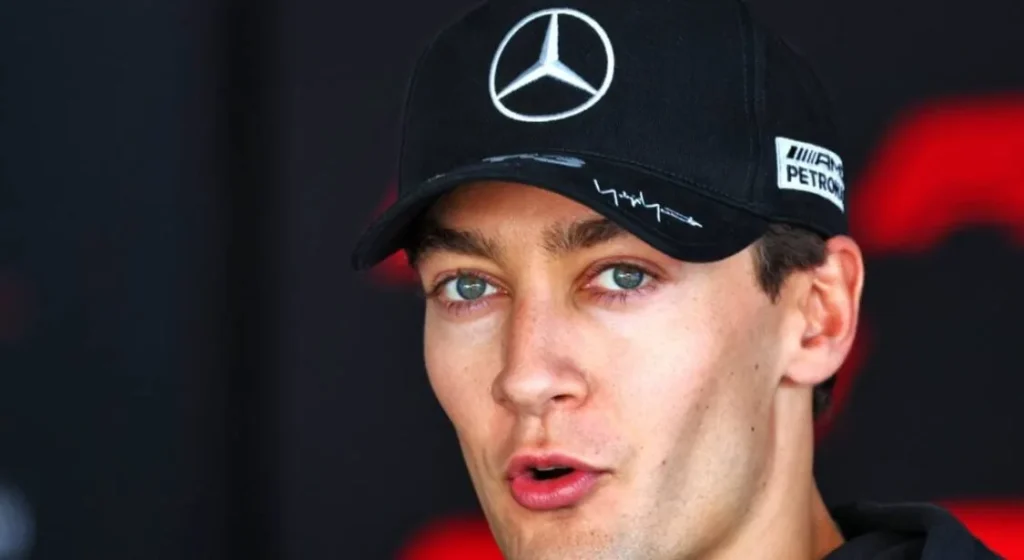
The Mercedes driver believes that the Japanese Grand Prix could reveal the true value of the 2026 regulations on track spectacle.
Read more Ferrari and Red Bull go on the attack at Suzuka: the hunt for Mercedes is on
As the third race of the season approaches, George Russell sees in Suzuka much more than just a Grand Prix. For the Briton, this mythical circuit represents a genuine full-scale test to evaluate the impact of the new regulations introduced in 2026.
A circuit beloved by drivers for its technical demands, Suzuka has nevertheless often been criticized for the lack of on-track spectacle. Previous generations of single-seaters, very efficient in aerodynamic downforce, have often produced races with little action despite impressive lap times.
Russell highlights this paradox: “The old cars were perfectly suited to Suzuka. We saw lap times among the fastest in history, but the race was very boring.”
Slower cars… but potentially more spectacular
With the new rules, the philosophy has changed. The emphasis on energy management and electric power fundamentally changes the way of driving and attacking a circuit like Suzuka.
According to Russell, the single-seaters will be slower in certain iconic sections, notably the famous “Esses”. But this deficit in pure performance could paradoxically favor on-track spectacle.
“We will probably be slower in the Esses this year” he admits, before adding that strategy should remain fairly conventional, with a single stop as in previous seasons.
However, he insists on a key point: a simple strategy does not necessarily prevent an exciting race. He gives the recent example of China, where a similar scenario provided a Grand Prix rich in action.
“It was also a one-stop race in China, and yet it was very exciting. So it will be a good test for the rules.”
An opportunity to transform a “boring” circuit
For Russell, the stakes are clear: if Suzuka, historically not conducive to overtaking, suddenly becomes a theater of intense battles, this would partly validate the direction taken by Formula 1.
Read more Oscar Piastri strikes hard in FP2: McLaren relaunches the battle against Mercedes at Suzuka
“If this circuit becomes exciting when it wasn’t before, that will be very interesting” he analyzes.
This potential transformation relies notably on the differences in energy management between drivers, which could create more opportunities for overtaking and variations in pace.
Adjustments already underway in qualifying
If the race generates optimism, qualifying remains a sensitive point. Since the start of the season, drivers must deal with complex energy management, leading to speed losses at the end of straights and frequent phases of “lift and coast”.
To address these criticisms, the FIA decided to reduce the energy recharge limit per lap in qualifying, from 9.0 to 8.0 MJ.
Russell welcomes this initiative: “It will have an impact, even if I don’t think it will radically change things.”
He especially praises the FIA’s willingness to quickly adjust the rules: “It’s good to see them trying to fine-tune the regulations. We are only at the third race, and overall, the races have been positive. Qualifying, on the other hand, still needs to be improved.”
Verdict expected this weekend
Suzuka could therefore mark a turning point in this new regulatory era. Between technical uncertainties and hopes for spectacle, all eyes will be on the Japanese track.
For George Russell, the verdict will be simple: either the new rules succeed in transforming an unspectacular classic… or F1 will have to continue reinventing itself.
Read more Lewis Hamilton blanked after the incident with Verstappen: the decisive testimony