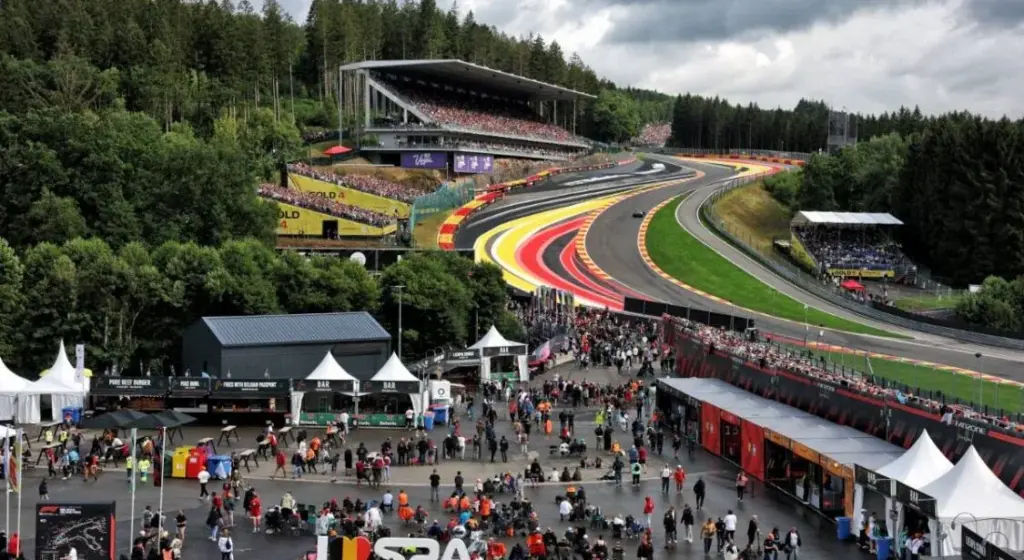
The FIA has confirmed the presence of five straight-line mode zones at Spa-Francorchamps. Among them, one will be located before Eau Rouge, a decision that could influence drivers’ energy strategies.
Read more Charles Leclerc facing criticism: «I know I haven’t become a bad driver»
Introduced this season to replace the DRS system, the straight-line mode allows drivers to adjust the aerodynamic setup of their car according to the circuit’s needs.
By activating this mode, the front and rear wings open to reduce drag and increase top speed on straights. Conversely, they return to their classic position in corners to maximize aerodynamic downforce.
The number of allowed zones varies depending on the circuits. In Monaco, for example, their use was completely banned due to the characteristics of the street track.
At Spa-Francorchamps, the FIA has chosen a much more ambitious approach with five active zones, the highest number since the Australian Grand Prix, the first round of the 2026 season.
A controversial zone before Eau Rouge
The main novelty concerns the section between La Source and Eau Rouge.
For the first time in 14 years, drivers will be able to use a system similar to DRS in this part of the circuit.
However, the FIA has decided to ban the activation of straight-line mode directly in the Eau Rouge-Raidillon sequence, considered one of the most demanding and dangerous passages on the calendar.
The presence of an active zone just before this section could nevertheless have a significant impact on the approach to the iconic corner, especially in terms of energy management and entry speed.
Details of the five zones at Spa
The five straight-line mode zones will be spread over several parts of the Belgian circuit:
- Zone 1: the start-finish straight;
- Zone 2: the section between La Source and Eau Rouge;
- Zone 3: the Kemmel straight after Eau Rouge/Raidillon, up to Les Combes;
- Zone 4: the exit of Stavelot, before the approach to Blanchimont;
- Zone 5: after Blanchimont, heading towards the Bus Stop chicane.
The overtaking mode, comparable to the old DRS with a power boost when a driver is within one second of another car, will also remain available on the main straight.
Read more Christian Horner was banned from accessing the F1 paddock for nearly a year
A major energy challenge for drivers
Beyond aerodynamics, Spa will mainly represent a considerable test for the new power units.
With its seven kilometers length and many full-throttle sections, the Belgian circuit is one of the most demanding tracks in terms of energy consumption.
Fernando Alonso recently warned about the difficulties drivers might face.
According to the Aston Martin driver, using all available energy at the start of the lap could prevent competitors from having electric assistance in the second sector.
“Silverstone and Spa demand a lot of energy, and you can’t deploy it on all the straights. At Spa, if you use deployment between turn 1 and turn 5, it’s over for the rest of the lap.”
The Spaniard explains that drivers will therefore have to make strategic choices.
“You have to save some energy to be able to use it between turn 14 and the Bus Stop. But if you deploy on these two long straights, then you have a one-minute sector 2 without any assistance.”
A delicate balance between performance and management
With five straight-line mode zones and a particularly long circuit, Spa should offer a perfect demonstration of the new challenges imposed by the 2026 regulations.
Drivers will now have to find the right balance between maximum speed, energy recovery, and intelligent use of electric power.
After Australia, Spa thus becomes the second track of the season to offer so many active zones. But unlike Melbourne, the Belgian circuit could reveal more than ever the limits of this new technical philosophy.
Read more Laurent Mekies praises Isack Hadjar’s steady progress against Max Verstappen