Ferrari believes it was penalized after designing its 2026 engine strictly following the initial rules. Fred Vasseur now accuses the FIA of having changed the conditions of the game under pressure from other teams.
Read more Honda sets a key goal for the Canadian Grand Prix after a major breakthrough
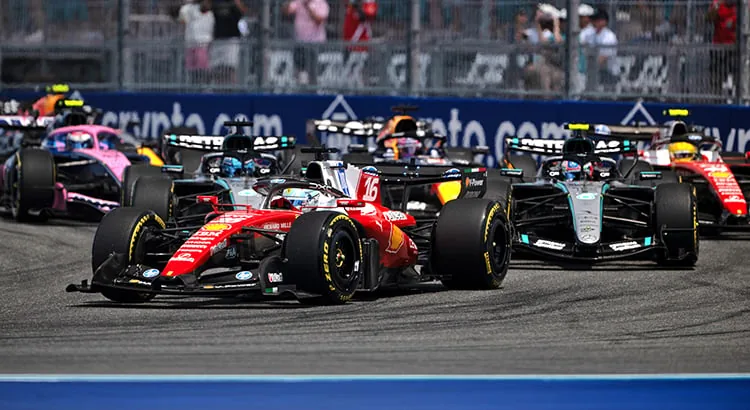
Ferrari impresses with the quality of its starts at the beginning of the 2026 F1 season. Will this still be the case at the Canadian Grand Prix this weekend? It is likely. Charles Leclerc and Lewis Hamilton have regularly jumped off the grid with remarkable efficiency, the result of a technical choice made in Maranello.
But behind this apparent advantage now lies deep frustration. Fred Vasseur indeed considers that the Scuderia was penalized after anticipating the difficulties of the new 2026 cars… before the FIA changed the starting procedures.
The Ferrari boss even believes that his team was a victim of an “unfair” situation.
A motor choice assumed by Ferrari
With the disappearance of the MGU-H in the new engine regulations, Ferrari feared extremely tricky starts due to the time needed to spin up the turbo.
The Italian team therefore made a technical compromise: using a smaller turbo to favor takeoffs at the start, even if it meant sacrificing a bit of maximum power.
“The compromise was simple: do we want to gain a tenth per lap or lose five positions at the start?”, explains Vasseur in an interview with The Race.
“If you ask the engineers, they answer: let’s make a good start.”
This choice was not an exploitation of a regulatory loophole according to Ferrari. It was rather a direct response to the rules initially set by the FIA.
Ferrari believes it was abandoned by the FIA
According to Vasseur, Ferrari had alerted the FIA the previous year about the potential risks related to the starts of the 2026 F1 cars. The response received was then very clear: teams had to adapt their cars to the regulations, not the other way around.
Ferrari therefore designed its engine project around this philosophy.
But after winter testing, several teams realized how problematic their own starts could be. Under growing pressure from the paddock, the FIA finally introduced a new pre-start procedure with more time to spin up the turbos before the lights went out.
A decision made in the name of safety.
For Vasseur, the problem is not so much the safety justification but the late change of the rules of the game.
Read more Ford open to a radical engine change
“I understand the safety argument, and it is the FIA’s right. But in the end, it is also a bit unfair for us.”
“Politically, it was well played”
The Frenchman also targets the political maneuvers of his rivals, who according to him amplified concerns about the starts to obtain an intervention from the FIA.
“When 40% of the grid starts complaining saying it’s extremely dangerous… politically, it was well played, but it wasn’t very fair.”
The GPDA director, George Russell, had notably publicly accused Ferrari of being “selfish” by refusing certain additional modifications to the starting procedures during the Chinese Grand Prix.
Vasseur however assures that Ferrari could not really oppose the final decision.
“It was a decision made for safety reasons. In that case, it’s the FIA who decides.”
Ferrari trapped by its own technical bet
What particularly annoys Ferrari is having developed its engine around a precise regulatory framework… before it was partially adapted afterwards.
“We developed this engine according to certain criteria, and in a way they changed the rule at the last moment.”
Vasseur even goes further by suggesting that teams facing difficulties could have been forced to start from the pit lane rather than seeing the procedure modified for the entire grid.
A statement illustrating the growing political tension around the new 2026 rules, as teams are already trying to defend their own technical choices in a particularly sensitive regulatory environment.
Read more One more Sprint, but a first for Montreal: with what prospects?