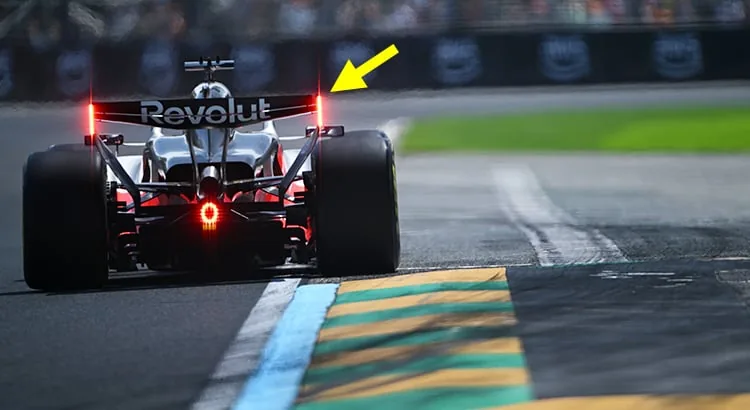
With the arrival of the new engine regulations in 2026, the rear LED lights of Formula 1 cars are taking on unprecedented importance in signaling electrical energy management.
Read more Spectacular crash for Verstappen in qualifying: the real cause finally revealed
The 2026 Formula 1 season marks the introduction of entirely new regulations, for both the chassis and the engine. However, the power unit is the main topic of discussion, particularly due to the increased importance of electrical energy.
The new generation of engines now relies almost as much on electrical energy as on the internal combustion engine. This near 50-50 split makes battery management much more decisive for performance.
In certain situations, drivers will even have to adopt unusual techniques to optimize available energy, such as lifting off on straights or downshifting to recover energy.
These developments have sparked debate, with some observers fearing that the complexity of the new rules will make the sport harder for spectators to follow.
Three LED signals to understand energy management in F1
To help better understand what is happening on track, the FIA has expanded the role of the rear LED lights. In the past, these lights were mainly activated when the hybrid system was recovering energy, particularly during braking phases via the MGU-K or when the MGU-H was recharging the battery.
With the removal of the MGU-H in the 2026 regulations, the system has been redesigned. The central rear light, combined with the two LEDs located on the ends of the rear wing, now allows for indicating different phases of energy management.
A first signal appears when the LEDs flash once: this means that the MGU-K is still providing energy, but at a level lower than the maximum authorized power of 350 kW. In this configuration, the car’s acceleration may be less significant than at full electrical power.
Read more The explosive starting grid for the Australian Grand Prix
When the LEDs flash twice, the MGU-K is no longer powering the system and is not recovering energy either. The car then runs solely on the internal combustion engine, which exceeds 500 horsepower in the 2026 regulations.
Finally, a rapid and continuous flashing indicates that the MGU-K is recharging the battery at full capacity while the internal combustion engine continues to provide full power. This situation corresponds to what is known as super clipping.
A safety tool… and strategic analysis
The super clipping occurs when the driver keeps the throttle wide open while the hybrid system recovers energy. In this case, the MGU-K acts partially against the internal combustion engine to recharge the battery.
This phenomenon can cause sudden variations in speed. One of the main objectives of these new light signals is therefore to warn the drivers behind so they can react more quickly and avoid any dangerous situations.
But these indicators could also become a valuable source of information for teams. By observing the behavior of the LEDs on opposing cars and comparing it to telemetry data, it becomes possible to identify areas where a car is using or recovering energy.
Lights used in several on-track situations
Beyond energy management, these rear lights can also be used in other situations. They can signal a safety car phase, a sector under double yellow flags, a stalled engine on track, or indicate the use of wet tires.
With these new light signals, the FIA hopes to make energy strategies more readable for spectators while improving on-track safety.
Read more Aston Martin ready to stop its drivers at the slightest problem in Australia