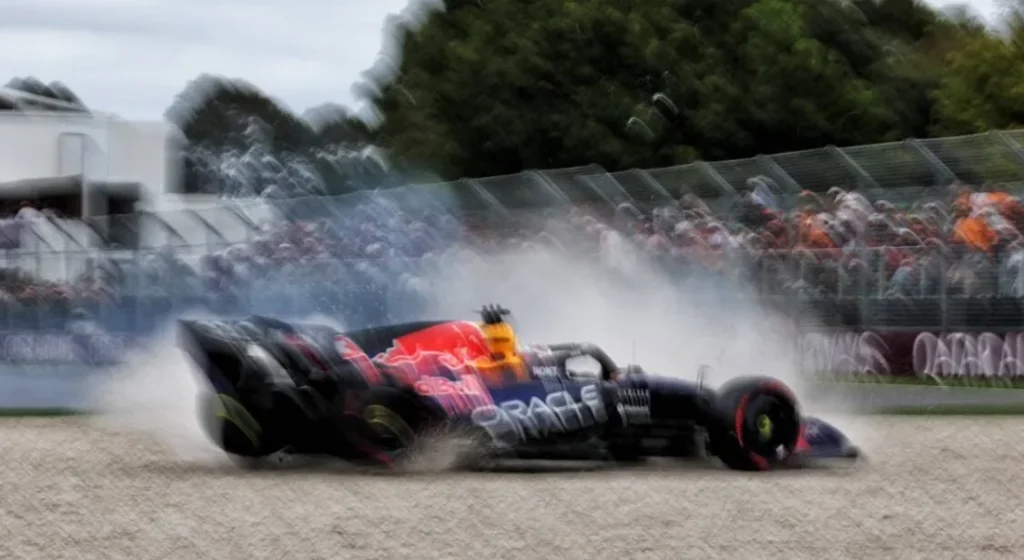
Eliminated in Q1 after a violent accident in Melbourne, Max Verstappen saw his qualifying session cut short. Technical analysis reveals that the cause was not mechanical, but linked to the energy recovery system.
Read more The explosive starting grid for the Australian Grand Prix
The first qualifying session of Formula 1’s new regulatory era turned into a nightmare for Max Verstappen. The Red Bull driver was eliminated in Q1 of the Australian Grand Prix after a spectacular accident at the Albert Park circuit.
As he began his very first flying lap, the four-time world champion brutally lost control of his car approaching the first corner, a fast right-hander at the end of the pit straight. The car spun before ending its race in the safety barriers.
The scene surprised the entire paddock. In the footage, the car seems to suddenly lock up at the rear upon entering the corner, sending Verstappen into a slide without him being able to react.
Team principal Laurent Mekies described the incident as “very brutal”, explaining that the team would analyze the data in detail to understand what had happened.
A first hypothesis quickly ruled out
Initially, many observers suspected a classic mechanical problem, such as a gearbox failure. Indeed, the incident occurred as Verstappen was downshifting while approaching the corner. But technical analysis quickly pointed engineers in another direction.
The problem did not stem directly from a mechanical component, but from a malfunction in the electronic management of the power unit, specifically in the energy recovery system. According to initial technical analyses, the incident was linked to a software bug in the ERS, the system responsible for recovering and redistributing engine energy.
During downshifting, the software reportedly misinterpreted information regarding engine speed and movements transmitted to the rear axle. Faced with this data considered abnormal, the system automatically went into safety mode. This protective reaction triggered extremely brutal engine braking. As a result, the rear wheels locked up instantly.
Read more Aston Martin ready to stop its drivers at the slightest problem in Australia
Under these conditions, Verstappen had virtually no chance of catching the car. The loss of grip at high speed immediately caused the car to go off track.
Contrary to what might have been thought, the rear electronic braking system (brake-by-wire) is not responsible for the incident. It was indeed the energy management of the power unit that caused the lock-up.
The challenges of a still immature technology
This episode illustrates the challenges faced by Formula 1 teams with the new generation of power units introduced this season.
Energy recovery and deployment systems now play a central role in performance, but they are still in a learning phase. Software anomalies or unforeseen behaviors can therefore have immediate consequences on track. Verstappen’s premature exit from qualifying is a striking example.
These technical challenges could also influence the race itself. Energy management will be a major strategic element, both for optimizing performance and for preserving system reliability. Scuderia Ferrari boss Frédéric Vasseur also believes that the race could hold many surprises.
With technologies still sensitive and energy management crucial throughout the distance, the scenario of a hectic Grand Prix in Melbourne seems far from improbable.
Read more Max Verstappen fumes: «This F1 is not right, I’m not having any fun»