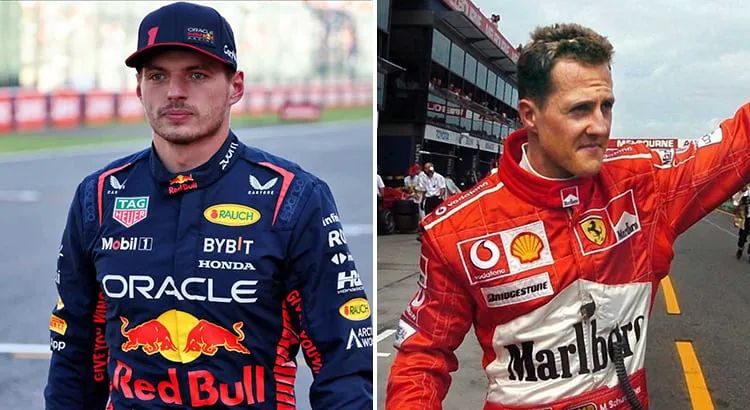
Contrary to a widely held belief in Formula 1, single-seaters are not custom-designed for a driver… even if the reality on track introduces significant nuances.
Read more Norris attacked backstage: Juan Pablo Montoya denounces a media «betrayal»
The question regularly arises in Formula 1: does a team design its single-seater for a particular driver? The example of Max Verstappen at Red Bull Racing often fuels this perception, as does that of Michael Schumacher during his time at Ferrari.
In fact, the answer is no. Teams never start from a driver’s profile to design their car. Their objective remains constant: to design the fastest possible single-seater based on objective data, derived from simulation and aerodynamic understanding.
The driver’s feedback: a decisive role
The confusion actually arises from the development process. An F1 single-seater constantly evolves throughout the season, and once on track, driver feedback becomes a key element.
In this context, the most performing driver within a team naturally sees their feedback taken into greater account. If they believe they can go faster with different handling, engineers will tend to orient development in that direction.
This is how certain profiles indirectly influence a car’s technical trajectory.
Verstappen and Schumacher: benchmarks for extreme style
Max Verstappen, like Michael Schumacher before him, is known for appreciating a very sharp car at the front, with an extremely responsive front end when turning into corners. This type of balance often implies a more unstable rear, especially on corner entry.
This compromise, which some drivers find difficult to exploit, can create significant gaps between teammates.
Former driver Alexander Albon described it precisely regarding his experience with Verstappen:
“The car is what it is. He is very fast. He has a quite unique driving style, which is not easy to deal with.”
Read more Chaos announced in Miami: rain ready to disrupt everything in the middle of a heatwave
“I like a car with a good front end, so quite sharp, direct. Max does too, but his level of aggressiveness is totally different – it’s extremely pointy.”
“To give an image, it’s like setting a computer mouse’s sensitivity to maximum: the slightest movement makes it cross the screen. That’s what it’s like. It becomes so lively that it puts you under tension.”
“The sharper the car becomes, the faster he goes. And to keep up, you have to take more risks. You’re a few tenths off, you push a little more… and you go off track.”
“You then lose confidence, it takes time to recover, the gap increases, and it becomes a vicious circle.”
A good driver performs everywhere… but not always at their maximum
What about a driver like George Russell? Would he be fast in another car, at Ferrari or Alpine?
In theory, yes. A fast driver remains fast regardless of the single-seater. But in practice, a car’s characteristics strongly influence their ability to fully exploit their potential.
Certain styles adapt better to certain balances. And even at the highest level, reaching the limit often depends on this subtle match between driver and machine.
Interaction more than dependence
Thus, teams do not build their cars for a driver, but the evolution of the single-seater can gradually reflect the preferences of the one who gets the most out of it.
A dynamic that explains why certain internal hierarchies may seem fixed… without necessarily stemming from a deliberate initial choice.
Read more Fernando Alonso sends a strong signal: F1 retirement is not for now