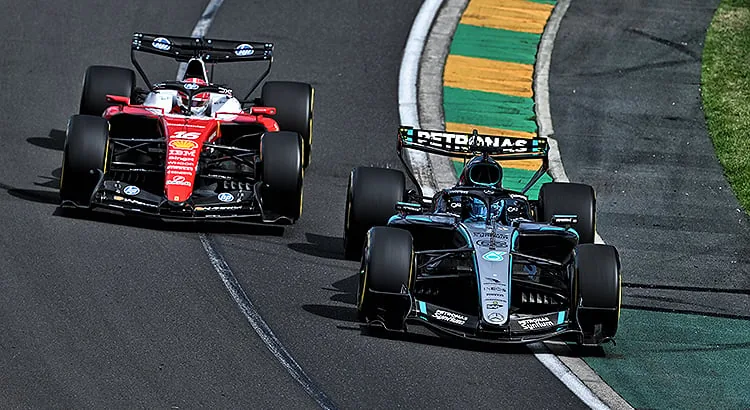
The intense duel between George Russell and Charles Leclerc illustrates how much the very nature of overtaking has changed with the new generation of engines.
Read more Tensions ahead in the paddock: Toto Wolff could thwart Horner’s plans at Alpine
The start of the Australian Grand Prix offered a breathtaking duel between George Russell and Charles Leclerc, immediately giving the new technical era of Formula 1 a visually spectacular dimension.
Leclerc had taken the lead at the start from the second row, but Russell quickly returned to his slipstream. The two drivers then engaged in a series of overtakes and counter-attacks that enlivened the opening laps of the race.
However, this duel was interrupted when Ferrari chose not to pit its cars under the virtual safety car on lap 12, while Mercedes brought in Russell and Kimi Antonelli for a low-time-cost tire change. This strategic choice proved decisive and contributed to Mercedes’ 1-2 finish, leaving Leclerc and Lewis Hamilton in third and fourth places despite a Ferrari capable of fighting for the win.
But behind the apparent spectacle of these battles, the technical reality of the duel was very different from what the image suggested.
Electric energy at the heart of overtaking
Most of the overtakes observed in this duel were not the result of a classic confrontation based on slipstreaming and late braking.
Indeed, when the lead car suddenly finds itself deprived of about 450 of the 1000 horsepower it has available and the straight is not over, the following car, still with its 450 additional electric horsepower, will inevitably pass.
In this context, the difference in available power becomes decisive. It’s not really an overtaking maneuver, but rather like a faster car passing a slower vehicle on the highway.
Visually, the result remains spectacular for the spectators. But in terms of pure driving, the exercise is of a different nature.
A tactical game rather than a driving duel
Leclerc nevertheless managed to hold off Russell for several laps, despite a potentially faster Mercedes.
However, his repeated overtakes before Turn 9 were not the result of an improvised maneuver.
The overtakes Leclerc performed in retaliation every time Russell had passed him at the start of the lap were the consequence of something he was doing three-quarters of a lap earlier.
Read more Max Verstappen furious with Lindblad on the radio: the explosive exchange revealed
This approach relied on very precise energy management. It is not a particularly skillful maneuver, but rather a very tactical action: taking less speed in the slow corners at the end of the lap in order to conserve enough battery so as not to run out of energy before the long acceleration leading to Turn 9.
The overtakes were therefore anticipated well in advance, and the maneuvers planned very far ahead.
In this context, the battles observed were more an exercise in energy strategy than a direct duel under braking.
A strategic duel that could have lasted
Russell managed to overtake the Ferrari three times, notably on the outside of Turn 12 when Leclerc lifted off to recharge his battery, and at Turn 3.
But each time, the Ferrari immediately regained the advantage thanks to its energy reserve on the long straight preceding Turn 9.
Russell tried to break this balance, notably with an attack under braking at Turn 11 — firmly repelled by Leclerc — then with an attempt at Turn 1 that ended in a wheel lock-up.
After this episode on lap nine, he seemed to be out of ideas to bypass the Ferrari’s energy strategy.
Ferrari then chose to bet on strategy by staying on track under the VSC, estimating that other neutralizations were likely and that fresher tires could offer an advantage later in the race.
But this duel also suggests that such a standoff could perhaps have lasted a very long time.
Other similar confrontations indeed persisted for a large part of the race, such as the one between Pierre Gasly and Esteban Ocon for tenth place. Oliver Bearman also eventually took the advantage over rookie Arvid Lindblad for seventh position, but only after a long battle.
Under these conditions, Leclerc might have been able to hold off the Mercedes for the entire race if Ferrari had simply chosen to pit during the first VSC — which would probably have kept the suspense going much longer.
Read more Max Verstappen’s dream with Red Bull revealed: a promise made before Mateschitz’s death