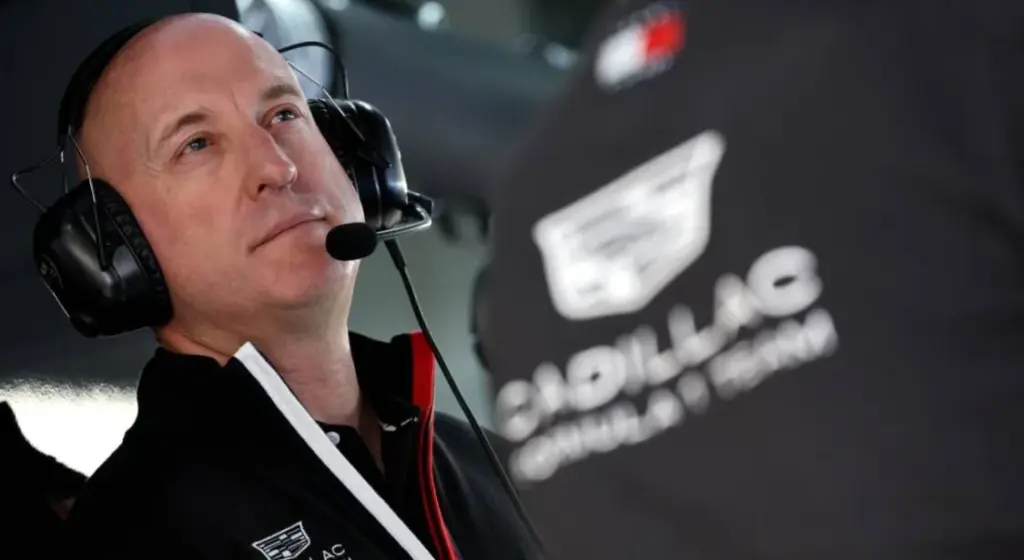
The arrival of Cadillac in F1 is clearly not limited to a simple customer team status: the project is structured around a major strategic objective, that of becoming a full-fledged manufacturer.
Read more Could Yuki Tsunoda succeed Esteban Ocon at Haas in 2027?
For now, the American team relies on a Ferrari engine, a classic solution to secure its entry into the discipline.
But at the same time, the boss Dan Towriss confirms that the development of the future in-house power unit is progressing faster than expected.
Mastering all components
The internal schedule is even ahead, with an introduction now planned for 2029, within the initial window, but with an operational margin already secured.
Technically, this is an extremely ambitious project. Designing a modern hybrid power unit involves the simultaneous mastery of several critical subsystems: high-efficiency thermal engine, MGU-K, high energy density battery, and extremely complex management software.
Cadillac, through the GM Performance Power Units group, has chosen a 100% internal development, without intellectual property transfer from Ferrari. This is a fundamental point: this is not a derivative program, but an architecture designed from a blank sheet.
Read more Nikolas Tombazis: «F1 is not in intensive care, adequate treatment should suffice»
This positioning is consistent with the industrial logic of a manufacturer like General Motors. In F1, the status of a factory team offers a decisive structural advantage: chassis-engine integration, optimization of energy flows, and total freedom on the technical philosophy. This is precisely what Cadillac aims for in the medium term.
Credibilizing the F1 program
However, a key element complicates the equation: regulatory uncertainty. Current power units are theoretically frozen until 2030, but discussions are already underway for an evolution as early as 2031, or even before. This means that the Cadillac engine could have a very short competitive lifecycle in its first iteration.
Despite this, Towriss’s logic remains clear: the challenge goes beyond simple short-term return on investment. It is about establishing Cadillac as a credible technological player in F1, with its own identity. In this perspective, even a program operated over two seasons can serve as a basis for the next generation.
In summary, Cadillac follows a typical trajectory of major manufacturers entering F1: client phase to learn, then ramp-up towards full independence. The difference here is the speed of execution. If the project continues at this pace, Cadillac could become a fully structured player earlier than expected and potentially play a much more central role in the post-2030 F1 landscape.
Read more Pierre Gasly refuses to aim small: Alpine urged to attack the top teams