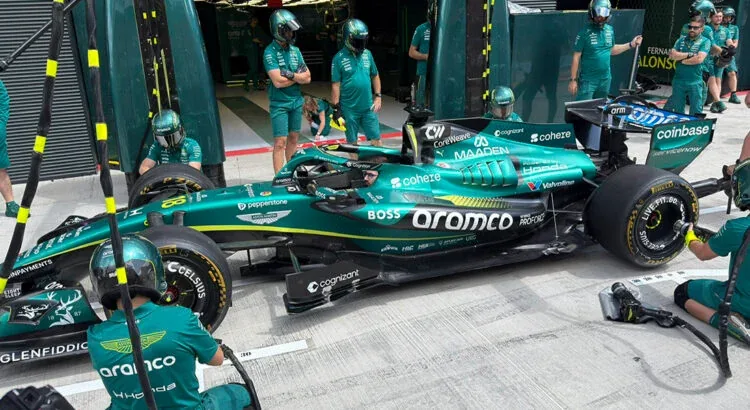
After ten Grands Prix without any real evolution, Aston Martin is finally launching the B version of its AMR26 in Hungary. A major turning point for the team… but also a decisive test for Adrian Newey.
Read more Ferrari refuses to get carried away before a highly anticipated Hungarian Grand Prix
Awaited for months, the B version of the Aston Martin AMR26 finally makes its debut this weekend at the Hungarian Grand Prix.
The Silverstone team had barely evolved its single-seater since the winter tests in Bahrain, preferring to concentrate all its resources on a single, vast development package. A strategy against the current trend in Formula 1, where evolutions are generally introduced in small touches throughout the season.
This choice reflects the extent of the difficulties encountered by Aston Martin. After ten rounds, the team occupies only the tenth place in the constructors’ championship, ahead of only Cadillac, with a single point scored by Fernando Alonso. A situation hardly compatible with the ambitions of Lawrence Stroll, the investments made in recent years and the arrival of Adrian Newey.
The famous British engineer had also explained that his first task was not to design new parts, but to upgrade the team’s development tools. According to him, the simulation software, working methods and internal organization were simply not adapted to a Formula 1 designed under an entirely new regulation.
A profoundly revised car
Contrary to what the expression “version B” might suggest, it is not an entirely new single-seater. The chassis retains the same general architecture, as do the gearbox and front suspension.
As Adrian Newey explains, “the main structural elements remain the same: the chassis and gearbox architecture does not fundamentally change”.
However, Aston Martin has profoundly revised many elements. “We have removed weight from the chassis and gearbox, which required new homologation and new crash-tests of the front chassis”, specifies the British engineer.
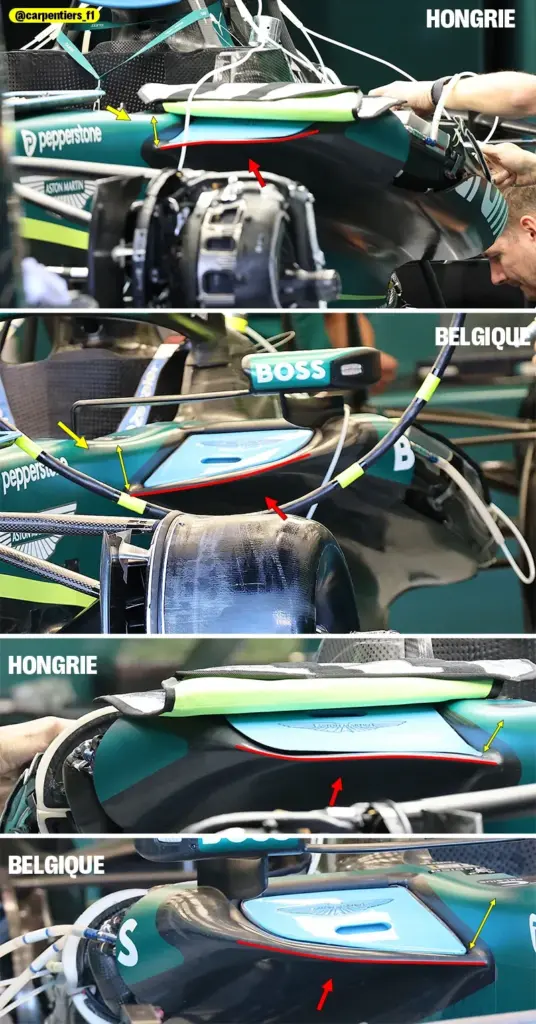
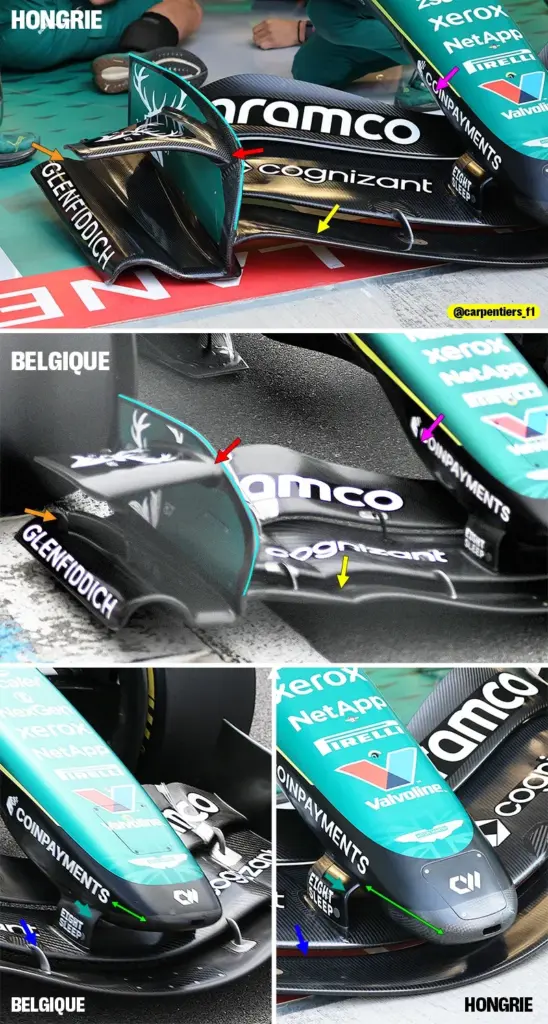
The rear suspension has also been revised, while a new nose and largely reworked aerodynamic surfaces make their appearance. “The front suspension is unchanged. The rear suspension is slightly modified. We have developed a new nose and thoroughly revised the aerodynamic surfaces,” Newey details.
The objective is also to finally bring the AMR26 closer to the regulatory weight limit, an area in which the car seemed to suffer since the beginning of the season. “We aim to get as close as possible to the minimum regulatory weight,” he summarizes.
First new features already visible
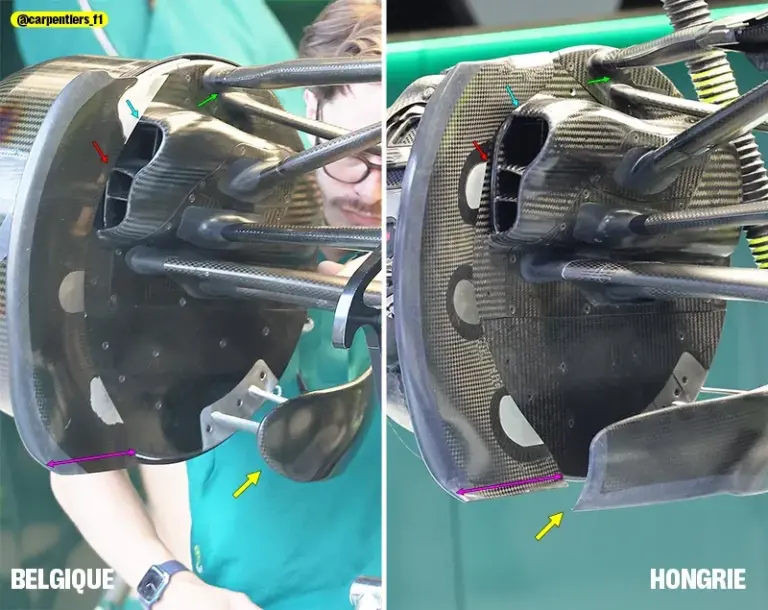
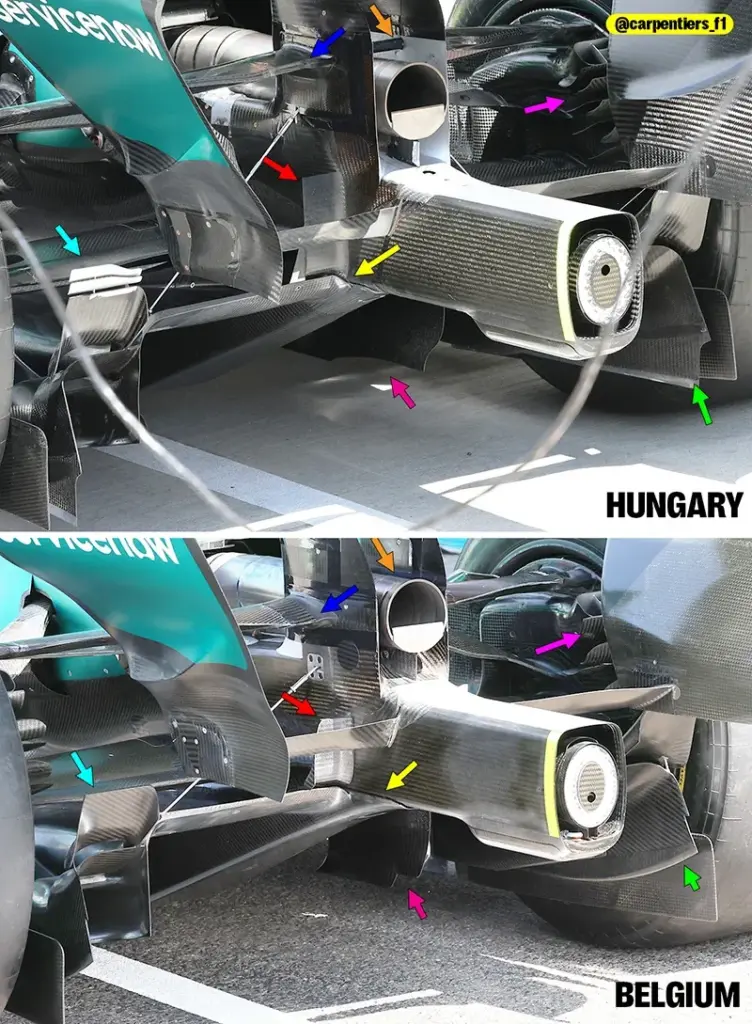
The first images taken Friday morning in the Aston Martin garage already allow several evolutions to be identified.
Read more A visit to McLaren revives rumors around Max Verstappen
The sidepods adopt a new design, while the flat floor features a larger opening (“mouse hole”) than on the previous version. The rear wing actuation mechanism also seems to have been modified.
However, these first elements represent only a part of the work done. Aston Martin plans to complete this evolution at the Dutch Grand Prix, where Honda will also introduce its only engine evolution of the season.
A full-scale test
For Mike Krack, head of track operations, this evolution will also be an examination of the new simulation tools developed by the team.
Due to a lack of private testing, Aston Martin will have to validate on track the correlations between its calculations and reality, notably through ride height tests, rake, and different settings that will probably continue over several Grands Prix.
The Luxembourger is therefore cautious: the team does not expect to immediately exploit the full potential of this new configuration.
A gamble that goes beyond the Hungarian Grand Prix
In the paddock, some estimates suggest a potential gain of up to 2.5 seconds per lap once the package is fully completed by the future Honda engine evolution. Even if this figure should be taken with great caution, Aston Martin refuses to put forward any official objective.
“We expect significant progress, but I prefer not to give figures. We will have to see what the car does once on track,” Adrian Newey tempers.
The real question, however, is not whether the team will immediately join the front runners. No one expects such a scenario.
The stakes are elsewhere: to verify that this new technical direction is the right one. After sacrificing the first half of the season to prepare this B version, Aston Martin must now demonstrate that its development process is finally working. The images unveiled in Hungary are the first clues.
Read more Aston Martin tempers expectations around its new single-seater