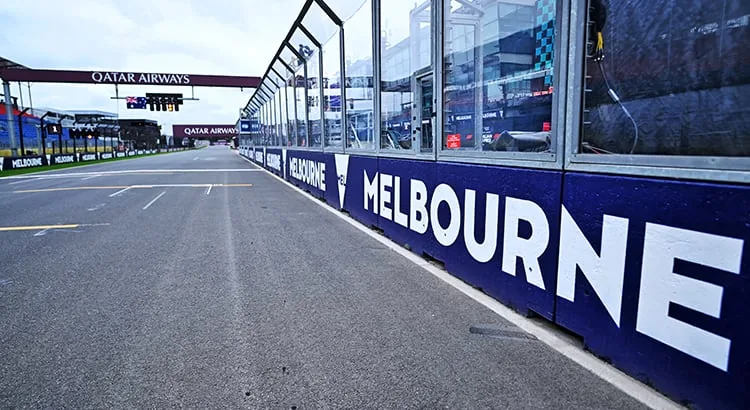
The FIA has decided to lower the limit of energy recoverable per lap in qualifying to prevent certain energy management strategies deemed too extreme.
Read more The stakes of Formula 2 with Rafael Camara and Colton Herta as luxury rookies
Energy management is one of the central challenges of the 2026 Formula 1 technical regulations. The power of the MGU-K hybrid system is to be increased to 350 kW – about three times more than in the current generation – while the MGU-H disappears.
However, this evolution comes with a major constraint: battery capacity remains largely unchanged. Teams must therefore deal with a similar amount of energy, but with a significantly higher electrical power to deploy.
Even on a single qualifying lap, determining where and how to use electrical energy requires particularly extensive optimization work.
On certain demanding circuits, such as Melbourne, poor management could lead drivers to deplete the battery on long straights if energy is used too early in the lap.
The risk of extreme recovery strategies
In this context, the FIA feared the emergence of unusual strategies in qualifying. Drivers could have been tempted to lift off earlier in certain fast zones to maximize energy recovery.
The idea would have been to slightly sacrifice speed at the end of the straight – where aerodynamic drag already limits performance gain – to recharge the battery more for the following sections of the lap.
If carefully optimized, such an approach could still offer a gain in lap time.
The problem is that these techniques could have led drivers not to attack fully during fast laps, whereas qualifying is supposed to represent the maximum expression of performance.
A limit reduced to 7 MJ in qualifying for the Australian Grand Prix
To avoid this scenario, the FIA has included a clause in the regulations allowing it to reduce the maximum amount of energy recoverable on a qualifying lap.
According to the 2026 technical regulations, “this limit may be further reduced, but not below 5 MJ, during sprint qualifying or qualifying sessions when the FIA considers that the recovery strategies required to comply with the previous 8.5 MJ limit are excessive.”
This provision is activated for the Australian Grand Prix in Melbourne, a circuit that is particularly demanding in terms of energy since nearly 70 % of the lap is spent at full throttle, with relatively few braking zones.
While the standard energy recovery limit is set at 8.5 MJ per lap, it will be lowered to 7 MJ in qualifying. In the race, the limit will be set at 8 MJ per lap, while the maximum value of 8.5 MJ will remain permitted during free practice.
Read more New blow for Aston Martin: Fernando Alonso deprived of track time in Melbourne
Less “super-clipping” and lift and coast?
This reduction should also limit the use of certain energy management techniques.
The current regulations provide that when the “super-clipping” phenomenon occurs – when the MGU-K recovers energy while the throttle is still fully open – recovery is limited to 250 kW.
On the other hand, when the driver lifts off, recovery can reach the maximum power of the MGU-K, i.e., 350 kW. In certain situations, particularly just before heavy braking, lifting slightly off the throttle could therefore have allowed more energy to be recovered with a limited loss of time.
By lowering the total recoverable amount, the FIA hopes to reduce the appeal of these approaches during qualifying in Australia.
Additional constraints on out-laps
The maximum limit of 8.5 MJ will however remain accessible in certain situations: during free practice, out-laps in qualifying, as well as in attack phases in overtake mode.
Out-laps in practice and qualifying will thus allow drivers to fully recharge the battery before starting their fast lap.
On the other hand, in the race, the 8 MJ per lap limit will continue to apply even after a pit stop.
A risk of increased traffic in qualifying
These energy constraints could also have indirect consequences on the conduct of qualifying in Australia, particularly regarding traffic.
Ayao Komatsu, team principal of the Haas team, believes that managing recharging during out-laps could become problematic.
“Yes, because to recharge the battery during the out-lap in certain sections you have to drive slowly, but on certain straights you have to be at full throttle. But if on that straight – where you should be flat out – you have to let someone past, you’re done, right?”
“So in qualifying there is really a big potential for disaster. But that’s also why free practice is so important: you have to simulate this situation as much as possible. You can’t arrive in Q1 and discover qualifying for the first time! What is the best compromise? It’s a huge aspect. It will be a good challenge.”
Read more Australian GP – FP1: Ferrari strikes hard with a 1-2 led by Leclerc