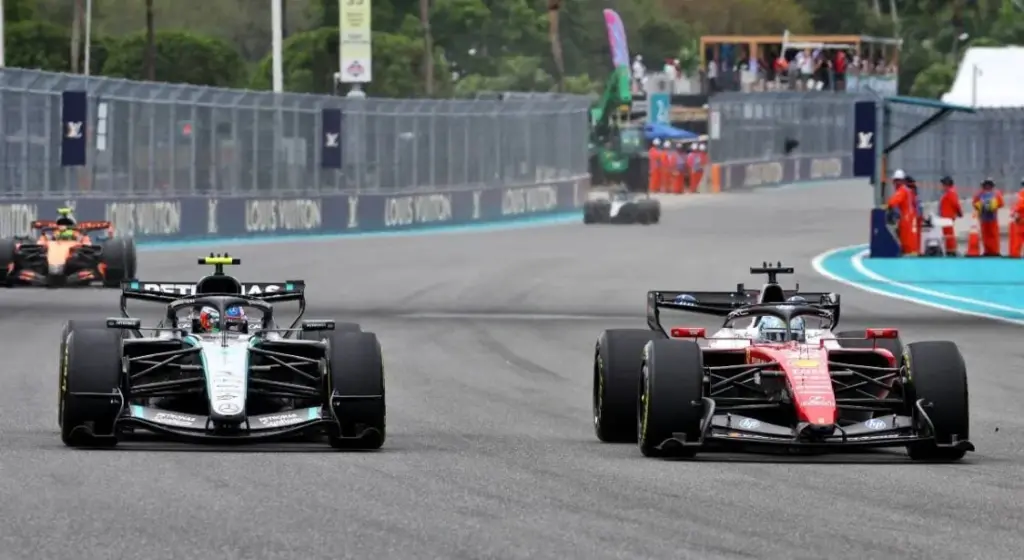
The former Scuderia Ferrari engineer, Rob Smedley, delivered a particularly pessimistic analysis of the new package of upgrades introduced by Ferrari in Miami: a disappointing weekend.
Read more Max Verstappen conquering the Nürburgring: his team is the favorite for the 24 Hours
The optimism surrounding the new features brought to the car did not last long. What was supposed to represent a turning point in Ferrari’s season ultimately turned into a new demonstration of the team’s deep difficulties.
However, the Scuderia arrived in Miami with high expectations around these upgrades, considered essential to reduce the gap with the leading teams.
Laborious progress
But the weekend’s verdict was brutal. Lewis Hamilton finished only sixth, while Charles Leclerc dropped to eighth place after a penalty. More worrying than the results themselves: despite the arrival of many new parts, Ferrari still seemed clearly inferior to Mercedes and McLaren in terms of pure performance.
For Smedley, who spent nearly ten years within Ferrari’s technical structure, the warning signs are extremely familiar. According to him, the problem goes far beyond a simple bad weekend. “It’s somewhat morally destructive,” he explains in the High Performance podcast. This triggers a negative loop from a technical point of view. You start to wonder: what have we brought? What works? What doesn’t work?”
The real danger appears when simulator, wind tunnel, and track data stop matching. In this case, engineers no longer work to make the car faster: they spend their time trying to understand why their development tools no longer reflect reality. “If correlations no longer work, you have to go back and redo a whole reverse engineering process. It completely slows down development,” Smedley continues.
Correlation at fault?
This concern is shared by Otmar Szafnauer, former head of Aston Martin and Alpine F1, his colleague on the podcast. According to him, when a team loses control of its technical correlations, it enters an extremely dangerous zone.
Read more Confirmed weight reinforcement at Alpine: David Sanchez can count on his new deputy
“You have limited resources. And instead of using these resources to make the car faster, you dedicate them to solving correlation problems,” he explains. If you no longer properly understand the car’s behavior, then improving performance becomes almost a matter of luck.”
Szafnauer also highlights another problem: engineers who should normally develop new performance find themselves mobilized to resolve internal malfunctions of technical tools. This further slows the team’s overall progress. According to him, some structures have teams dedicated to these analyses, but this is not always enough when problems become significant.
This is precisely the scenario that seems to worry Ferrari today. The problem may not simply be that the Miami upgrades did not produce the expected gain. The danger is that they introduced doubt and uncertainty at the very heart of the technical department. In Formula 1, this loss of confidence can quickly cost weeks of development and lead to a real internal crisis.
A formidable competition
The timing is all the worse as rivals progress rapidly. McLaren transformed its performance level in Miami thanks to its own upgrades, Mercedes seems to continue gaining strength, while Red Bull Racing remains always capable of bouncing back.
Ferrari, on the other hand, now risks locking itself into a phase of technical introspection that Smedley knows very well from having experienced it in Maranello. That is why his expression “morally destructive” resonates as much more than a simple comment on a bad weekend. It sounds like a serious warning about the possible start of a new negative spiral for the Scuderia.
Read more Alpine is preparing a major recruitment with the arrival of a senior FIA official