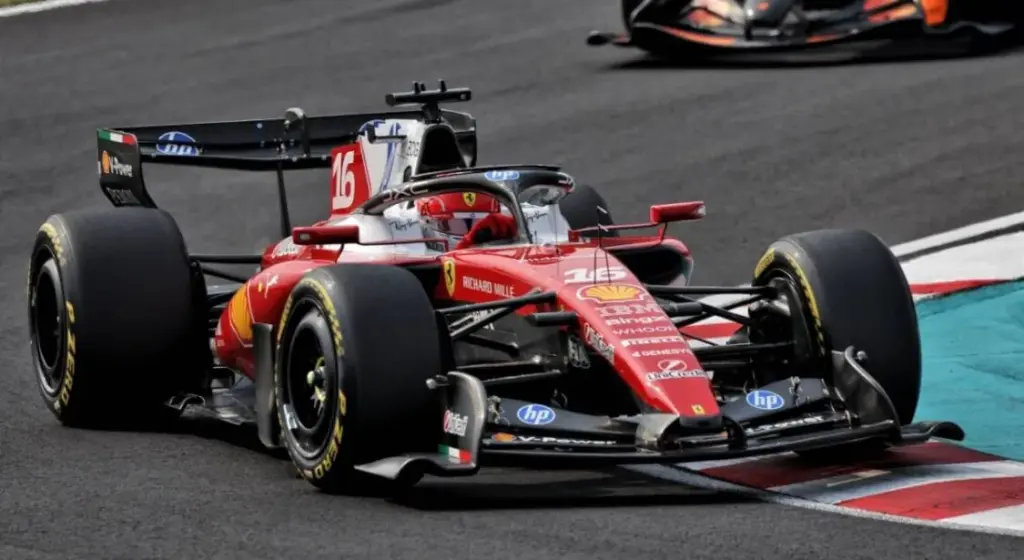
Constrained by energy management, Charles Leclerc believes that drivers can no longer push the limits in Q3. A worrying observation for the spectacle.
Read more Liam Lawson debunks a crazy rumor about leaving Supercars
As the first races of the season progress, one observation becomes clear in the paddock: energy management has become a determining factor, sometimes at the expense of pure driving. On circuits like Melbourne, Shanghai, or Suzuka, the cars are particularly limited in terms of energy.
Under these conditions, drivers must juggle between performance and economy, multiplying “lift and coast” phases or finely managing their electric deployment. The result: even in qualifying, where every thousandth counts, it becomes difficult to fully exploit the car’s potential.
This phenomenon was notably illustrated in some fast corners, where the cars suddenly lost speed, due to lack of available energy.
Charles Leclerc regrets a loss of instinct
Faced with this evolution, Charles Leclerc does not hide his frustration. For the Ferrari driver, the very essence of qualifying is disappearing.
“In Q3, normally, you go out to try things you’ve never tried before, he explains. Taking risks, pushing the limits… that’s always been the most rewarding part of our careers. Today, it’s no longer possible.”
According to him, the slightest mistake is immediately penalized. A small loss of control, an oversteer, or a too harsh correction directly impacts energy management, which penalizes the end of the lap.
“As soon as you exceed the limit a bit, it costs energy, and you pay the price afterwards” he specifies.
Consistency now takes precedence over boldness
This constraint profoundly changes the drivers’ approach. Where boldness made the difference, it is now consistency that is rewarded.
Read more Formula 1 losing momentum? Formal denial from the FOM, supported by figures
“Today, it feels like consistency is more important than being brave and trying something new” regrets Leclerc. An evolution he finds unfortunate, as it reduces the intensity and challenge of qualifying sessions.
This feeling echoes the words of Fernando Alonso, who recently compared some sections at Suzuka to a real charging phase, as if the cars became temporarily dependent on their battery rather than pure performance.
Solutions under study before Miami
Aware of the problem, the governing bodies and teams are already working on adjustments to the technical regulations. Several discussions have taken place and should continue ahead of the Miami Grand Prix.
The goal is clear: to give drivers more freedom without compromising the overall balance of the cars. However, finding the right formula remains a complex challenge, given the many parameters to consider.
Nevertheless, Leclerc remains slightly optimistic: “It is a known problem. The FIA and the teams do not accept it as is, he assures. There is a lot of work behind the scenes, and I hope we will find a solution.”
A key issue for the spectacle in F1
Beyond pure performance, it is also the DNA of the sport that is at stake. Qualifying has always been a moment where drivers could shine individually, flirting with the limits.
If this dimension gradually disappears, F1 could lose part of its intensity and appeal. It remains to be seen if the upcoming adjustments will rebalance the scale between technology and instinct.
Read more Jean Todt refused an offer to lead Red Bull Racing and its motorsport activities