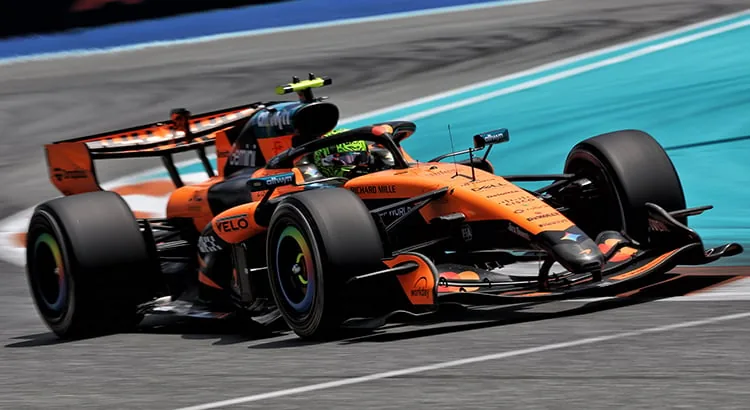
Lando Norris ended Mercedes’ perfect streak in sprint qualifying in Miami, a turnaround explained by a combination of technical and strategic factors.
Read more McLaren changes everything in Miami: a heavily revamped MCL40 on track
Lando Norris’s pole position for the Miami Grand Prix sprint race marks a first this season: Mercedes did not lock out the front row.
While Kimi Antonelli managed to limit the gap to 0.222 seconds, George Russell only set the sixth fastest time, ending an until-then undisputed dominance in qualifying.
Contrary to what one might have thought, this change in hierarchy is not linked to the regulatory adjustments on energy management introduced this weekend. The Miami circuit, little sensitive to these changes, did not amplify their impact.
Imperfect settings on the Mercedes
First key factor: Mercedes did not find the right operating window.
Since the start of the season, drivers have praised the effectiveness of the W17 chassis, but in Miami, the balance was not there. George Russell particularly suffered, especially in the technical sequences of the second sector.
“Miami is not a circuit I love, honestly, especially with these warmer conditions. I was overheating the tires a lot in the twisty section in the middle. I struggled to find the right balance with the car. Not much more to say.”
This difficulty in stabilizing the car led to increased thermal degradation of the tires, directly penalizing performance over a lap.
Kimi Antonelli also mentioned a complicated session, describing a “rather messy” approach, before suddenly finding performance in SQ3 with the soft tires.
Read more The competitive Alpines in Miami: double breakthrough in Sprint despite persistent doubts
A different energy strategy at McLaren
Second determining element: energy management.
McLaren intensified its work in this area after being surprised by Mercedes’ lead at the start of the season. A progression already visible in Japan, and confirmed in Miami with a distinct approach.
Telemetry data shows that Norris chose to deploy more energy out of turn 3. Result: a gain of over 20 km/h on this section compared to Antonelli’s Mercedes.
This choice implies a compromise: less energy available later in the lap. But in practice, Mercedes did not sufficiently compensate for this advantage on the following straights.
This strategic divergence should be subject to thorough analysis on the Mercedes side ahead of the main qualifying.
The impact of development delay
Finally, the technical development context played a significant role.
The five-week gap since Japan allowed several teams to introduce major upgrades. McLaren, Ferrari, and Red Bull all took a step forward this weekend.
Conversely, Mercedes limited itself to minor adjustments, with a small wing on the exhaust and a modification of the front brake drum. The team chose to postpone a more substantial package to later in the season, potentially in Canada.
This delay was immediately felt in performance.
“It’s quite surprising to see how much McLaren and Ferrari have progressed, so it’s really impressive. We knew they would probably close the gap, but they were faster than us.”
Mercedes is therefore temporarily paying the price for this strategic choice, hoping that more significant gains in the medium term will compensate for this temporary setback.
Read more Charles Leclerc impressed by McLaren in Miami, Ferrari remains in the fight despite the pressure