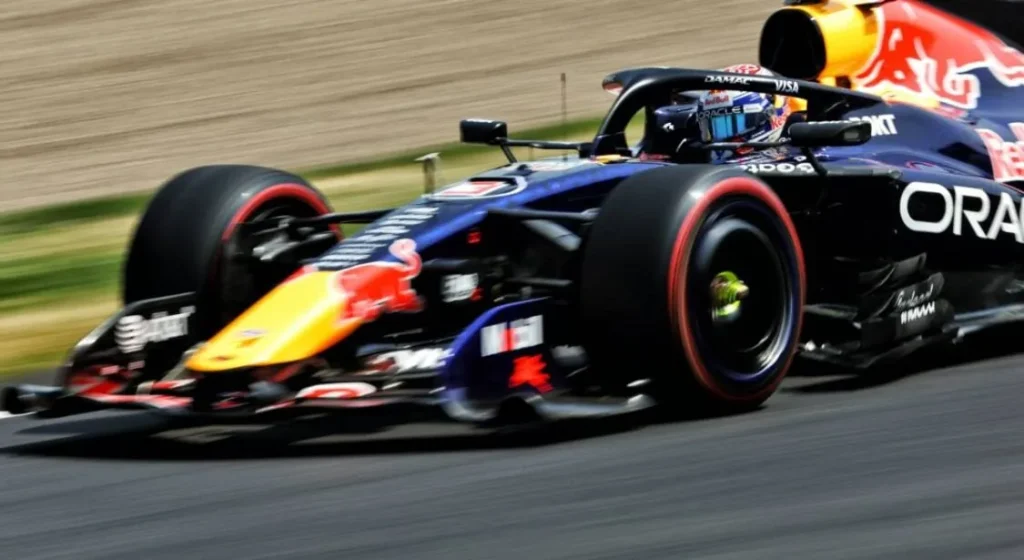
Long pointed out, the RB22’s overweight does exist… but it is far from the most alarmist estimates.
Read more Max Verstappen hits rock bottom at Suzuka: a rare humiliation that confirms the Red Bull crisis
As the Japanese Grand Prix approaches, many questions surrounded the single-seater of Max Verstappen and Isack Hadjar. The cause: a possible overweight problem that would have heavily penalized Red Bull’s performance.
It all started with an image taken in the pit lane during the weekend held at the Shanghai circuit. Hadjar’s car was seen displayed at 716,5 kg on the FIA scales after qualifying.
Taking into account the weight of the drivers, some calculations quickly circulated, suggesting that the RB22 exceeded the regulatory limit set at 768 kg (car + driver) by more than 20 kg. An alarming hypothesis.
A real gap… but much smaller
In reality, the situation is much less dramatic. Red Bull would indeed be facing an excess of weight, but this would be between 9 and 10 kg, which is about half as much as the initial estimates.
However, this figure should be put into perspective. Several parameters can influence the measured weight of a single-seater: settings, the presence of additional sensors, or even certain specific configurations used during sessions.
Even if the gap is more contained, it remains no less problematic in a discipline where every detail counts.
A direct impact on performance
In Formula 1, weight is a key factor. An overweight of 10 kg can cost about two-tenths of a second per lap, a significant gap in an extremely tight grid.
Read more Kimi Antonelli does it again at Suzuka: masterful pole, Verstappen caught out in Q2
Beyond pure lap time, this surplus also affects the overall balance of the car. This can complicate settings, harm tire management, and make the single-seater more difficult to exploit, especially on technical circuits.
This could partly explain why Red Bull, although competitive in qualifying in Melbourne, seems to have lost ground to its rivals in recent weeks.
An expected response in Miami
Faced with this situation, the Austrian team is not remaining inactive. An evolution package is in preparation and should be introduced at the Miami Grand Prix, the fourth round of the F1 2026 calendar.
The objective is clear: lighten the RB22 in order to regain performance and handling. Initially planned earlier in the season, this plan was delayed, notably due to the cancellation of the Bahrain and Saudi Arabian Grands Prix.
Until then, Verstappen and his team will have to deal with an imperfect single-seater. But if the improvements live up to their promises, Red Bull could quickly return to the fight at the front.
One thing is certain: in such a competitive season, every kilogram counts… and this one could well make all the difference.