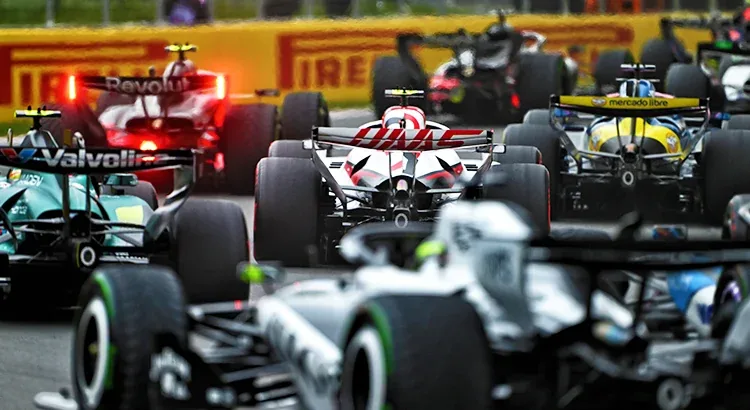
After the first 5 Grands Prix of the 2026 season, the official qualifying figures reveal a radical power shift. One team dominates the timed session.
Read more Charles Leclerc raises a key point in the debate on F1 rules
The introduction of the brand new technical and engine regulations in 2026 promised a leap into the unknown for the entire paddock.
After five Grands Prix held from Melbourne to Montreal, the winter speculations give way to the relentless reality of the stopwatch.
It is the perfect time to take stock of the “pure speed” in qualifying for the 2026 F1 cars, where the machines are laid bare, without tire management or race strategies.
Mercedes untouchable, McLaren and Ferrari neck and neck
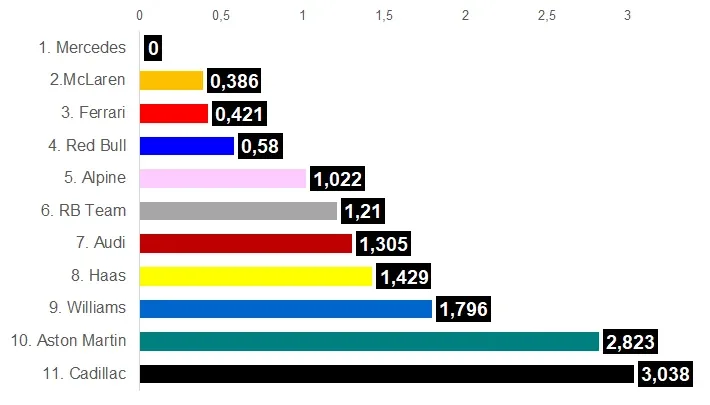
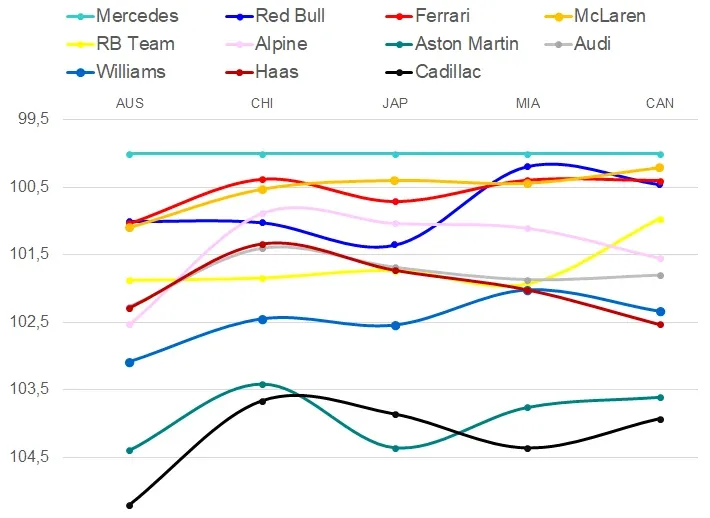
The mathematical observation is relentless: the Mercedes team has established itself as the absolute reference on Saturdays. Serving as the 100% baseline over the first five rounds of the year, the German team sets the pace at the start of this new technical era.
Behind, the fight for the position of first runner-up is intense:
- McLaren takes the honorary second place with an average gap of 0.386 tenths of a second from the reference.
- Ferrari closely follows its Woking rival, conceding 0.421 tenths of a second to the Silver Arrow.
F1 2026: Red Bull lurking, the resurgence confirmed
Used to the top in previous seasons, Red Bull occupies fourth place in this pure performance ranking, with an overall average delay of 0.580 tenths of a second.
However, a detailed examination of the progress sheet shows that the champion team is correcting course.
Read more Max Verstappen opens up about his life as a father: «I know the difficult moments will come»
After a quieter start to the season in Australia (101.000%) and Japan (101.352%), the Milton Keynes outfit has significantly reduced the gap during the recent outings in Miami (100.189%) and Canada (100.453%), thus approaching the pole pace.
Alpine leads the pack, Aston Martin and Cadillac distanced
In the second half of the 2026 F1 table, Alpine asserts itself as the leader of the midfield (5th force at an average of 1.022s), narrowly ahead of RB Team, Audi, and Haas, all grouped within less than half a tenth.
On the other hand, the situation is much harsher for the back of the grid. Aston Martin (+2.823s) and newcomer Cadillac (+3.038s) suffer a significant delay. For these two teams, the timing sheet indicates there is still a gulf to bridge to hope to join the fight for Q3.
A 2026 F1 hierarchy set to evolve
While the first mathematical verdict of this 2026 F1 season highlights the excellence of the engineers from Brackley (chassis) and Brixworth (engine), this initial hierarchy is expected to evolve significantly.
We are only at the beginnings of a fierce aerodynamic development war. With cars born under unprecedented philosophies, the pace of gains in wind tunnel testing and via CFD simulations will be particularly high in the coming months.
The other short-term focus concerns the weight of the cars. Several teams are already working on drastic chassis lightening programs to reach the minimum regulatory weight, a gain that will directly translate on the stopwatch. Finally, in the medium term, regulatory development opportunities on engines (ADUO) will allow lagging engine manufacturers to correct course and optimize their output.
Read more Oscar Piastri sends a warning to McLaren in the fight with Mercedes