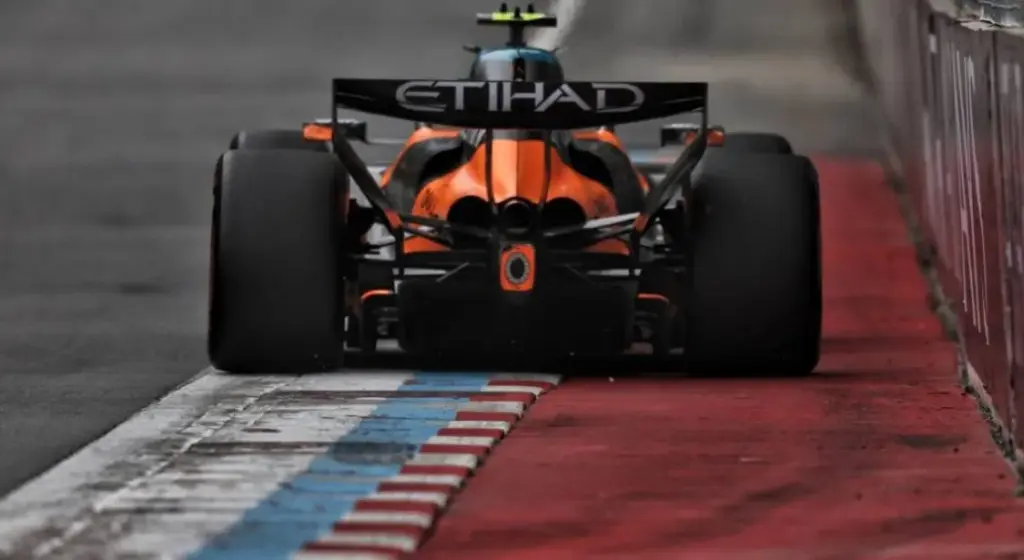
The idea of a return of V8 engines in Formula 1 continues to gain momentum and could cause a major upheaval in the technical balance of the championship with a new engine manufacturer.
Read more Kimi adoube Kimi: when Räikkönen appreciates Antonelli, while warning him…
Behind this reflection led by the FIA lies a clear ambition: to simplify the power units of the next decade and reduce dependence on extremely complex hybrid systems introduced in recent years.
This evolution could even open the way to a scenario so far hardly conceivable: seeing McLaren develop its own engine.
Simpler and cheaper engines
The FIA president, Mohammed Ben Sulayem, indeed believes that a simpler and more financially affordable engine regulation could convince new manufacturers to take the step: “I believe that when we introduce this new regulation, even McLaren will make its own engine”, he said to the Sports Business Journal.
According to him, the current complexity of hybrid power units is today the main obstacle for customer teams like McLaren. A hypothesis that has not been completely ruled out by Zak Brown.
The American executive acknowledges that the British team could seriously consider this possibility if future rules made the project economically viable: “If we have a financially reasonable engine regulation, then yes, we would consider that.”
For several seasons, McLaren has been using Mercedes engines as part of a partnership that continues until 2030. But the arrival of the new hybrid units in 2026 has revived some frustrations on the Woking side.
The debate is open
The British team has acknowledged several times that a customer status strongly limits its understanding and optimization of modern power units, as these systems require very deep access to manufacturer data.
Read more Strong turbulence at Ferrari with the launch of its highly controversial new electric car
This situation more broadly revives the debate on the technological direction of Formula 1. On one side, some stakeholders want to keep a strong hybrid component to maintain the link with the modern automotive industry. On the other, several voices advocate for simpler, lighter, less expensive engines and above all more spectacular in terms of sound.
Zak Brown nevertheless believes that, despite the criticisms, the sporting spectacle remains at a very high level: “The racing is excellent. If you just watch the Grands Prix on television, without listening to the drivers, the product remains very good. There are overtakes, battles for the win and different leaders.”
The McLaren boss nevertheless reminds that F1 always tends to amplify every technical debate: “Everything is amplified a thousand times.”
Logical evolution
But he also acknowledges that the current regulations may have pushed some technological aspects too far: “I think we have gone to an extreme that the majority of drivers do not really appreciate.”
For Brown, this evolution is nevertheless part of the historical DNA of the discipline: “There has always been management: previously tires, today batteries. It remains motor racing.”
If the FIA really decides to steer the discipline towards simplified V8 engines by 2030 or 2031, the impact could be considerable. Beyond the spectacle and costs, the entire technical structure of the grid could evolve, potentially with new engine manufacturers… and perhaps one day a McLaren engine in Formula 1.
Read more Gucci becomes title sponsor of Alpine F1 in a giant deal estimated at 150 million dollars