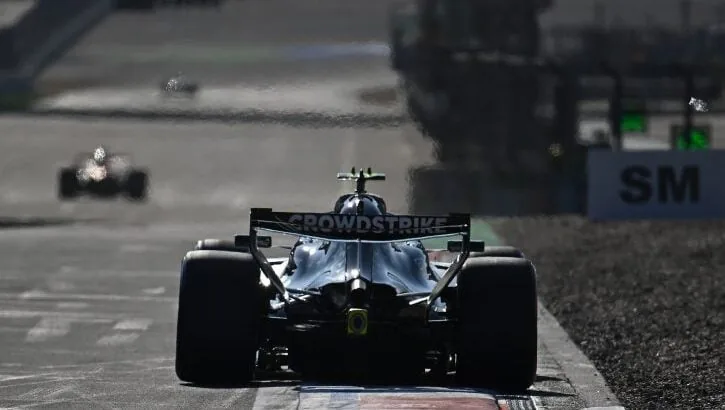
Toto Wolff supported the idea of a return of V8s in Formula 1, while outlining an ambitious vision of a “mega-engine” hybrid capable of redefining the performance of the discipline in the future.
Read more Red Bull and McLaren align their views on the Lambiase case
While FIA president Mohammed Ben Sulayem is pushing for a possible return of naturally aspirated engines as early as 2030 or 2031, the discussions are intensifying in the paddock around a potential major technical change.
And on the side of Mercedes, Toto Wolff assures that the German manufacturer is ready to actively participate in this revolution.
The concept of the “mega-engine”
While he acknowledges the nostalgia and emotion associated with the V8 era, Wolff nevertheless believes that a return to purely thermal engines would be hardly defensible in the automotive context of the next decade.
“At Mercedes, we are open to new engine regulations. We love V8s, they evoke great memories and, from our point of view, they perfectly match Mercedes’ DNA”, he said in Miami.
But the Austrian insists on one essential point, namely maintaining a strong hybrid dimension to keep a link with the technological evolution of the automotive industry: “They rev high, but we also have to think about how to bring enough electric energy so as not to lose all connection with the real world. If we go back to 100% combustion, it could seem a bit ridiculous in 2030 or 2031.”
1200 horsepower
Wolff thus imagines a spectacular power unit combining thermal power and massive electrification: “Maybe we could extract 800 horsepower from the thermal engine and add 400 additional horsepower via electric energy, or even more.”
Such a configuration would bring the total power to about 1,200 horsepower, a figure already circulating in some technical discussions in the paddock.
Read more Christian Lundgaard wins the Indy GP for McLaren, Romain Grosjean (DCR) unlucky
The Mercedes boss specifies, however, that any evolution must be planned in a structured way and take into account the financial realities of manufacturers: “We fully understand the current economic constraints of manufacturers. The situation is not easy for anyone. But if the project is well designed and well executed, Mercedes will be present to come back with a real racing engine.”
Red Bull also interested
The idea of a return to simpler, more powerful, and louder engines also appeals to other players on the grid. At Red Bull Powertrains, team principal Laurent Mekies confirmed that Red Bull and its partner Ford Motor Company were open to all options.
“At Red Bull Powertrains, we are quite enthusiastic about this idea,” he explained. “We had to start from scratch to develop this power unit and we believe the base is already solid.”
Mekies nevertheless acknowledges that the Red Bull-Ford engine still lags somewhat behind Mercedes in terms of performance, while praising the work done by the engineers: “We are probably a bit more flexible and independent. We don’t have a huge historical heritage to defend, but we are very motivated by this new challenge.”
Towards a new technical revolution?
As Formula 1 reflects on its future identity, the idea of a return to louder, simpler, and much more powerful engines is no longer just nostalgia for enthusiasts.
With manufacturers, teams, and governing bodies seeming increasingly aligned on exploring new solutions, Toto Wolff’s vision of a “mega-engine” hybrid could well mark the beginning of the next great technological battle in Formula 1.
Read more Will the 2026 championship enter a new phase at the Canadian Grand Prix?