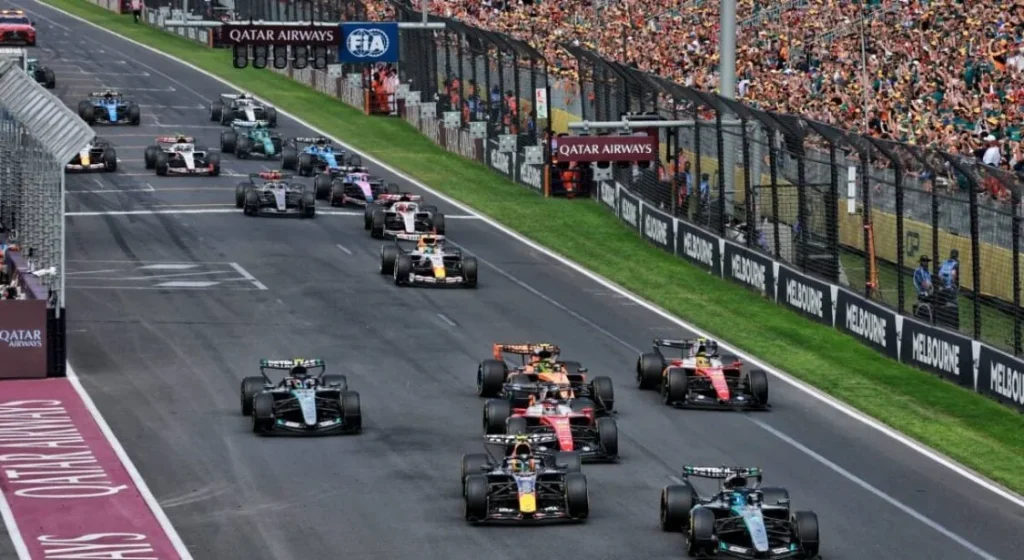
The first Grand Prix of the season in Melbourne highlighted several problems related to Formula 1’s new technical rules.
Read more Fred Vasseur defends Ferrari’s latest strategic failure after Australia
Formula 1 entered a new technical era in 2026, but the first race of the season, held in Australia, primarily highlighted the limits of this regulatory revolution. At the Albert Park circuit, several unusual scenes illustrated the difficulties encountered by drivers with these new single-seaters.
One of the most striking examples appeared between turns 8 and 9, where some cars saw their speed drop to around 60 km/h on a portion of the circuit that is normally fast. The cause: a battery drained too quickly and energy management becoming decisive. In this context, performance no longer depends solely on pure speed, but on the drivers’ ability to save and use their energy at the right time.
Energy management has become central
Onboard footage also showed a surprising phenomenon: drivers lifting off in areas where they should normally be attacking. Qualifying laps, usually synonymous with maximum attack, sometimes turned into energy management exercises.
This change in philosophy profoundly alters the nature of the discipline. Instead of being a demonstration of absolute speed, certain parts of the lap look more like a saving strategy, which contrasts with the traditional image of Formula 1.
The race also provided some particularly worrying moments. At the start, Liam Lawson’s Racing Bulls almost came to a dead stop on the grid when his turbo system failed to deliver the expected power. Franco Colapinto narrowly avoided a collision thanks to a last-second reflex.
After the race, several drivers also mentioned the significant speed differences between cars depending on their available energy level. Lando Norris notably warned that these gaps could cause serious accidents in the future.
Despite the high number of overtakes observed during the race – around 130 – many of them were linked to these energy variations rather than genuine driving maneuvers.
Read more Josef Newgarden (Penske) emerges on the Phoenix oval, Romain Grosjean (Coyne) out of luck
A headache for the FIA and Formula 1
Faced with these problems, the FIA must now find solutions without completely overturning the regulations. Several paths are already being discussed in the paddock.
One of them would involve modifying the “superclipping” system to allow cars to recharge their batteries more efficiently during braking phases. Other teams suggest increasing energy recovery limits to allow drivers to attack more.
But this option could have a major side effect: lap times could drop by several seconds, significantly altering the performance balance.
Regulations that are difficult to modify
Another possibility would be to reduce the battery’s influence on performance. However, this would also pose a problem, as the very concept of the 2026 engine is based on an equal power split between the internal combustion engine and the electric motor. Modifying this principle in depth would be extremely complex, especially after the colossal investments made by manufacturers to develop these new technologies.
Formula 1 therefore finds itself in a delicate situation. The 2026 rules were designed to attract new manufacturers through technologies closer to those of road cars and a more sustainable image. Backtracking too quickly could discourage these industrial partners and call into question years of development.
For F1 and the FIA, the challenge is now to find a compromise between technological innovation and on-track spectacle. But with teams already deeply committed to their development programs, the window for major changes could close very quickly.
Read more «Enzo», the Ferrari legend in four episodes starting tonight on Canal +