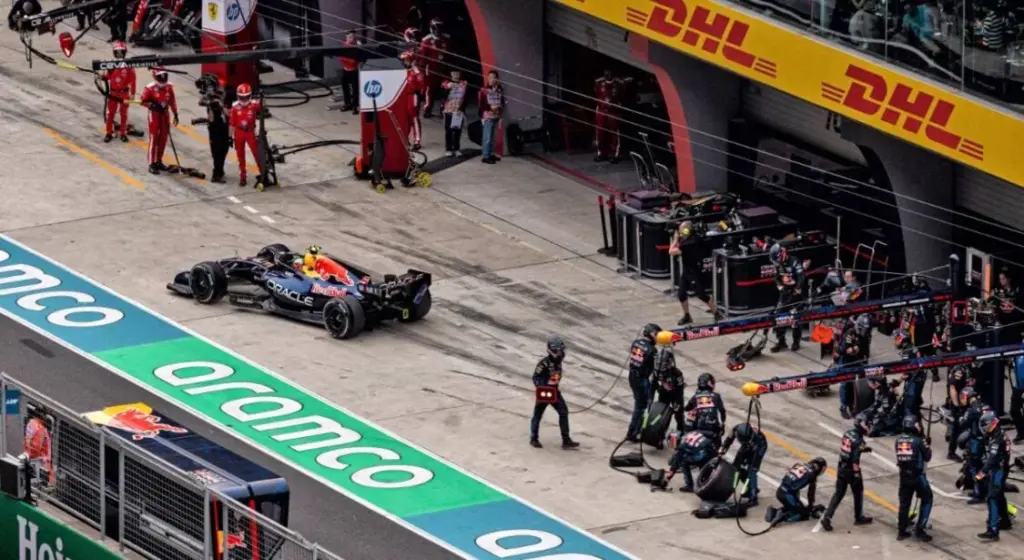
The start of the 2026 Formula 1 season has indeed highlighted a rather monotonous trend strategically, with a clear dominance of one-stop races, which tends to harm the show.
Read more No Indy 500 for Colton Herta, but he will race in F2 at home: a major first
But according to Mario Isola, still head of competition at Pirelli for a few more weeks, this situation is temporary and linked to an incomplete learning phase of the new cars.
The underlying problem comes from the tire design process: Pirelli had to work from simulations and theoretical data provided by the teams, without having reliable real references.
Caution of the teams
Testing was done with “mules,” that is, modified cars that did not faithfully reproduce the characteristics of the 2026 F1 cars, especially regarding active aerodynamics and energy management.
Result: the current tire compounds are slightly conservative compared to the real potential of the cars. Added to this is an approximately 10% decrease in overall grip, due to the combination of reduced aerodynamic downforce and narrower tires. In this context, teams naturally favor long stints and cautious management, which mechanically favors one-stop strategies.
Read more David Coulthard: Miami might not reveal the true impact of recent adjustments
Towards brighter days?
But this balance is expected to evolve quickly. As engineers better master key elements like energy recovery and deployment, drivers will be able to drive at higher speeds and stress the tires more, especially in traction phases and fast corners. This should mechanically increase thermal degradation and open the door to alternative strategies.
The implicit goal — from both the manufacturer and FIA sides — is to recreate a sufficient performance differential between compounds to make multiple strategic approaches viable in the same race. In other words, to reduce the current unique optimum (one-stop) in favor of a range of competitive scenarios allowing multiple stops.
If this convergence is confirmed in the coming months, we should see a gradual return of more dynamic races tactically, where the timing of stops, opportunities for undercut/overcut, and stint management will again become decisive variables.
Read more BYD could set its sights on Williams