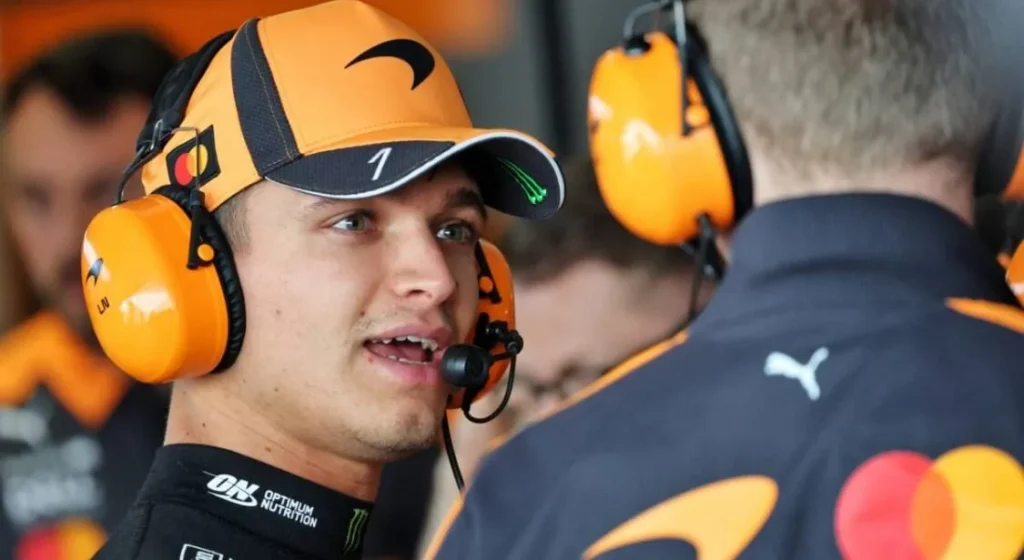
Fifth in Suzuka, Lando Norris experienced a frustrating race, a symbol of the limits of the new 2026 rules. Facing Lewis Hamilton, the Briton even hesitated to overtake…
Read more Toto Wolff sounds the alarm: 2026 rules still «immature»
At the end of the Japanese Grand Prix, Lando Norris secured a solid fifth place, but far from satisfying in terms of content. On the Suzuka track, the McLaren driver found himself at the heart of a duel as intense as it was revealing against Lewis Hamilton.
Because beyond the simple on-track confrontation, this battle highlighted the limits of the new technical regulations introduced in 2026. Since the start of the season, drivers have unanimously denounced the excessive importance of energy management, which directly impacts the quality of the show.
Norris no longer hides his annoyance at this evolution, pointing to a system that he believes distorts the very essence of racing.
“There are two aspects. From a racing point of view, there is above all safety, which perhaps played a role today,” he explains.
An energy system at the heart of the problem
The heart of the debate lies in energy management between recovery and deployment, which has become central to the performance of the cars. This complex mechanic creates sometimes brutal speed gaps between two cars, depending on their engine usage mode.
These differences were also at the center of the impressive accident involving Oliver Bearman and Franco Colapinto, a direct consequence of closing speeds deemed dangerous.
But beyond safety, it is the clarity and purity of the on-track battle that are in question. Drivers must now deal with technical constraints that dictate their actions, sometimes to the detriment of racing instinct.
Read more Verstappen under pressure: his criticisms could harm F1
“I didn’t even want to overtake him”
The most striking moment of Norris’s testimony concerns precisely his duel with Hamilton. While he had the necessary pace to attempt an attack, the Briton voluntarily hesitated. A situation almost unthinkable in Formula 1.
“From a driving point of view, honestly, I didn’t even want to overtake Lewis, it’s just that the battery deploys and I don’t want it to deploy, but I can’t control it,” he confides.
This loss of control over such a crucial element as available power creates absurd scenarios. Overtaking sometimes becomes counterproductive, because the energy consumed then prevents defending one’s position.
“I overtake him, then I have no battery left, so he passes me back easily. It’s not driving. This yo-yo effect, even if some say otherwise,” Norris continues.
An F1 judged too artificial
In the end, it is the entire current philosophy of the discipline that Norris questions. For him, drivers should remain masters of their machines, and not depend on algorithms or unpredictable energy constraints.
“When you are at the mercy of what the engine delivers, drivers should at least have control over it, and that is not the case today,” he concludes.
This observation, shared by a large part of the grid, could carry significant weight in the upcoming discussions between the FIA, the teams, and the engine manufacturers. Because if nothing changes quickly, it is the very essence of Formula 1 that seems to be in question today.
Read more The new Qiddiya circuit is revealed with an extraordinary corner