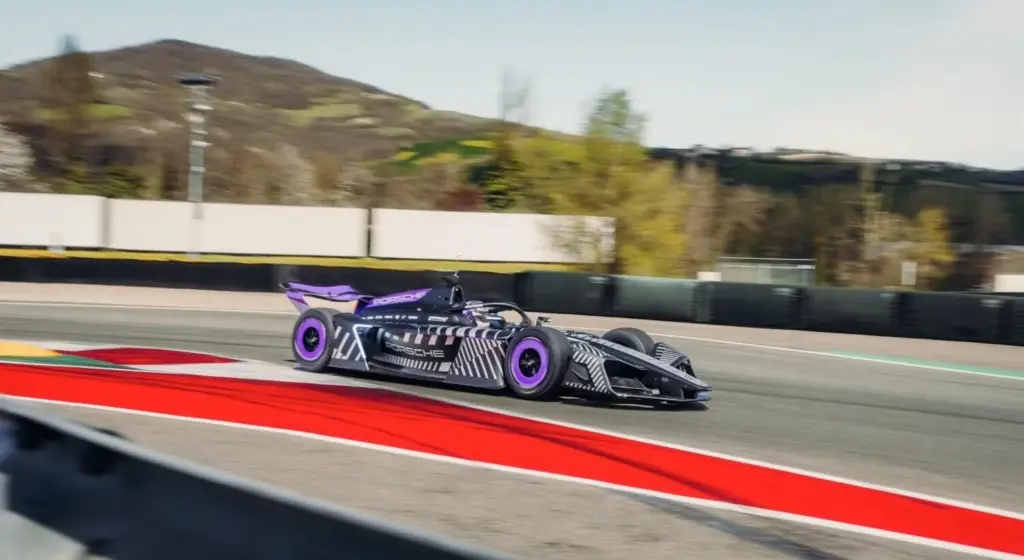
The Fédération Internationale de l’Automobile and Formula E officially launched the new GEN4 single-seater on track during a demonstration run at the Circuit Paul Ricard, marking the beginning of a new era for electric motorsport.
Read more Aston Martin in crisis: Honda warns that the solution will not be immediate
This new-generation car will be further developed by teams and manufacturers before its competitive introduction in the 2026/27 FIA Formula E World Championship season next December.
In terms of performance, the GEN4 represents a spectacular leap. It exceeds 335 km/h, goes from 0 to 100 km/h in approximately 1.8 seconds and from 0 to 200 km/h in 4.4 seconds — 1.5 seconds faster than the previous generation.
600 kW in Attack Mode
In race mode, it offers 50% more power compared to the GEN3 Evo, while Attack Mode reaches up to 600 kW (equivalent to 815 hp), an increase of 71%. It also introduces two distinct aerodynamic configurations — one oriented towards pure performance in qualifying, the other optimized for energy management in the race — and becomes the only permanent all-wheel drive single-seater.
The real-world demonstration highlighted this performance gap, particularly through overtaking simulations on previous generations GEN1, GEN2, and GEN3. The current prototype is already about five seconds faster per lap than the GEN3 Evo and up to ten seconds faster than the GEN3 in qualifying configuration.
The committed manufacturers — including Porsche, Jaguar, Nissan, Stellantis, Mahindra, and Lola Cars — now have a very advanced technological base to push development even further.
Read more Red Bull shaken: Max Verstappen will leave before his engineer, according to a shock prediction
Racing as a laboratory
Beyond pure performance, the GEN4 aligns with the discipline’s “track-to-road” philosophy. With a charging capacity of up to 600 kW and high-efficiency propulsion systems, it serves as a laboratory for tomorrow’s electric vehicle technologies. Manufacturers also benefit from greater freedom over electronic systems, reinforcing the relevance of developments for road applications.
The sustainable dimension remains central: the car incorporates at least 20% recycled materials, tires composed of 65% natural and recycled materials (including 30% certified natural rubber), and a rare-earth-free battery. In terms of safety, the GEN4 introduces reinforced standards with a structure capable of withstanding higher loads, an enlarged cockpit, and power steering designed to limit stresses during impacts.
Cutting-edge technology
FIA President Mohammed Ben Sulayem emphasized that this was a declaration of intent on the future of this technology, while FE CEO Jeff Dodds described the GEN4 as a generational leap capable of achieving performance levels deemed impossible for electric vehicles just five years ago.
The GEN4 is not just an evolution but a major technological breakthrough. It illustrates both the acceleration of performance in electric motorsport and Formula E’s ambition to remain at the forefront of innovation, bringing competition and future mobility ever closer.
This performance leap brings FE closer to F1 and certainly places it at the F2 level: one can therefore question the relevance of urban circuits in its economic model. Real modern tracks close to large cities will probably be better suited to these new electric rockets, even if it means losing a bit of Formula E’s DNA.
Read more «Too artificial»: a McLaren driver turns his back on F1