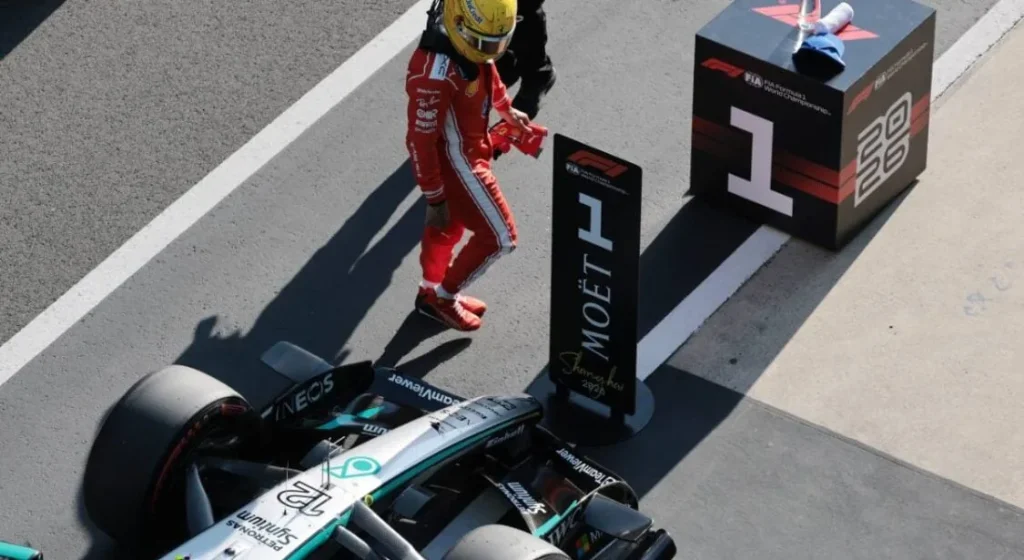
Lewis Hamilton suspects Mercedes of using a very aggressive engine mode in qualifying. The Ferrari driver claims to know this system perfectly, having used it for years.
Read more Fifth, Lando Norris accepts his position against rivals «out of reach»
Lewis Hamilton was quick to analyze Mercedes’ dominance in qualifying at the start of this 2026 F1 season. According to the Ferrari driver, the German team has a very specific engine setting, comparable to the former famous “party mode”.
This extremely aggressive mode would allow Mercedes to release more power during qualifying, which would explain the sudden gaps observed between the different phases of the session.
Hamilton, who spent more than a decade at Mercedes, claims to know this type of operation perfectly.
“The difference is that I was at Mercedes for a very long time, so I know how it works there.”
A gap that grows throughout qualifying
The qualifying figures in Shanghai indeed seem to support the Briton’s theory. During sprint qualifying, Hamilton was only 0,118 seconds behind George Russell in SQ1. But as the sessions progressed, the gap widened abruptly.
In SQ2, the difference rose to more than eight-tenths, before narrowing slightly in SQ3. A similar trend was observed during the classic Grand Prix qualifying.
Hamilton remained relatively close during the early phases, but Mercedes’ advantage became more pronounced as the session progressed. In Q3, he finally finished 0,351 seconds off the pole position set by Kimi Antonelli.
For the Ferrari driver, this sudden progression is no coincidence: “In qualifying, they have another mode they can activate, a bit like the ‘party mode’ back then. From Q2 onwards, they activate it, and we don’t have it.”
Read more Alpine fined after an unusual blunder on Gasly’s car
An advantage limited to qualifying
Hamilton notes, however, that this advantage seems to manifest itself mainly over a fast lap. Once the race starts, the hierarchy seems to tighten, which could be explained by the impossibility of using these extreme settings over long distances.
“In the race, they obviously don’t have this mode, so their advantage is less significant.”
This difference could explain why Ferrari manages to stay relatively close to Mercedes’ pace during sprints and races, despite a visible deficit in qualifying.
Ferrari is looking for the key
For Ferrari, the goal now is to understand exactly what allows Mercedes to extract so much performance during the decisive phases of qualifying. Hamilton believes there is clearly an additional element that his former team is managing to exploit.
“We need to understand what it is, because they are managing to extract something more, especially from Q2 onwards.”
The Briton again highlights the spectacular evolution observed between the different phases of qualifying.
“We saw it during sprint qualifying: in SQ1, we weren’t very far away. And suddenly, the gap becomes huge. It goes from a tenth to seven-tenths or half a second. It’s a big step.”
A finding that promises to fuel discussions in the paddock, as Ferrari tries to close the gap with Mercedes in the fight for pole positions.
Read more Lewis Hamilton promises to shake up Mercedes: Ferrari seriously threatens supremacy in Shanghai