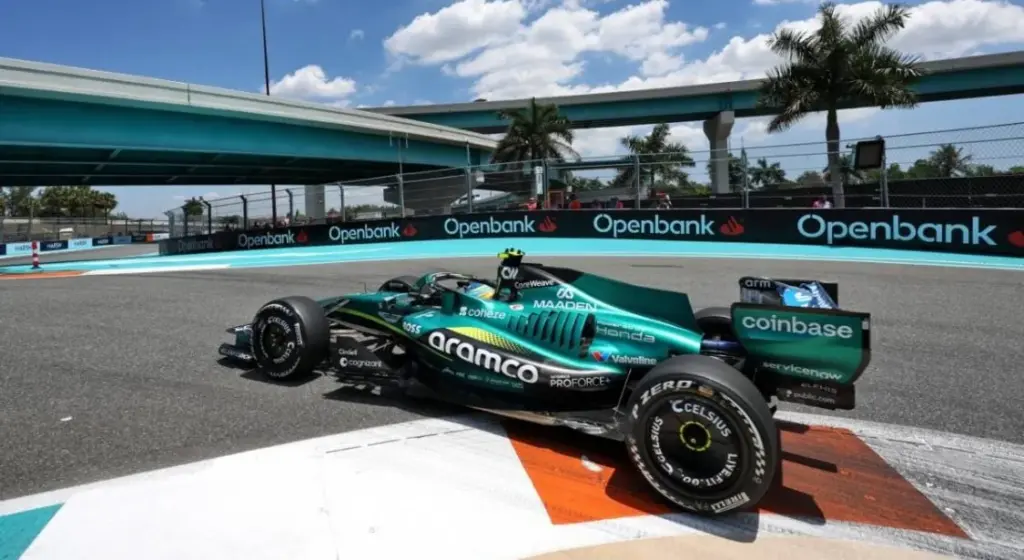
Honda has posted the worst financial results in its history since its stock market debut in 1957: the Japanese manufacturer had already warned in March that a significant loss was unfortunately expected…
Read more Max Verstappen narrowly avoids disaster at the 24 Hours of Nürburgring
The official figures published on Thursday confirmed this worrying trend.
For the fiscal year ended in March, Honda recorded a loss of 423 billion yen, approximately 2.68 billion dollars.
No immediate impact in F1
Results even worse than during the pandemic years, when the group had decided to massively accelerate its transition to electrification and officially withdraw from Formula 1 at the end of 2021. However, a new withdrawal does not seem to be on the agenda: the company assured that this financial situation would have no direct impact on Honda Racing Corporation nor on its future F1 program.
“Honda Motor had already communicated its financial forecasts in March before Thursday’s official announcement. The outlook was therefore clear since that time,” explained the manufacturer. “HRC does not observe any specific changes affecting sporting activities following the financial announcement of May 14.”
Beyond the numbers themselves, it is especially their origin that raises questions. The CEO Toshihiro Mibe acknowledged that these losses were mainly linked to massive investments made in electric vehicles and the group’s electrification strategy.
However, these investments have not yet produced the expected results, especially in the United States. The situation was worsened by the policy of the Donald Trump administration, which eliminated in September 2025 the tax credit of up to 7,500 dollars granted to electric vehicle buyers.
Electric questioned
These difficulties now push Honda to review its automotive strategy. The manufacturer has notably suspended an 11 billion dollar investment project intended to produce electric vehicles and batteries in Canada.
From the Formula 1 perspective, another decision is particularly noteworthy: Honda abandons its previous goal that 20% of its global sales in 2030 be composed exclusively of electric vehicles. Toshihiro Mibe also confirmed that the group is, for now, giving up its ambition to sell only electric cars from 2040.
These strategic changes are particularly interesting in the current context of discussions about future F1 engines. During the development of the current engine regulations, Audi and Honda were among the strongest advocates of strong electrification, consistent with their industrial orientation at the time.
Read more Pierre Gasly comes alive: “It’s so much more rewarding and promising for the future”
Back to V8s?
But today, the discourse is clearly evolving in the paddock. The CEO of F1, Stefano Domenicali, recently acknowledged that the FIA and Formula 1 may have given too much importance to manufacturers’ demands when defining the current rules.
“I personally see sustainable fuels playing a central role in the future, with a different balance regarding electrification and a greater thermal engine,” he said.
The FIA president, Mohammed Ben Sulayem, went even further by stating that a return of the V8 is now almost certain: “It will happen. It’s only a matter of time. In 2031, the FIA will have the power to do it without a vote from engine manufacturers. But we would like to introduce it as early as 2030, which many now demand.”
The idea of a V8 engine powered by sustainable fuels is already receiving a favorable reception in the paddock, including at Mercedes-Benz.
Manufacturers unanimous
The head of Mercedes, Toto Wolff, has indeed shown openness to this development: “We love V8s. We are totally open to new engine regulations. If we return to 100% thermal power, it might seem ridiculous in 2030 or 2031. Maybe we can imagine a ‘mega-engine’ with 800 horsepower of thermal power and an additional 400 thanks to electric energy.”
Even Ford Motor Company, now engine partner of Red Bull, is favorable to this direction. Its competition director Mark Rushbrook explained that Ford has also revised its strategy, abandoning its initial project to completely stop thermal cars. The same tune at GM for Cadillac, while Ferrari has also revised its electric strategy.
But one thing is already clear: the difficult year experienced by Honda calls into question the total electrification model that still seemed inevitable a few seasons ago in Formula 1.
Read more Valtteri Bottas’s Cadillac disappeared… while he was in the shower: FBI investigation!