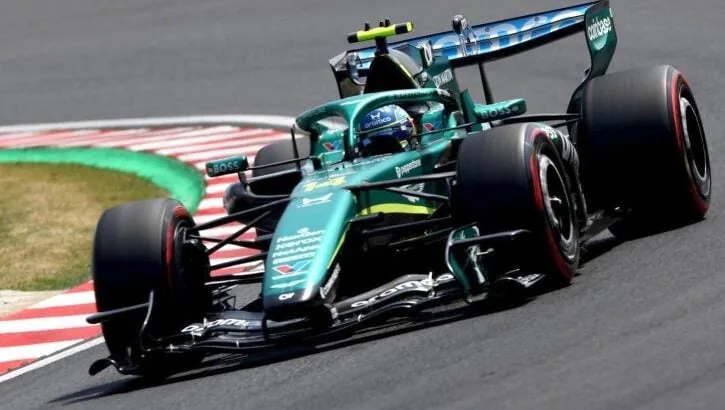
Two-time world champion Fernando Alonso gives a particularly harsh assessment of the 2026 regulations, pointing out not just a simple adjustment flaw, but a profound transformation.
Read more Yuki Tsunoda is not giving up: he wants to believe in a second chance
According to him, what is disappearing is the central role of the driver in pure performance.
Where Formula 1 historically relied on the ability to push the car to the limit, especially in fast corners, it is now moving towards a logic dominated by energy management.
Unnatural driving
On a circuit like Suzuka, iconic for its fast sequences and its famous 130R corner, Alonso explains that the driving philosophy has been totally reversed. These curves, once synonymous with maximum commitment and risk-taking, are now becoming zones where drivers lift off to recharge the battery.
The goal is no longer to pass as fast as possible, but to optimize the energy available for the following straights. This approach transforms historically decisive sections into simple recovery phases, which he summarizes scathingly by calling them “charging stations”.
Read more Summit meeting on April 9: it is time to act to save F1 2026
In this context, performance no longer primarily depends on the driver’s courage or feel, but on their ability to manage energy parameters imposed by the regulations. Alonso goes as far as to suggest, provocatively but revealingly, that a large part of the paddock could now drive these cars, as the demand in fast corners has decreased. What he deplores is not just a loss of difficulty, but a loss of meaning : the areas of the circuit that once served to distinguish the best no longer fulfill this function.
Priority management
The problem, according to him, is structural. It is not simply a matter of correcting certain effects like “superclipping” or power losses, but of recognizing that the very balance of the cars is biased in favor of energy management and straight-line performance. Even with regulatory adjustments, he believes that it will no longer be necessary to push the car to the limit in every corner, which marks a break with the very essence of the discipline.
Behind this criticism lies a broader question about the identity of Formula 1. If fast corners no longer constitute a major technical and human challenge, then what still allows exceptional drivers to be differentiated ? For Alonso, the answer seems worrying: Formula 1 risks becoming less a matter of instinct and bravery than an exercise in optimized management, where the machine and its constraints dictate the pace more than the driver’s pure talent.
Read more «He is at a dead end»: Is Carlos Sainz at the end of the road in Formula 1?