After two weeks of break, Formula 1 returns to one of its most iconic circuits with the Belgian Grand Prix, the penultimate round before the summer break.
Read more The King of the Belgians will present the trophy to the winner on the Grand Prix podium
Often nicknamed “the university of Formula 1,” Spa-Francorchamps is renowned for the variety of technical challenges it poses to both drivers and engineers.
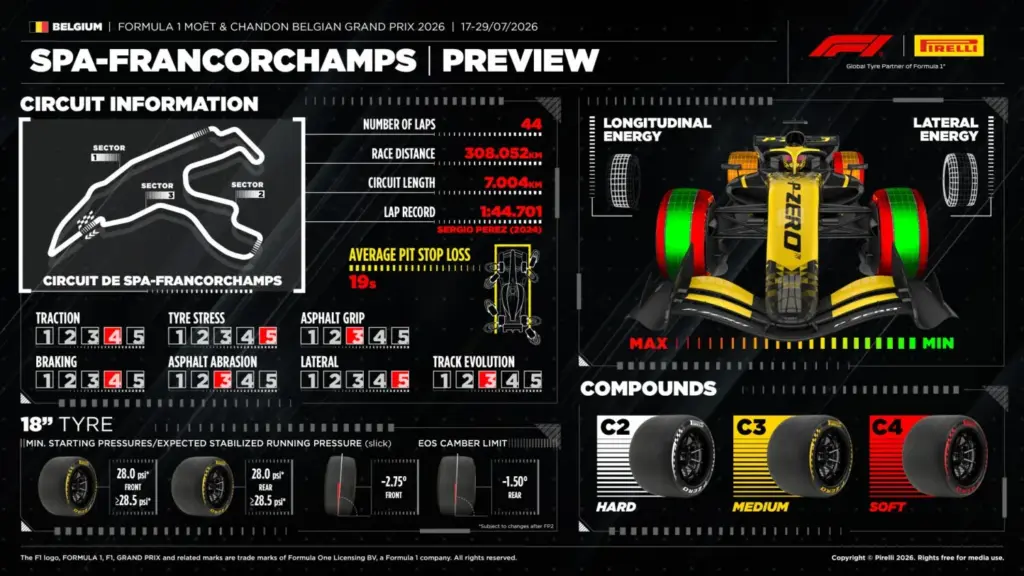
With its 7.004 kilometers, the Belgian track is the longest on the calendar. Present in the world championship since 1950, and previously since 1925, it captivates as much by its history as by its unique profile, combining long straights, fast corners, and significant elevation changes.
Hard tires on the slide
As often in the Ardennes, the weather could play a major role. The circuit benefits from a particular microclimate, which favors very changeable conditions. In case of rain, some sections can dry quickly while others remain wet, considerably complicating the choice of tires between slicks and intermediates.
For this event, Pirelli has selected the C2, C3, and C4 compounds, the three hardest available mixes. Spa is among the most demanding circuits of the season for tires, even if the stresses remain slightly lower than those encountered at Suzuka or Silverstone.
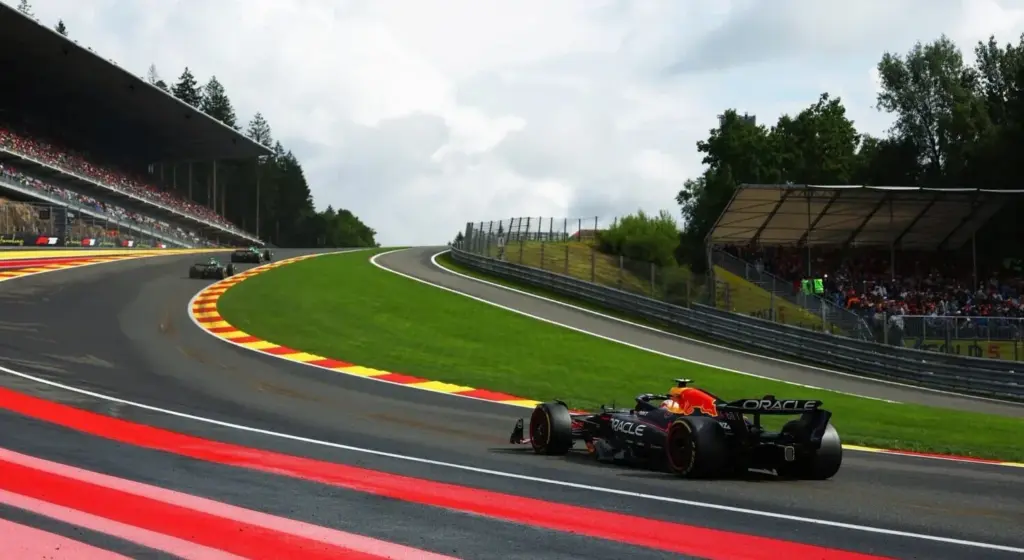
The most iconic sector remains the Eau Rouge-Raidillon sequence, where the cars climb a steep hill at very high speed before emerging onto the long Kemmel straight. This section was recently equipped with grooves in the asphalt to improve water drainage and visibility when conditions are wet.
A circuit with three faces
The surface, completely redone two years ago, generally offers little grip at the start of the weekend. However, this should improve thanks to the passage of the 24 Hours of Spa, held at the end of June, which deposited more rubber on the track.
Read more Loïc Serra, the man behind Ferrari’s technical revival in collective form
The three sectors of the circuit have very different characteristics: the first sector favors top speed with several long straights conducive to overtaking, then the second sector is much more technical, with a succession of fast corners and downhill curves, and finally the third sector is smoother and develops on a slight uphill to the finish line.
Finding the right compromise between maximum speed and aerodynamic downforce remains one of the main headaches for engineers. The new aerodynamic rules introduced this season could, however, facilitate this work. Teams will be able to use more downforce in the twisty parts while benefiting from low-drag mode on the long straights.
Heat could influence strategies
As at Silverstone, energy management will also be crucial. Drivers will have to optimize the deployment and recovery of electrical energy throughout the lap, Spa being among the most demanding circuits in this area.
Temperatures could finally have a significant impact on the race. During the last 24 Hours of Spa, held at the end of June, the track temperature exceeded 55°C. If such conditions recur, the thermal degradation of the tires could increase significantly, making a two-stop strategy more likely.
Whatever the weather conditions, Pirelli nevertheless expects the two hardest compounds in its range to play a central role during Sunday’s race, as was the case at Silverstone.
Read more Lewis Hamilton wants to bounce back at Spa after his disappointment at Silverstone