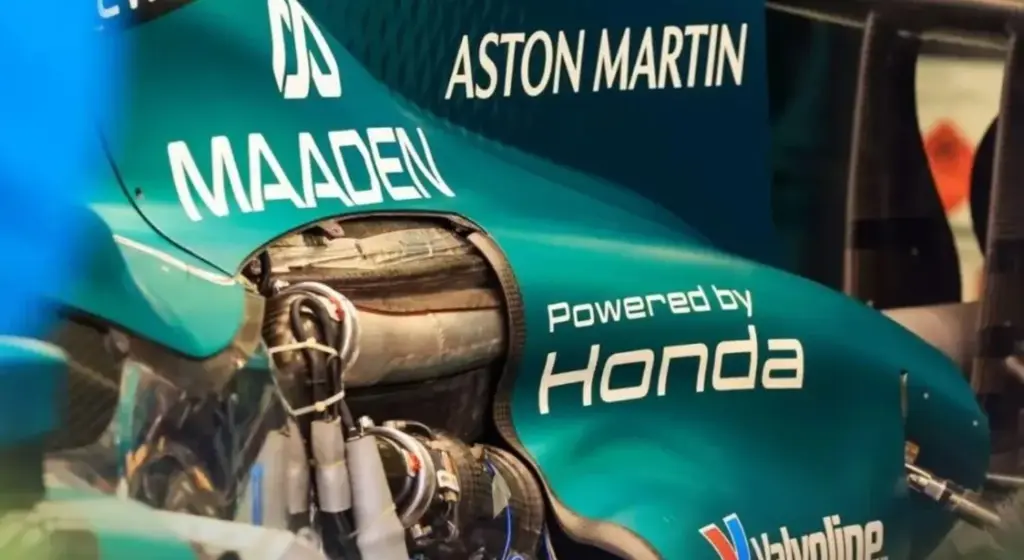
The Hungarian Grand Prix marked a real turning point for Aston Martin after months spent at the back of the grid and questions about the effectiveness of its simulation tools: now it’s Honda’s turn to act!
Read more Max Verstappen and Toto Wolff in Sardinia: a meeting that fuels rumors…
The Silverstone team has finally seen the first concrete effects of the extensive development program for its AMR26.
The new chassis met expectations, to the point of convincing Fernando Alonso that the next step now rests with Honda, expected to bring a major evolution of its power unit.
Honda expected to deliver at Zandvoort
The Japanese manufacturer does not hide it: it also feels this pressure as its new engine is about to make its first kilometers during a promotional filming day before its competitive debut scheduled at Zandvoort.
Aston Martin’s progress has not gone unnoticed in the paddock. Carlos Sainz even went as far as to say that the British team now has the best midfield chassis, proof of the leap forward made thanks to the major technical overhaul introduced in Hungary.
“I don’t think so,” says operations manager Mike Krack. “We will know during the next races if we have really made a step forward in terms of performance or not.”
The next step is already planned. The day after the Grand Prix, Honda completed the first laps with its new engine specification during a filming day limited to 200 kilometers at the Hungaroring, a seemingly positive test.
Major engine upgrade
This upgrade, credited with an additional 30 to 40 horsepower, will then make its race debut at Zandvoort after the summer break.
Fernando Alonso acknowledges that expectations are now high: “There is a bit of pressure on Honda. We are a team and we work together. Honda has been helping us since the beginning of the year to solve the car’s weaknesses and, on our side, we have helped them with stint consistency, energy deployment, and software.”
For Alonso, this collaboration is just beginning: “The road is still long and we know it, but we hope this is only a first step to allow both factories to work with more confidence. That is the most important.”
Read more “A bit too dramatic”: Max Verstappen puts the criticism of Red Bull starts in check
A correlation finally restored
Another source of satisfaction concerns the correlation between factory simulations and the performance observed on track, a problem that had been handicapping Aston Martin for many months: “What we saw in Hungary more or less matches what we expected, because the correlation is good and performance has improved.”
The two-time world champion nevertheless reminds that the development of this new car is only just beginning: “Of course, this is only the beginning with this new car, as it is also based on a different concept. There will still be tuning and optimization work, and we will also benefit from the engine upgrade. It will be an interesting test to see where we stand after the break and what it will allow us to aim for.”
At Honda, the message is similar. Honda Racing Corporation’s chief engineer, Shintaro Orihara, openly admits that the chassis progress now puts the engine in the spotlight.
“To be honest, yes,” he replies when asked about the pressure felt. “We are now back in the fight with the other teams. Every improvement is therefore very important to close our gap. Introducing this new power unit at Zandvoort is essential now that the chassis is working well. Our engine should allow us to gain time per lap. Before that, the filming day will be a first technical validation.”
Engine vibrations finally resolved
However, the Hungarian weekend was not perfect. During Friday’s free practice, vibrations on the Honda engine caused some concern.
Fernando Alonso was reassuring: “They were completely resolved on Saturday morning. We replaced the power unit with a newer one. It was perhaps an old engine that was having end-of-life issues, because everything went well on Saturday and Sunday.”
Orihara provided details on the origin of the problem: “These oscillations appeared because the engine temperature was not optimized in this new chassis. We adjusted some parameters and made considerable progress.”
With a chassis now considered competitive and an imminent engine upgrade, Aston Martin approaches the second half of the season with renewed optimism. The upcoming races will measure whether the progress glimpsed in Hungary marks the beginning of a real step change.
Read more Fred Vasseur defends Hamilton after his series of penalties