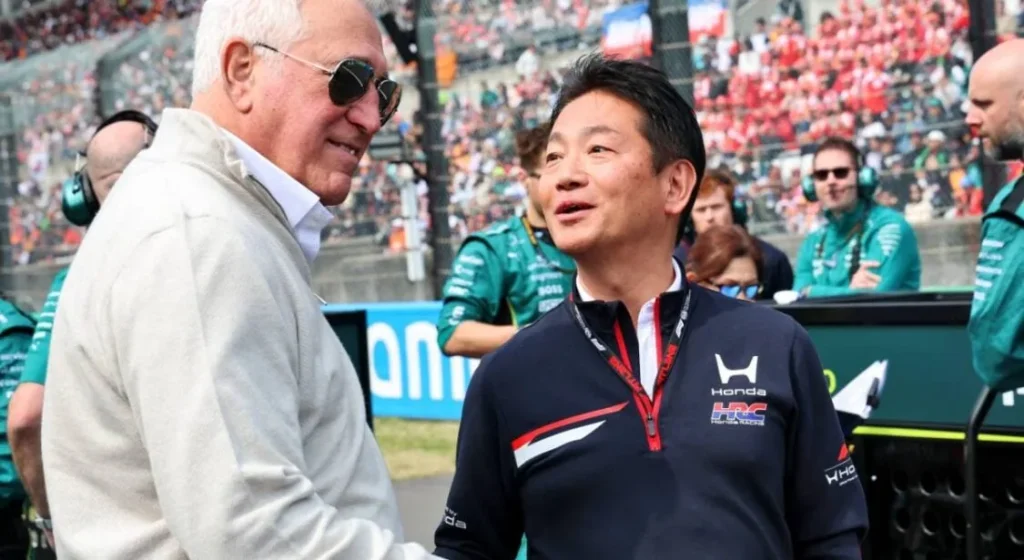
Aston Martin approached the Japanese Grand Prix knowing that their problems with Honda would not be well received by local fans, and the course of the race only confirmed the unease.
Read more Major upgrade for McLaren in Miami: enough to turn the tables?
Before the Japanese Grand Prix, Honda had acknowledged that the vibration problem at Aston Martin required more time to be resolved, thus reducing their expectations for improvement this season.
But it was above all the relationship between Honda and Aston Martin that raised concerns ahead of Suzuka, following Adrian Newey’s criticism of the engine manufacturer.
Whose fault is it?
However, the Japanese manufacturer denied any rumors of tension with its partner, emphasizing that both parties were working together to resolve these issues. And while Honda and Aston Martin remain clear about their future as partners, a recent internal change has been observed in the way they approach their concerns with their Japanese suppliers.
Aston Martin officials knew that comments like those Adrian Newey had previously made would not be well received by Japanese fans. They therefore established a policy of ‘silence’ on the subject.
“I think the local media and fans know well that Aston Martin itself is partly responsible for this situation. While Honda had to make significant changes to its engine planning, other manufacturers have been working in a consistent direction since the start of 2022, says Koji Watanabe, president of HRC (photo above). Criticism and the shifting of responsibility were therefore not welcome here at Suzuka, and Aston Martin understood this, adopting a calmer and more reasonable approach to the media.”
“The entire Aston Martin team focused on optimizing its engine performance and understanding the capabilities of a chassis that was still very uncertain after the first two races of the season, he added. The performance of Aston Martin-Honda at Suzuka was certainly not excellent, but at least we finished the race without major problems. So we can say that the policy of silence and focusing on the work has paid off.”
Read more Haas reserve Jack Doohan will discover endurance this weekend in Barcelona
Shared blame, according to Anderson
Discussing Aston Martin’s performance at the Japanese Grand Prix, Gary Anderson (former technical director at Silverstone in the last century, editor’s note) pointed out that their lack of pace compared to the top teams shows that the chassis is just as much to blame as the Honda engine problems.
“It is clear that the AMR26 is significantly slower on the straights, acknowledges Gary Anderson, former technical director at Silverstone (in the last century, editor’s note). Alonso, who was 2.731 seconds behind the fastest car in Q1, was 8.9 km/h behind the fastest car at the speed trap, 9.8 km/h on the start/finish line, 14 km/h at the end of Sector 1 and 8.8 km/h at the end of Sector 2.”
“These are significant gaps, but my calculations do not entirely explain the delay in Q1. Alonso was probably not much faster in the corners either, he estimates. If Honda has to catch up on a significant delay, Newey and his team must also extract more speed from the chassis. The AMR26 was designed according to the constraints of the chassis team, without compromise to adapt to the engine’s requirements, and features very interesting elements, such as the shape of the sidepods and the structure of the suspension arms, which are an important part of the aerodynamic package.”
Work to do before Miami
This analysis is not surprising, as Honda blamed the vibrations on Aston Martin after finding that engine improvements had only a marginal impact on race performance.
With the next Grand Prix not taking place until May, Aston Martin will have to work very hard with Honda to ensure that these problems are further mitigated by the Miami meeting.