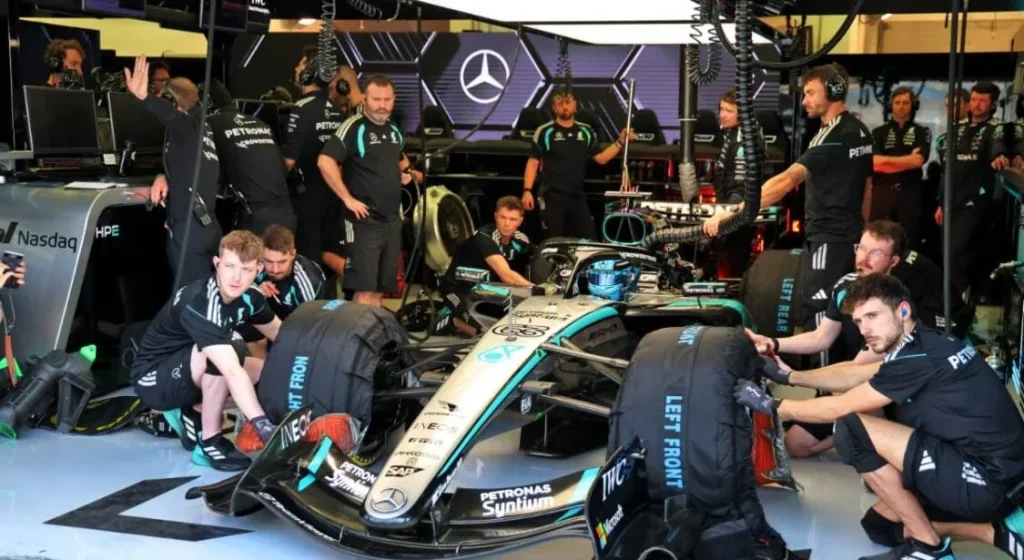
Despite their dominant performance in Australia, the season opener, Mercedes encountered some reliability issues in Melbourne, which forced them to replace several components.
Read more A first Sprint in 2026 on a demanding circuit for tires and energy
F1 power units consist of several elements: the internal combustion engine (ICE), the kinetic motor-generator unit (MGU-K), the turbocharger (TC), the energy store (ES), the control electronics (CE), and the exhaust (EX).
During the 2026 season, a driver cannot use more than four ICEs and turbochargers, three MGU-Ks, energy stores, and control electronics, as well as four exhaust sets.
However, given the new regulations put in place for 2026, an additional copy of each of these elements is considered a “bonus”.
Early replacements
Several drivers were forced to use new power unit components during the Australian Grand Prix, marking a first test of the new Formula 1 rules for 2026.
The new hybrid era introduces a more complex set of limitations, with each driver limited to four internal combustion engines (ICE) and turbochargers (TC), three kinetic motor-generator units (MGU-K), energy stores (ES), and control electronics (CE), as well as four exhaust sets (EX) over the season.
As the 2026 rules represent a major technological change, teams also benefit from an additional “bonus” for each component, offering them increased flexibility to adapt to the new systems. Next year, teams will have to finish the season with fewer components.
Read more The Chinese Grand Prix TV schedule
Tricky start for Mercedes
Despite this expanded allocation, five drivers needed new parts as early as the opening weekend. George Russell received a new energy store, new control electronics, and a new power unit auxiliary component, with Mercedes taking precautions to ensure reliability in the face of this unprecedented hybrid architecture.
His teammate, Kimi Andrea Antonelli, was equipped with two new power unit auxiliary components as part of a cautious approach for his first Grand Prix.
Williams made similar changes for Carlos Sainz, who also received a new energy store, new control electronics, and a new power unit auxiliary component to avoid any reliability issues early in the season.
Honda and Audi also affected
Aston Martin and Audi also made adjustments, with Lance Stroll and Gabriel Bortoleto each receiving a new power unit auxiliary component.
This first wave of component changes highlights the challenges teams face during the first race weekend under the 2026 regulations and underscores the crucial importance of careful power unit management throughout the coming season.
Read more Ferrari prepares the «Macarena» rear wing to challenge Mercedes at the Chinese Grand Prix