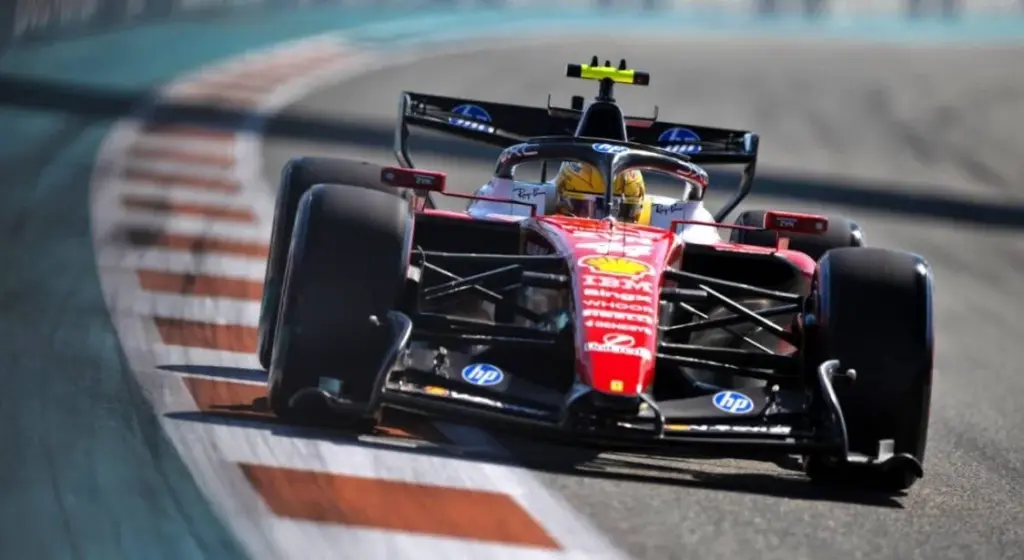
The upgrades introduced by Ferrari in Miami have significantly improved the SF-26 in corners. But the data also reveals a much deeper problem: the red car continues to lose a lot of ground to Mercedes on the straights.
Read more Formula 1 drivers raced the 24 Hours in the “Green Hell” before Max Verstappen
The set of new features introduced by Ferrari in Miami pursued a dual technical objective: increase aerodynamic downforce to maximize the SF-26’s efficiency in corners, while reducing drag to limit the deficit on the straights.
Because despite its qualities in winding sections, the Ferrari still suffers from a significant disadvantage compared to Mercedes during acceleration and at full throttle. Part of the problem would come from an estimated engine deficit of about 30 horsepower on the thermal engine side.
Miami therefore represented a particularly important test for Maranello, especially since Mercedes had not yet introduced the major upgrades planned for the W17, expected later in the season, notably in Montreal.
The Prancing Horse thus had a rare technical window to try to reduce the gap thanks to a set of new features affecting several areas of the car: front wing, deflectors in front of the sidepods, floor, diffuser, and the use of the famous “Macarena” wing.
Slow corners remain the strong point of the Ferrari SF-26
The weekend data shows that Ferrari has not lost its main asset. Quite the opposite.
In qualifying, Andrea Kimi Antonelli outpaced Charles Leclerc by 0.345 seconds. But in slow sections, the Ferrari continued to gain several tenths on the Mercedes.
This point is particularly interesting because it shows that the engineers at Maranello did not simply “unload” their car to gain top speed. The SF-26 maintains a very good level of mechanical and aerodynamic grip in slow corners, with effective rotation and a still competitive minimum speed.
The upgrades therefore seem to have preserved — or even strengthened — the car’s efficiency in sections where downforce and grip play a major role.
The real problem appears during acceleration
Where Ferrari continues to lose a lot of ground is in the transition between corner exit and full acceleration.
According to the analysis of the Miami data, Antonelli gained nearly seven tenths on Leclerc on the straights. A gap that cannot be explained solely by the engine power deficit.
The problem also seems linked to a too high resistance to advancement (the famous “drag”) of the Ferrari SF-26, a defect already identified for several weeks. The rotating rear wing used in Miami — nicknamed “Macarena” — certainly helped reduce some of the drag, but not enough to close the gap with the Silver Arrows.
Read more Half a billion dollars invested in the project of a new circuit in Denmark
The overall reading of the package then becomes quite clear: Ferrari managed to improve the car’s behavior in corners, but without solving the structural limits of the SF-26 in traction and full-throttle progression phases.
Worrying numbers in race pace
The race confirmed this trend even more clearly.
Over long stints, Ferrari lost about half a second per lap to a Mercedes that was almost frozen in terms of development.
The speed figures are particularly revealing. Mercedes had about an 8 km/h advantage on median top speed; and the gap still exceeded 2 km/h on average full-throttle speed.
The most interesting detail concerns throttle usage. Ferrari spends no less time at “full throttle” than Mercedes. The SF-26 even opens the throttle slightly longer than Antonelli’s and Russell’s W17s.
In other words, the problem does not come from a later throttle application.
The real deficit appears when the Ferrari accelerates: the car generates less speed and less progression than the Mercedes. The SF-26 seems to struggle to convert its level of downforce into effective acceleration.
This difficulty is regularly accompanied by significant wheelspin during torque unloading, which heavily stresses the tires over long stints.
Miami confirms that Ferrari has only passed a first step
The upgrades introduced in Florida were not a miracle solution to the SF-26’s problems, and Ferrari was aware of that.
The package seems to have worked in corners, where the car now appears more efficient and stable in rotation and grip phases. However, the car’s limits on the straights remain extremely visible.
The real corrections are now expected later in the season, notably between June and July, with the first major upgrades on the powertrain side.
Miami therefore mainly showed a Ferrari capable of improving certain aspects of its car, but still far from having solved the main structural problem of its SF-26.
Read more Charles Leclerc does not dream of Schumacher’s records, but only of a world title