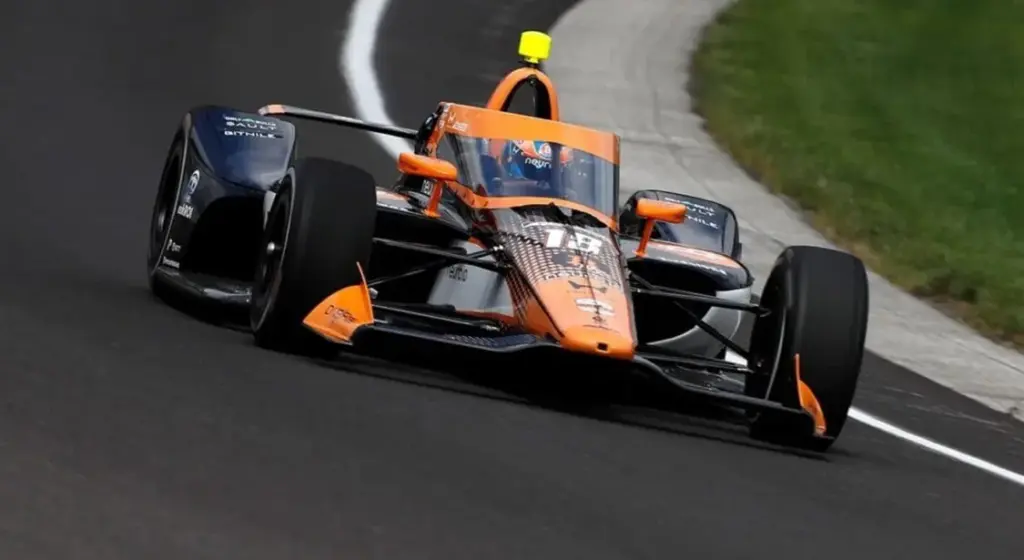
May is synonymous with Indianapolis in the United States with the Indy Grand Prix on the road circuit this weekend, followed by qualifying and the Indy 500 shortly after: an opportunity to discuss this alternative to F1.
Read more Oscar Piastri is already wary of Mercedes: «We’ll see what it’s worth»
In May, do as you please, as the saying goes: in the USA, this inevitably means the Indianapolis speedway, home of the famous 500 Miles, the oldest automobile race in history, with the first edition dating back to 1911.
The Indy 500 even counted towards the world drivers’ championship (as it was called at the time) in the 1950s, before the arrival of Formula 1 in the States.
Apples and oranges
Comparing the Grand Prix and the 500 Miles doesn’t really make sense because the two disciplines are culturally very different. On one side, the priority is given to the most sophisticated technology, and on the other, it’s the notion of spectacle that rules.
While F1 pits the best drivers in the world against each other in very different single-seaters with engines supported by major manufacturers, IndyCar uses spec chassis supplied by Dallara and two engine partners, Chevrolet and Honda. Moreover, the specificity in North America lies in the variety of circuits, from ovals where dizzying speeds are reached to road or street circuits more comparable to those visited by F1.
The sporting and technical level is probably less professional and certainly less perfectionist in IndyCar than in Formula 1, but sometimes more spectacular. Ten or fifteen drivers are capable of winning at the start of each race, which is obviously not the case in the Grand Prix.
Read more Juan Pablo Montoya adds fuel to the fire against Verstappen despite the controversy
An alternative for some drivers
The greatest drivers have crossed the Atlantic one way or another to compete against the best in both championships, whether at the beginning or end of their careers. Mario Andretti won the Indy 500 in 1969 and then competed in F1 without really giving up American competitions. More recently, Jacques Villeneuve and Juan Pablo Montoya first shone in IndyCar before moving to the Grand Prix with the success we know.
Conversely, stars like Emerson Fittipaldi or Nigel Mansell came to the other side of the Atlantic covered in F1 glory before also winning at Indianapolis. On the French side, IndyCar (or Champ Car at the time) succeeded for Sébastien Bourdais, then snubbed by Formula 1, while Simon Pagenaud headed west without hesitation to embrace a remarkable American career. Finally, more recently, it is Romain Grosjean (photo above) who is extending his career in IndyCar after ten seasons in F1.
Our experts Ziv Knoll and Pierre Van Vliet discuss this in our latest video show in collaboration with the site The Human Side of Racing.
To follow on TV
This very busy May will be followed starting this Saturday during the Indy GP held on the road circuit in the center of the speedway, before the Indy 500 qualifying the following weekend and finally the glorious 500 Miles on the last Sunday of the month as per a century-old tradition.
On television, Canal+ Sport offers the entire American championship live, while in Belgium, VOO Sport World provides extensive coverage of IndyCar with long summaries on Wednesday evenings and live Indy 500 on May 25th.
Read more Verstappen pushed towards Ferrari: «He would be more comfortable than with Mercedes»