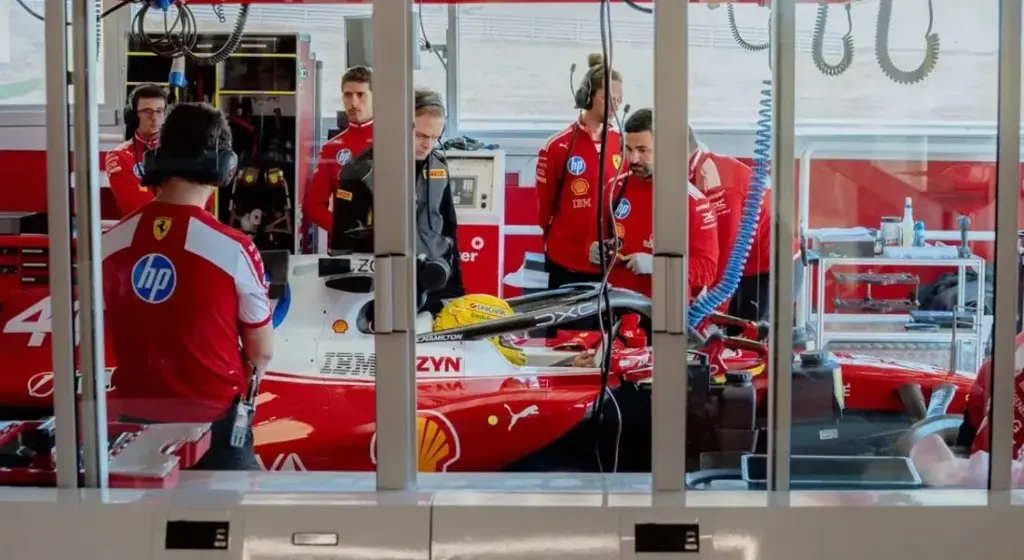
Two days of testing as part of a promotional shoot are on the Scuderia Ferrari’s schedule this week in Monza, but every lap is used to continue making progress.
Read more F1 driver market: Verstappen ready to unleash total «madness»?
Technical Director Loïc Serra confirmed that Ferrari remained strictly faithful to its roadmap during the April break, continuing in parallel the development of the SF-26 and the future 2027 project without deviating from its initial strategy.
According to him, this type of planning is long-term and cannot be impacted by the cancellation or occasional absence of certain races: “Your development plan is not built in a week or a month,” he explains, insisting on the discipline needed not to give in to calendar uncertainties.
Reflection and Orientation
The French engineer recalls that the development of the SF-26 began at the start of 2025, illustrating the very extended temporality of technical cycles in Formula 1, where a single-seater is designed and optimized over more than a year even before being actually used in race conditions. In this context, on-track data collection becomes a critical factor.
Serra emphasizes that each lap completed improves the overall understanding of the car, tires, and their interaction. Conversely, a reduction in running — like that observed recently — mechanically slows down this learning process.
Read more Adjustments to the 2026 regulations are a first step: permanent evolution
He also highlights the importance of competitive intelligence in a team’s technical evolution. Observing innovative solutions on rival cars can guide certain development decisions, provided they are integrated coherently into one’s own concept.
Managing the Schedule
However, Serra insists on a fundamental point of organizational engineering: the strict separation between short-term and long-term projects. Without this discipline, emergencies related to immediate performance risk compromising the structural advances necessary for the future, particularly in view of upcoming regulatory changes.
Finally, he acknowledges that the absence of certain races has a concrete impact on the available database. While Ferrari already has a good understanding of circuits like Bahrain thanks to winter testing, other tracks — like Jeddah — represent gaps in terms of data on tires, specific conditions, and track characteristics. A deficit that could, in the short term, limit the precision of development and settings, but this is also true for the competition.
Read more Formula 1 drivers in the crosshairs of the Italian tax authorities: rich people’s problems!