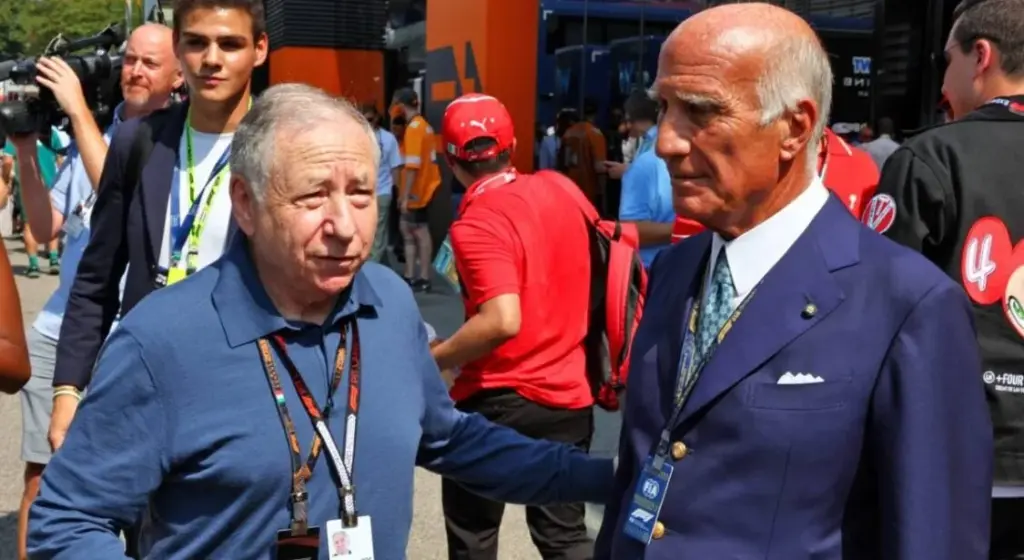
Jean Todt’s testimony sheds light on a quite fascinating moment in modern Formula 1 history, as it reveals that a completely different scenario could have unfolded for Red Bull Racing.
Read more Despite some minor issues, Oscar Piastri enjoyed the Pirelli test at the Nürburgring
At the end of his cycle at Ferrari — a 16-year period marked by historic dominance notably with Michael Schumacher — Todt was an extremely sought-after figure.
Dietrich Mateschitz, in the midst of building his F1 project after acquiring Jaguar, saw in him the ideal leader to structure his entire motorsport program.
No better than Ferrari
Mateschitz’s insistence, going so far as to personally travel to Paris several times, shows how much he considered Todt a strategic piece: “Although he hated traveling, Dietrich came to see me twice in Paris to try to convince me, recounts the French executive. But I had a different perspective after having won everything with the most iconic brand in the sport.”
Todt’s refusal is primarily explained by a personal trajectory logic. After reaching the top with Ferrari, he felt he could not do better and chose not to start a new operational cycle as demanding.
Read more Another «nail in the coffin» for Red Bull in F1?
This is a typical end-of-executive-career decision: avoiding the risk of tarnishing an image by trying to replicate a success that is hard to equal in a different context.
A different path
This choice had major indirect consequences. Red Bull ultimately continued with Christian Horner, appointed in 2005, and history has shown that this decision was formative for the team’s culture. It is reasonable to think that Todt’s arrival would have profoundly changed the project’s DNA: probably more structured in the manner of Ferrari, but perhaps less agile in its early years.
For his part, Todt shifted towards an institutional dimension by becoming president of the Fédération Internationale de l’Automobile in 2009. This repositioning allowed him to have a global impact on the sport rather than being limited to a single team: a form of logical continuity after having already won everything at the operational level.
This refusal illustrates a key point: some decisions in F1 are not only about performance or ambition, but also about personal timing and managing a legacy. And in this specific case, it indirectly helped shape two major trajectories: that of Red Bull… and that of the sport’s governance.
Read more Alpine brings Rosso to Enstone: a strong signal from Renault?