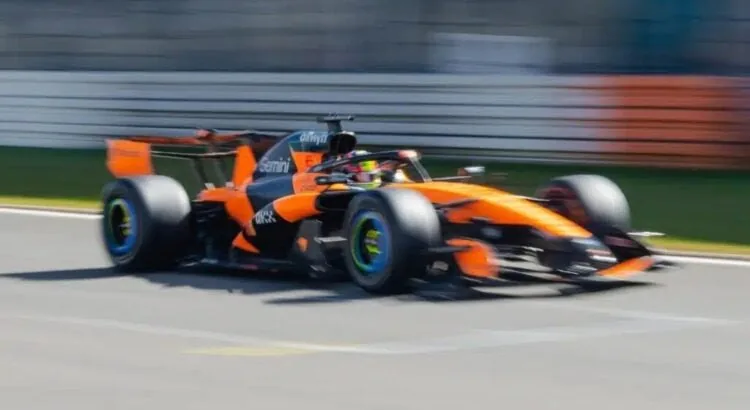
The return of Formula 1 to the Nürburgring, even within the framework of Pirelli tests, had symbolic and technical value, but Oscar Piastri’s day was heavily disrupted although very useful.
These two days of tire tests replaced those planned in Bahrain in March and concerned the teams Mercedes and McLaren with their regular drivers who were able to shake off rust during this forced five-week inactivity period before the F1 season resumed in Miami in early May.
On the first day, held in initially wet conditions, Piastri and George Russell started with installation laps on intermediate tires before switching to slicks as the track dried.
Lack of running
Both drivers completed several short stints with different versions of the C3 compound, in a typical tire development program. But while Russell was able to continue with long stints in the afternoon — setting the best time in the process — Piastri was sidelined for a large part of the session due to an unspecified technical issue.
This setback is all the more penalizing for the Australian as he is going through a difficult start to the season, with very little actual running in race conditions. In this context, every kilometer is critical, even in a test as controlled as Pirelli’s, especially in the phase of warming up the tires.
Read more Alpine brings Rosso to Enstone: a strong signal from Renault?
As he himself explained, these days do not allow working on pure performance — settings being strictly limited — but they remain essential to validate systems, refine ergonomics and above all accumulate track time with a car still recent in this regulatory era.
Understanding the tires
The key point is the very nature of these tests: they are focused on tires, which greatly reduces the teams’ freedom. It is impossible to test major developments or deeply modify settings. On the other hand, this allows consolidating the overall understanding of the car, which is particularly valuable early in the season, especially with 2026 cars very sensitive to energy parameters and track conditions.
For Piastri, the benefit therefore remains limited but not zero: even a few stints allow improving the feel and correlation between simulator and track. Nevertheless, compared to Russell — who was able to run a complete program — McLaren leaves with a slight operational deficit for its Australian driver.
The second day of the test, with Lando Norris and Kimi Antonelli at the wheel, was therefore important to maximize the data collected. In an environment where every detail counts, losing half a day of running may seem minor, but in the current phase of understanding the 2026 cars, it is far from trivial.
Read more A regulatory «miracle» in Miami? The head of Racing Bulls tempers expectations