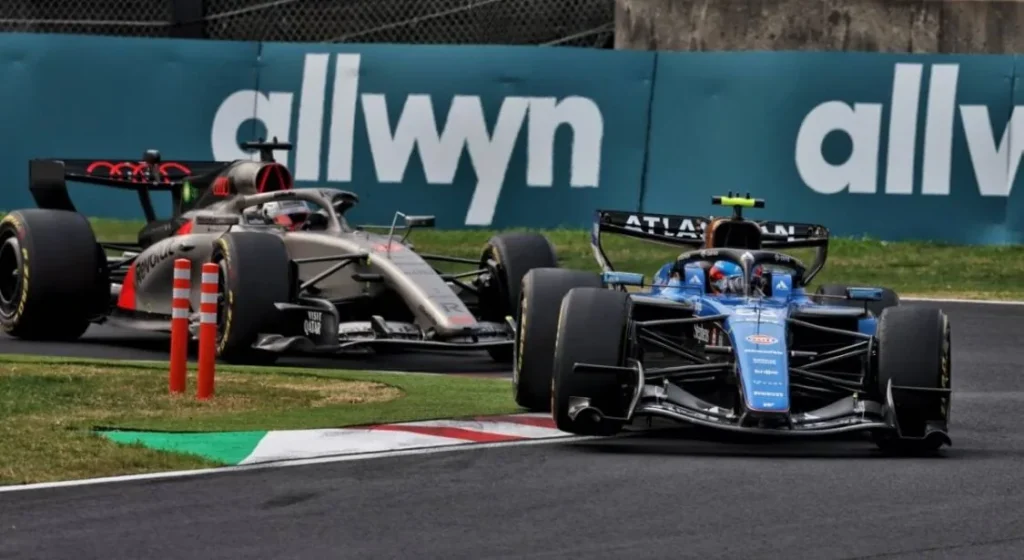
For Carlos Sainz, what was supposed to be a solid second season at Williams is starting to look like a professional dead end, and according to Martin Brundle, the exit could be closer than expected.
Read more Haas F1 fourth in the constructors’ championship: David vs. Goliath
With a tone almost tinged with sympathy, the Grand Prix commentator at Sky Sports F1 paints a worrying picture of Sainz’s current situation at Williams: a team struggling to find its feet under Formula 1’s new rules, and offering little immediate hope.
The Spaniard’s move to the British team seemed, on paper, to be a long-term bet. Ousted from Ferrari at the end of 2024, Sainz had signed a multi-year contract with Williams, betting on a renaissance in this new era.
A harsher reality than expected
But the reality has proven more difficult: Williams’ pre-season was compromised before it even began, due to failed FIA crash tests and a car that was apparently too heavy compared to the regulatory limit.
On the track, the difficulties are just as marked: the team regularly finds itself in the second half of the pack, just ahead of rivals like Aston Martin, Audi, or Cadillac (photo above).
Sainz has managed to scrape together a few points, but the overall trajectory remains concerning. And as Brundle points out, the real problem isn’t limited to performance; it’s what comes next.
“Where would Carlos go?”
Brundle’s central argument is brutally simple: even if Sainz wanted to change teams at the end of the season, almost all doors are closed elsewhere.
“Where would Carlos go? He’s been at McLaren, he’s been at Red Bull with Toro Rosso back in the day. He’s been at Ferrari and now Williams,” explains the former Grand Prix driver. “There’s no room at Mercedes. He’s obviously already driven for Renault, now Alpine. It’s hard to know where he could go to find better without revisiting places where, for one reason or another, he wasn’t invited to stay.”
It’s a blunt inventory of an already full career that, paradoxically, is now working against Sainz rather than in his favor. Having already driven for most of the grid’s top teams, the Spaniard finds himself in an unusual position: experienced, but, paradoxically, with few options.
Read more Helmut Marko wants to give priority back to driving
Talent to spare… with no clear way out
Brundle is careful not to downplay Sainz’s abilities, but his analysis reflects a certain realism about the driver’s position in the F1 hierarchy.
“So it’s really complicated for him,” he adds. “I sympathize, because while I don’t think he has the absolute talent of a Verstappen and the like, he’s a fighter. He’s like his father – uncompromising – and it often shows. Some of the races he’s won have been absolutely remarkable, so it would be a shame. He’s in a dead end because he’s already driven for almost half the teams on the grid during his career.”
This expression – “in a dead end” – sums up the dilemma well: Sainz is respected, proven, and resilient, but not enough to guarantee a seat at the front of the pack. In a sport where timing is crucial, his situation has rarely seemed so precarious.
Waiting for the improbable
For Brundle, there is only one realistic way out: something unexpected.
“And so, unless an opening arises unexpectedly, for example, if Red Bull suddenly needs someone because Max decides to do GT or sim racing for a year or two, I don’t know what else he could do,” Brundle concludes.
It’s a hypothetical scenario that highlights the lack of concrete opportunities. For now, Sainz seems tied to a project that is stalling, and on a grid where mobility is limited and contracts are long, patience might be his only option.
But in Formula 1, patience can be costly. And as Williams continues to struggle, the concern isn’t just about current results; it’s about what those results could mean for a driver who suddenly finds himself without an obvious prospect.
Read more Formula 2 and F1 Academy out in Montreal to compensate for cancellations