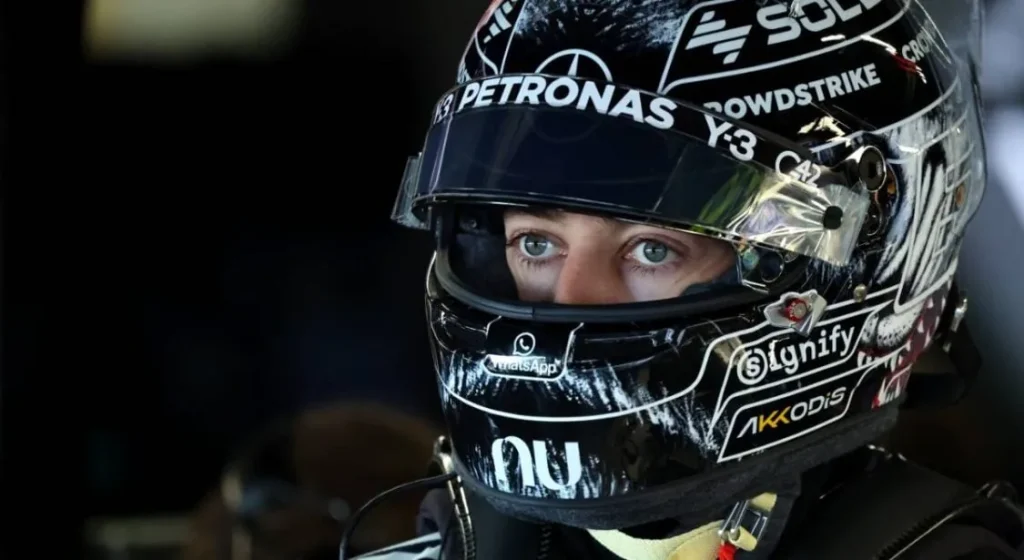
Despite an initial adjustment at Suzuka, George Russell believes that F1 has not gone far enough to correct the problem of “super-clipping”.
Read more Lando Norris on the brink of a penalty: McLaren is already playing with fire in 2026
Formula 1 has already reacted, but for George Russell, it is not yet enough. On the occasion of the Japanese Grand Prix held at the Suzuka circuit, the FIA decided to reduce the energy available in qualifying, from 9 to 8 megajoules.
A change introduced to limit the controversial phenomenon of “super-clipping”, which has become very visible with the new 2026 rules. However, despite this adaptation, the Mercedes driver believes that the problem is only partially resolved and that a more radical approach would have been preferable.
“Super-clipping” still at the heart of the debate
This technical phenomenon is raising more and more questions in the paddock. On circuits like Suzuka, where heavy braking zones are rare, the cars struggle to recover enough energy via conventional systems.
Result: drivers find themselves at full throttle… while losing speed. The cause: hybrid systems that recover massive amounts of energy — up to 250 kW out of the 350 kW available — causing a sudden drop in straight-line performance.
This situation creates unusual speed gaps and disrupts driving, particularly when approaching fast corners, which has fueled criticism from many drivers since the start of the season.
Russell validates the decision… but wants more
Despite his reservations, Russell recognizes that the reduction to 8 MJ is a step in the right direction. The Briton, championship leader and in particularly good form at Suzuka, does not hide the fact that an even greater reduction would have improved the situation further.
Read more Verstappen reassured: Red Bull’s weight problem less critical than expected
“The move from 9 to 8 MJ was clearly the right decision, he judges. But we could probably have gone even further. It would have slightly slowed lap times, perhaps by about a second, but the extreme variations in speed would have been less marked.”
The Mercedes driver points in particular to the performance losses at corner exits, which he believes are relatively easy to correct in the short term. But for him, the real issue lies elsewhere: making driving more natural and consistent.
“Coming out of the last corner, I was losing about two to three tenths, but that’s something that can be corrected quite easily for qualifying. Generally speaking, I think we can afford to reduce the available energy even further.”
A debate that is only just beginning
This stance restarts a broader debate on the balance between technology and driving in Formula 1. While the new rules aim to enhance energy efficiency, they profoundly change the sensations on track.
With several drivers already critical, including Russell, it is likely that the FIA will continue its adjustments in the coming weeks. Suzuka could well be just a first step in the evolution of these still young… and already much-discussed regulations.
Read more Max Verstappen hits rock bottom at Suzuka: a rare humiliation that confirms the Red Bull crisis