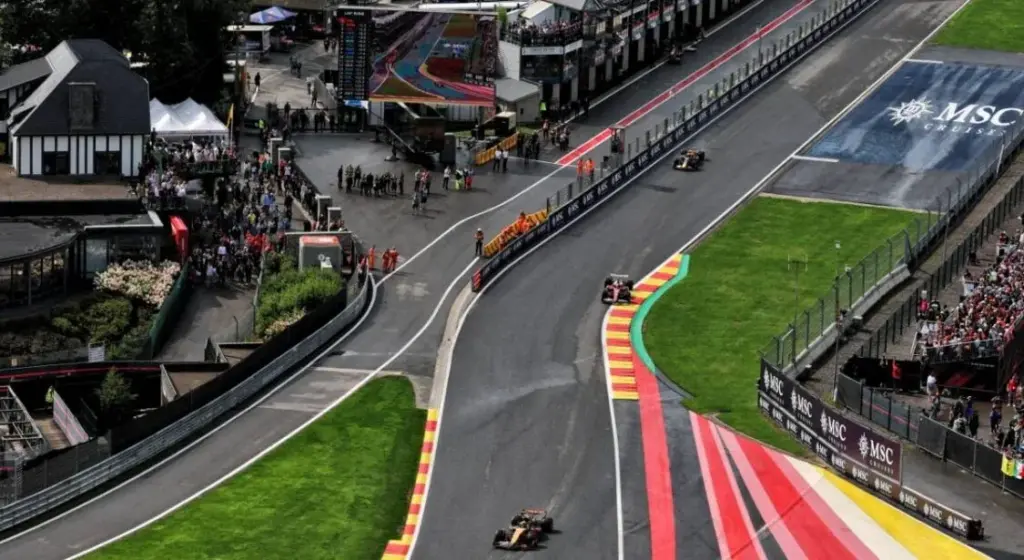
The Spa-Francorchamps track promises to be a real test for the new single-seaters. Andrea Stella fears that energy management will take precedence over real on-track duels.
Read more Oscar Piastri identifies weather conditions as one of McLaren’s weaknesses
The Belgian Grand Prix could highlight one of the main flaws of the 2026 regulations. With its long straights and a profile particularly demanding for hybrid power units, Spa-Francorchamps should push teams to their limits in terms of energy management.
Andrea Stella, McLaren’s director, believes that the Belgian race could once again demonstrate that overtaking is more dictated by energy deployment than by the pure performance of the drivers.
Spa, a major challenge for energy management
Since the introduction of the new power units in 2026, drivers must constantly juggle between recovering and using electrical energy. This constraint sometimes forces them to lift off in unusual parts of the circuit to recharge the battery before long accelerations.
Spa-Francorchamps is one of the most demanding circuits in this area. The long full-throttle sections, such as the climb to Les Combes or the Kemmel straight, make energy management particularly complex.
Unlike Silverstone, where the Sprint format allowed teams to gather a lot of data before the main race, the Belgian weekend follows a classic format. Teams will therefore have less information to refine their strategy.
Easier overtakes… but less natural
While overtakes have been numerous in recent races, Andrea Stella believes their nature has changed.
According to the McLaren boss, the speed gaps generated by energy deployment are sometimes so significant that they reduce the intensity of on-track battles.
“Spa will be an interesting circuit for everyone. Like Silverstone, it will be very demanding in terms of energy management.”
The Italian executive also recalls that his drivers, Lando Norris and Oscar Piastri, expressed their concerns after the British Grand Prix.
“Our drivers told us that speed differences were sometimes very unpredictable. When they report this kind of problem, you have to listen to them because they have good reasons to do so.”
Read more Guenther Steiner calls for permanent stewards and AI assistance in Formula 1
He expects to face the same difficulties in Belgium, where the straights are even longer.
“At Spa, the straights are longer and we will have to deal with new challenges regarding power unit usage. Managing energy deployment will be crucial.”
Five Straight Mode zones, a shared record
The Belgian circuit will feature five Straight Mode zones, an unprecedented number since the season opener in Melbourne. Drivers will be able to activate their active aerodynamics between La Source and Eau Rouge, then again on the Kemmel straight, before new zones towards Stavelot and the Bus Stop.
This increase in activation zones could also change the teams’ technical choices.
Spa-specific wings soon useless?
Traditionally, Spa pushed teams to use low-drag aerodynamic configurations to maximize top speed.
With the arrival of active aerodynamics, this advantage could become much less important.
“We will see if some teams still bring low-drag configurations as in the past. With Straight Mode, there is now much less interest in using smaller wings.”
Andrea Stella believes this evolution could profoundly change the teams’ technical approach on the legendary Belgian circuit.
While the spectacle should be guaranteed thanks to many overtakes, the McLaren boss fears that these will be more dictated by energy constraints than by driving skills, thus illustrating one of the main limits of the new rules introduced in Formula 1 in 2026.
Read more Williams wants to take advantage of Spa to progress: James Vowles hopes to exploit the data