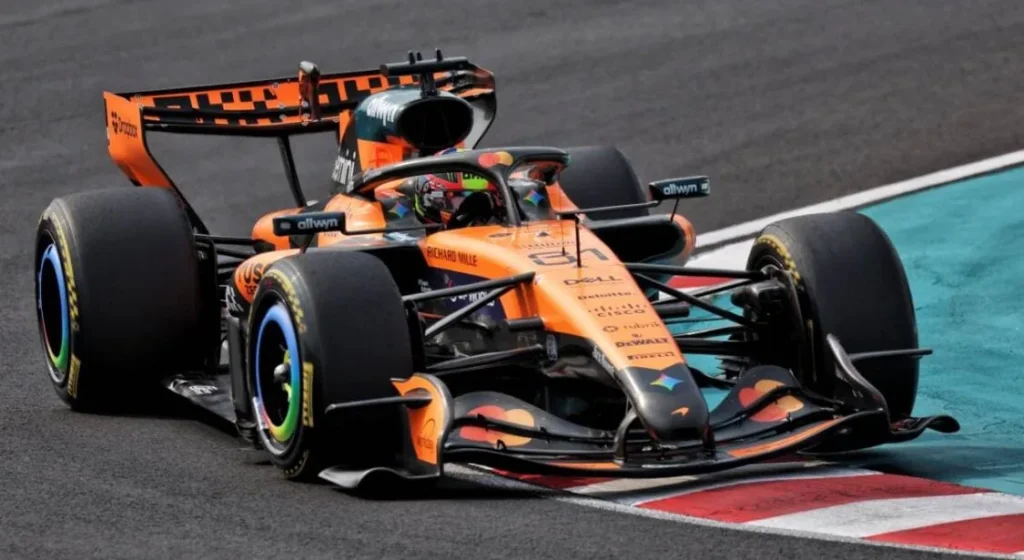
Oscar Piastri finally unlocked his season at the Japanese Grand Prix with a solid second place, built on a well-executed start, an area in which he had been struggling this season.
Read more Audi impresses: Gabriel Bortoleto in the top 10, Nico Hülkenberg in the middle of the grid
The McLaren driver reacted perfectly to the lights going out this time, immediately taking the lead and settling into the front of the race during the first stint.
A position he managed to control with mastery, notably against George Russell, who remained in his wake without ever posing a direct threat.
A controlled race… until the neutralization
Piastri then seemed to be engaged in a potentially winning scenario. His pace was solid, his tire management clean, and track position — crucial at Suzuka — clearly played in his favor.
But the safety car intervention completely reshuffled the deck. Like several leaders, the Australian saw his strategic advantage disappear, notably allowing Kimi Antonelli to return to the race for victory thanks to a perfectly timed stop.
“It would have been very interesting to see what would have happened without that. I would have had George behind and I would have had a chance to keep him behind”, explains Piastri, aware that the course of the race partially escaped him due to this external factor.
Read more The exploit of Arvid Linblad, the Suzuka rookie
A logical but measured frustration
Second at the finish, Piastri shows a contained frustration, revealing a driver now in a position to play a leading role: “It’s a shame not to see what could have happened, but being disappointed to finish second is positive”, he emphasizes — a statement that clearly reflects the Australian driver’s change in status. Having long struggled to convert his performances, he now seems capable of turning his opportunities into solid results.
Beyond the raw result, Piastri highlights the quality of his team’s collective work: “A huge thank you to the team who executed the race very well and did a very good job.”
Strategically clean, without major errors, McLaren maximized its potential on a circuit where overtaking is particularly difficult, which reinforces the value of this second place.
Still a deficit in pure performance
Despite this encouraging result, Piastri remains clear-eyed about the current hierarchy: “We still need to find a bit more performance, but at least we managed to make the most of what we had.”
An important observation: while McLaren is now capable of perfectly exploiting its opportunities, it still lacks a slight advantage in pure pace to systematically compete with Mercedes on this type of track.