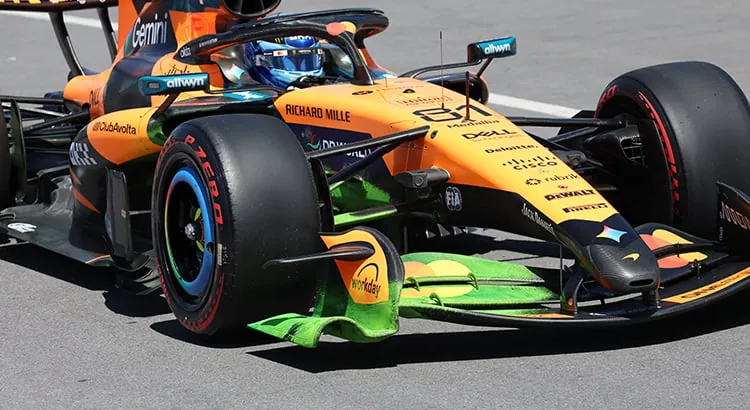
McLaren arrived in Montreal with a significant aerodynamic package aimed at bringing the MCL46 closer to Mercedes, but a key part has already disappeared: the new front wing, deemed insufficiently effective after the free practice sessions.
McLaren’s technical offensive at the Canadian Grand Prix experienced an unexpected first setback.
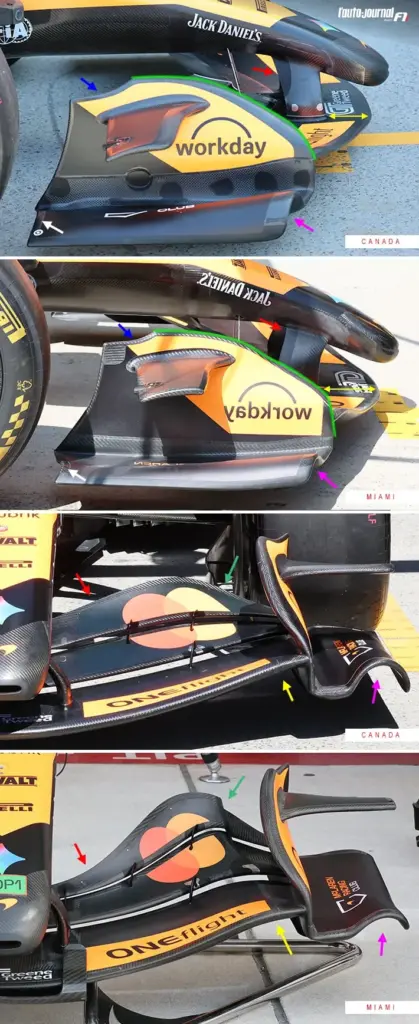
Introduced on Friday as part of a large aerodynamic package and described in our exclusive image below, the new front wing of the MCL46 was removed as early as the Sprint qualifying, the team considering that it did not produce the expected performance gains.
Lando Norris ran with this new specification during the only free practice session of the weekend, while Oscar Piastri started the session with the old front wing before making a direct comparison by switching to the new version.
But the drivers’ feedback quickly led McLaren to revert to the previous specification. After the Sprint qualifying, concluded with Norris in third position and Piastri in fourth, both cars seemed set to keep the old wing until the end of the weekend.
“The front wing did not quite deliver what we expected and we ultimately decided to use the previous specification, which gave the drivers more confidence and allowed them to extract more performance,” explained Neil Houldey, McLaren’s technical engineering director.
A central part of a larger package
This withdrawal is all the more notable as McLaren considered this wing as a structural element of a wider development package, presented as the second phase of the major evolution started in Miami.
The new front wing featured visible changes, notably a revised profile of the side fins and a modified geometry in the endplate area to better condition the airflow towards the rest of the car.
Read more McLaren worries despite its developments: Lando Norris admits to a difficult Friday in Montreal
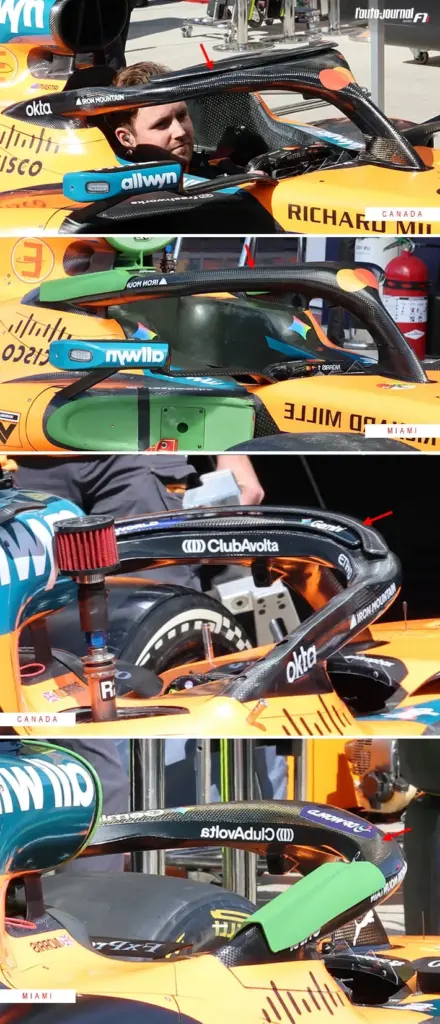
The package also included a new small wing on the halo (see below), aimed at improving the flow around the cockpit and engine cover, developments on the floor, new cooling options on the engine cover, as well as work on the rear suspension fairings and rear wing endplates.
One element, however, nuances the interpretation of the performance: all these developments were designed around the flows generated by the new front wing. By removing this part, McLaren potentially deprived its car of part of the expected aerodynamic benefit.
McLaren remains cautious
At McLaren, however, they refuse to draw definitive conclusions in a context considered atypical. Norris highlighted the specifics of the Montreal track, known for low grip and difficult to correlate with the team’s simulation tools.
“Some things were perhaps a bit more debatable and we probably need more time to analyze the data,” explained the Briton.
“It’s such a strange track, with very little grip. You bounce on the curbs and you don’t get a completely faithful representation of everything we observe in the wind tunnel.”
The World Champion thus believes that a reintroduction of some novelties could happen quickly, perhaps as early as the next round or, more likely, on a more conventional circuit like Barcelona, where McLaren hopes to get a clearer reading of the real potential of its evolution.
Despite this partial step back, Norris believes the rest of the package showed encouraging signs: “The rest of the car was clearly working well and I regained confidence in Q3, especially with the soft tires.”
Read more Lewis Hamilton makes his radical choice at Ferrari after a breakthrough in Montreal