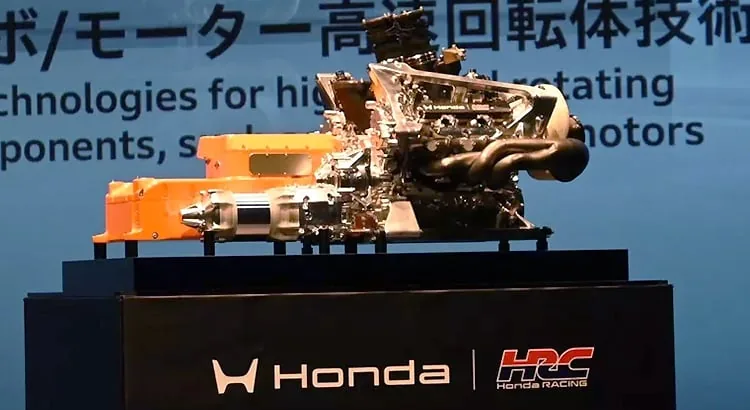
The difficulties encountered by Honda during winter testing may not be limited to the battery: Adrian Newey has suggested that the main deficit could actually come from the internal combustion engine.
Read more Pierre Gasly surprised to see top teams still dominating despite 2026 rules
During pre-season testing, Honda identified a major problem affecting its battery system. This is reportedly linked to strong vibrations transmitted to the element on which the assembly (in orange above) is mounted.
These vibrations are said to cause particularly violent shaking of the battery pack, to the point of damaging the system.
However, the exact cause of the phenomenon has not yet been identified by Honda, meaning the manufacturer is unable to eliminate these vibrations for the moment. On the other hand, it seems to have found a way to slightly improve the battery’s protection to limit the damage.
Honda remains discreet about its performance deficit
The Japanese manufacturer has refused to comment on the potential performance deficit of its engine. Honda explains that as its winter testing program was heavily disrupted, the engine mounted in the original AMR26 was never run at its maximum speed.
Under these conditions, the team claims it does not have a precise estimate of its actual performance level.
However, Honda must have an initial idea. And while discussions have mainly focused on the battery problem — along with the idea that the MGU-K may have been running at reduced power during testing — legendary engineer Adrian Newey has suggested that the main limitation could come from the internal combustion engine.
The V6 could remain the determining factor
This analysis aligns with certain statements made before the season by Honda officials. They had explained that it was difficult for them to reproduce the performance achieved with the V6 under the previous regulations, due to the very different operation required by the new generation of engines.
The implication was clear: Honda believed that the internal combustion engine could remain the main differentiating factor, despite the increase in MGU-K power, which is now close to 50 % of the total power unit output.
Newey’s comments point in this direction:
“One of the problems with these regulations is that the more you lack power from the internal combustion engine, the more you have to compensate by using electrical energy to fill that gap. This means that by the time you really want to use that electrical energy on the straights, your battery is already empty.”
“So it becomes a kind of self-sustaining downward spiral. The fairly simple calculation of the impact of internal combustion engine power on lap time is compounded by the effects of the lack of electrical energy.”
Confidence shown in Honda’s ability to react
Such a remark hardly seems insignificant. Adrian Newey is rarely inclined to mention this type of scenario without reason, which could suggest that Honda is indeed suffering from a power deficit in its internal combustion engine.
The British engineer, however, was keen to emphasize his confidence in the Japanese manufacturer’s ability to progress quickly.
“There is no point in speculating now, as it will be more or less revealed on track this weekend. They have proven themselves in the past and we have total confidence in them.”
Read more Lewis Hamilton mentions a «massively different» change at Ferrari