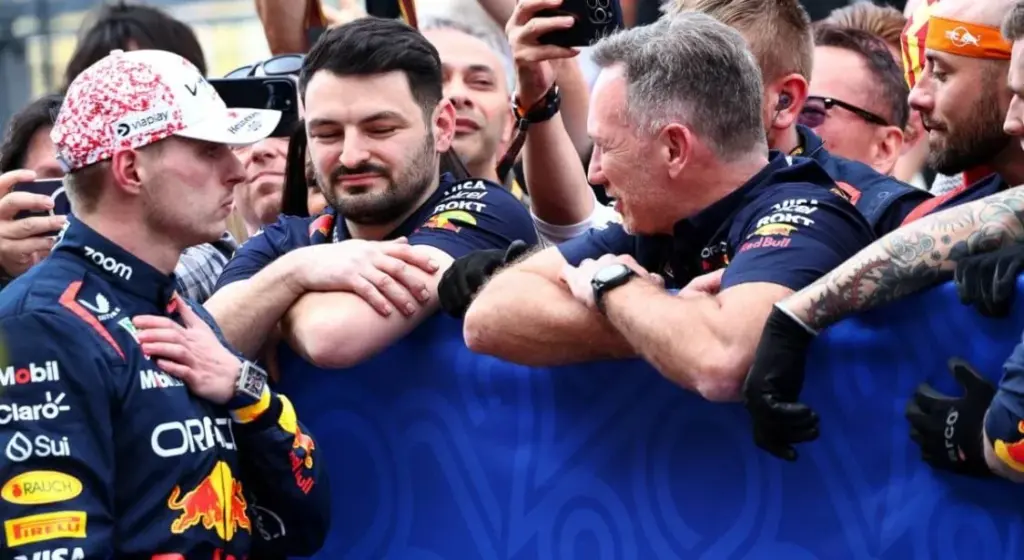
Max Verstappen’s move to Red Bull in 2016 surprised the entire paddock. Helmut Marko now reveals that Christian Horner himself was not in favor of this decision, which was considered too risky.
Read more Max Verstappen narrowly misses out on pole at the 24 Hours of Nürburgring
In 2016, Red Bull surprised everyone by deciding to promote Max Verstappen after only four Grand Prix races that season with Toro Rosso. At just 18 years old, the Dutchman replaced Daniil Kvyat alongside Daniel Ricciardo, while the Russian driver was demoted to the sister team.
This decision was made in a very tense context after the Russian Grand Prix. Kvyat had made two major mistakes on the first lap by hitting Sebastian Vettel twice. For Helmut Marko, it became clear that something had mentally broken down with the Russian driver.
“Kvyat had already experienced difficulties before, but in 2016 he was no longer the same driver,” Marko explained in an interview with De Telegraaf. From the winter tests, he was constantly complaining about the brakes. We understood that we had to act quickly.”
Although Carlos Sainz was also among the potential candidates for promotion, Red Bull ultimately chose Verstappen without hesitation.
Christian Horner did not want to promote Verstappen so quickly
In hindsight, this choice now appears as one of the greatest strokes of genius in recent Formula 1 history. Yet, internally, not everyone was convinced by this rapid promotion.
Helmut Marko revealed that Christian Horner was opposed to the idea of launching Verstappen into the deep end so early in his career.
“Christian Horner did not agree with this promotion after only four races in 2016,” the Austrian confided. Many people also felt that Max was far too young and that this choice was dangerous.”
Read more Sergio Pérez is having fun fighting with the Aston Martins at the back of the pack
At the time, Verstappen had only one full season of F1 experience behind him. His boldness, aggressiveness, and very offensive style already sparked a lot of debate in the paddock.
Carlos Sainz, also a member of the Red Bull program, took this decision particularly hard. According to Marko, the Spaniard was very disappointed not to have been chosen.
Verstappen immediately silenced the critics
While some feared that this promotion came too early, Verstappen responded in the most spectacular way possible in his first appearance under the Red Bull colors.
At the 2016 Spanish Grand Prix, held in Barcelona, the young Dutch driver won the race after the collision between the Mercedes of Lewis Hamilton and Nico Rosberg. He thus became the youngest winner in F1 history.
This immediate victory fully validated the bet taken by Helmut Marko and Red Bull. Verstappen then established himself as the natural leader of the team before winning four consecutive world titles.
In hindsight, Christian Horner’s hesitations seem almost anecdotal. But they mainly show how much the decision to promote Verstappen so early represented a huge risk for Red Bull.
Ten years later, this choice probably remains one of the major turning points in the Dutchman’s career… and in modern Formula 1 history.
Read more Rob Smedley questions Ferrari’s disappointment in Miami: beware of the negative spiral